

The 2026 Competitive Marketing Summit, held at The ART Hotel in Denver, Colorado on March 17-18, brought together competitive intelligence leaders, product marketers, and corporate strategists for two days of hands-on learning and connection. Featuring 13 sessions, 27 expert speakers and two keynote speakers, the conference centered on “The Art of Competitive Marketing,” exploring how organizations can blend strategy, creativity, and real-world insights to navigate an increasingly complex and fast-moving landscape. The event attracted a highly engaged group of practitioners, from CI specialists to go-to-market leaders, all focused on sharing proven approaches and elevating their competitive impact.
A consistent theme throughout the conference was:
While organizations have more access to data, tools, and AI than ever before, the real challenge lies in translating that intelligence into meaningful business impact.
AI continues to play a central role in shaping the competitive intelligence function, but its value is increasingly dependent on how well it is integrated with human expertise, contextual understanding, and organizational alignment.
Across the conference, discussions consistently pointed to a shift from intelligence generation to intelligence activation, with organizations focusing on how to operationalize insights across marketing, sales, and product teams.
Key Themes from the Conference
AI is Scaling Intelligence, But Not Replacing Human Judgement
AI was a central topic, but the tone has shifted from hype to realism. We heard consistently across the conference that AI is most effective when used to augment, not replace, human intelligence, particularly in areas requiring strategic judgement and contextual understanding.
Across sessions, there was broad agreement on where AI is delivering value:
- Data collection
- Pattern recognition
- Content generation
However, AI has limitations. For example, Klue’s presentation on building a trusted competitive data layer highlighted key limitations:
- AI outputs are often generic
- Context is frequently missing
- Speed is prioritized over accuracy and relevance
- Limited ability to interpret meaning or drive action
As they put it: AI has made competitive answers faster, but not necessarily better.
The Takeaway: AI is a powerful accelerator for competitive intelligence, but not a substitute for it, the real advantage comes from combining AI-driven speed with human judgment, context, and strategic interpretation.
The Volume of Intelligence is Increasing, But Signal Extraction is the Challenge
It was the consensus that the issue is no longer access to data, but the ability to extract meaningful insight from it by structuring, filtering, and interpreting it effectively.
For example, Zaven Gabriel’s session demonstrated a structured AI workflow for:
- Converting large volumes of unstructured content (e.g., video transcripts)
- Into actionable competitive insights such as pricing signals, ROI weaknesses, and objection handling
Similarly, the Red Hat session emphasized the importance of:
- Asking targeted, specific competitive questions
- Leveraging primary research (interviews, surveys) to get direct answers
- Focusing on persona-driven insights rather than broad market analysis
The Takeaway: The challenge is no longer gathering intelligence, it’s cutting through the noise to extract clear, actionable insights that directly inform decisions.
Differentiation is Becoming Increasingly Difficult
Another clear theme: everything is starting to sound the same. In Alan Berkson’s session on corporate narratives, he argued “while products can be copied, narratives cannot.”
With AI lowering the barrier to content and messaging creation, differentiation is becoming harder, not easier. As a result:
- Messaging is converging across competitors
- Feature-based differentiation is becoming less effective
- Buyers are experiencing increased noise and reduced clarity
In this environment buyers are overwhelmed and organizations that fail to clearly articulate their value risk competing primarily on price.
The Takeaway: As AI drives messaging convergence, clear, differentiated narratives, not features, are becoming the key to standing out and avoiding price-based competition.
Pricing Pressure Reflects Underlying Value Gaps
One important insight discussed at the summit was the relationship between pricing pressure and value communication.
As presented in Sedulo Group’s session:
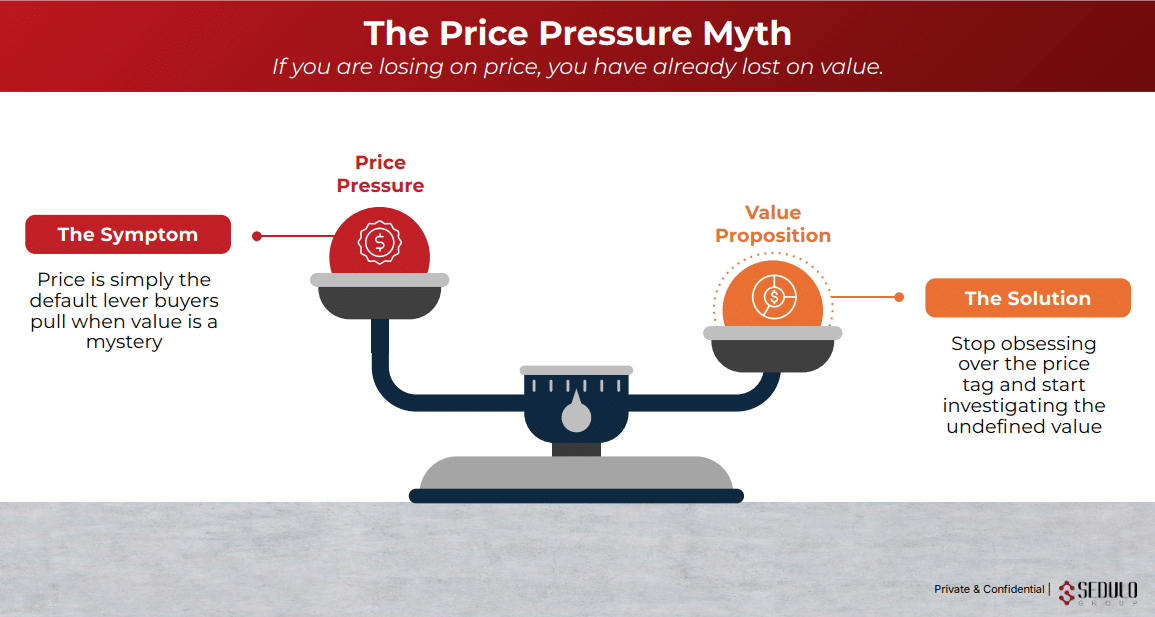
If you are losing on price, you have already lost on value.
Too often, pricing is treated as a negotiation issue. But the reality is that price pressure is usually a symptom of something deeper: unclear, unproven, or misaligned value.
The “Price Pressure Myth” presented by Sedulo Group and Corrigo, illustrates this clearly: buyers default to price when value is a mystery.
Three primary gaps were identified:
- Benchmarking Gap – Limited understanding of how value compares to competitors
- Delivery Gap – Misalignment between value proposition and buyer priorities
- Confidence Gap – Inability to support value claims with credible evidence
The Takeaway: Most organizations don’t have a pricing problem; they have a value communication problem.
Shifting From Features to Value Drivers
Another consistent theme was the need to transition from feature-centric messaging to value-driven positioning.
Many organizations continue to focus on what their product does, rather than why it matters to the buyer.
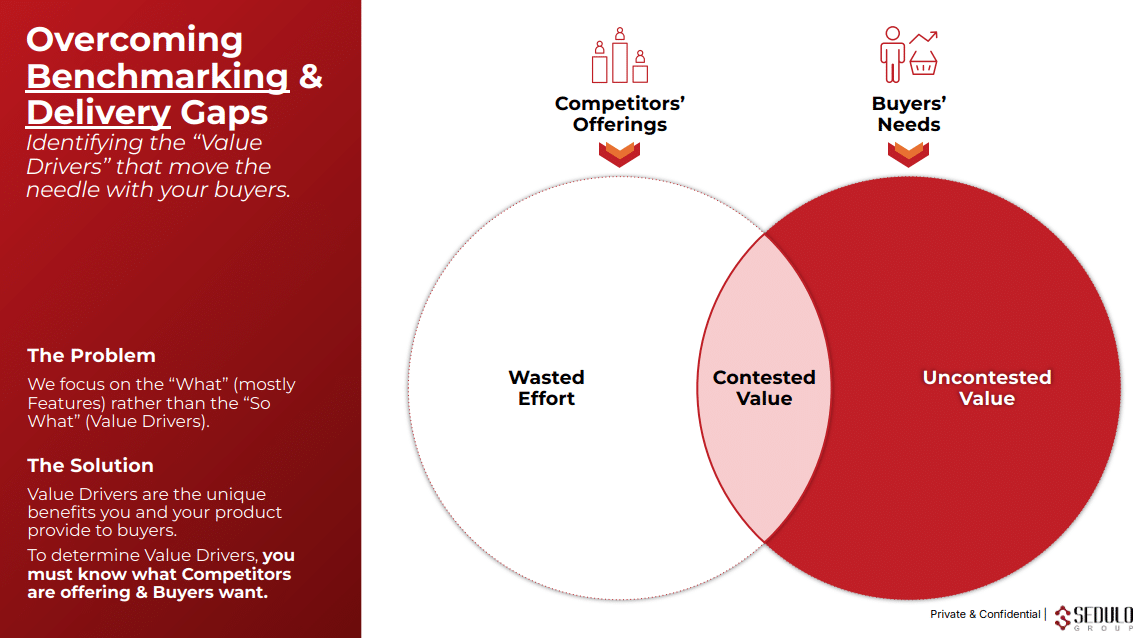
True differentiation comes from identifying:
- What buyers actually care about
- Where competitors are over-indexing
- Where uncontested value exists
Most effort is wasted competing on the same things. The real opportunity lies in uncontested value.
This is where competitive intelligence becomes strategic, not descriptive. It’s about finding where you can win, not just where you compete.
The Takeaway: Competitive advantage comes from shifting focus from features to the value that matters most to buyers, and identifying where you can win, not just where you compete.
The Role of Competitive Intelligence is Expanding
The conference also highlighted the evolving role of competitive intelligence within organizations.
CI is no longer limited to:
- Tracking competitors
- Producing reports and battlecards
Instead, it is increasingly expected to:
- Inform strategic decision-making
- Align cross-functional teams
- Drive consistency in messaging and positioning
As organizations become more complex, the ability of CI to connect insights across functions is becoming a key driver of its impact.
The Takeaway: Competitive intelligence is evolving from a reporting function into a strategic driver that connects insights across the business to influence decisions, alignment, and outcomes.
External Perspectives (Analysts, Sustainability, Market Signals) Are Underutilized
Several speakers emphasized the importance of looking beyond internal data.
In Renee Murphy’s session, Inside the Analyst’s Mind, she highlighted that:
- Analyst reports (e.g., Forrester Wave) shape buyer decisions
- Evaluation frameworks provide structured insight into competitive positioning
- Understanding analyst methodologies can be a strategic advantage
Additionally, in the Beyond Greenwashing session, the speakers reinforced that:
- Emerging areas such as sustainability are becoming sources of competitive differentiation
- Strategy is increasingly tied to long-term competitive advantage
The takeaway: Competitive intelligence must extend beyond internal data to include external signals and market-shaping forces.
Competitive Intelligence Must Translate Into Actionable Narratives
Another consistent theme was the need to move beyond insight generation toward insight translation.
The “translation challenge” presented in multiple sessions highlighted that the same intelligence must be communicated differently to different audiences:
- Executives need strategic implications
- Sales needs positioning guidance
- Customer success needs retention strategies
Insight alone does not create value. Interpretation and communication do.
The Takeaway: Competitive intelligence only creates value when it is translated into clear, audience-specific narratives that drive action across the organization.
Final Thoughts
The 2026 Competitive Marketing Summit highlighted an important evolution in the role of competitive intelligence.
While organizations continue to invest in AI and data capabilities, the greatest opportunity lies in how effectively that intelligence is applied.
The organizations that will succeed are those that can:
- Combine AI with human expertise and context
- Translate insights into clear, differentiated value propositions
- Align teams around a shared understanding of value
- Execute consistently across marketing, sales, and product
As the competitive landscape continues to evolve, success will depend less on the volume of intelligence generated, and more on the organization’s ability to turn that intelligence into action.