

Most companies are surrounded by market signals, but many still struggle to turn them into direction. Market intelligence is what separates noise from movement, helping organizations maximize competitive advantage by identifying where demand is shifting, where competitors are gaining ground, and where the next commercial risk or opportunity is emerging.
To find out what 477,538 opinions of insights, strategy, or marketing leaders in the US were about market intelligence, Sedulo partnered with Artios to utilize AI-driven audience profiling to synthesize insights from online discussions over 12 months, ending on June 29th, 2026, to a high statistical confidence level. Our findings show how they are approaching market intelligence today, where the function is creating value, and what still needs to improve as organizations try to make better use of market signals.
Index
- Data and methodology
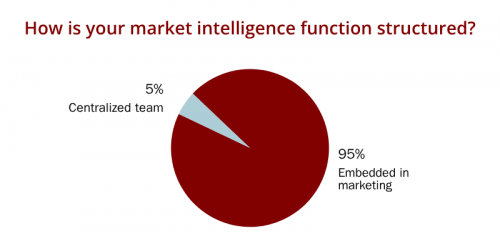
- 95% of insights, strategy, or marketing leaders’ market intelligence function is embedded in marketing, and the remaining 5% has a centralized team as their core structure
- 23% of insights, strategy, or marketing leaders rate their market intelligence maturity as advanced, a further 23% as leading, 25% as basic, and 3% as developing, yet 27% rate their maturity as nonexistent
- For 22% of insights, strategy, or marketing leaders, market intelligence informs key decisions, 18% occasionally reference it, and it drives most decisions for 1%; however, 37% rarely use market intelligence to shape their strategy, and 22% don’t use it at all
- 24% of insights, strategy, or marketing leaders’ buyer personas are data-driven and current, 24% are built but outdated, another 24% have buyer personas in development, 24% don’t have any, and 5% only have informal personas
- 50% of insights, strategy, or marketing leaders rarely update their buyer personas, and 11% agree that updates are not a major driver in business, 23% are driven to update them by sales feedback, and 13% by new research, while just 2% feel that market shifts are not a motivator for updates
- 58% of insights, strategy, or marketing leaders capture movie of customer insights using CRM data, 15% rely on interviews, 14% on surveys, and 1% on social listening, but 12% don’t formally capture VoC insights at all
- Market gap analysis is how 59% of insights, strategy, or marketing leaders identify white space opportunities; however, 41% of leaders don’t formally identify these opportunities
- 60% of insights, strategy, or marketing leaders somewhat understand emerging competitors, 37% understand them moderately well, and 1% very well, while 1% don’t understand them well, and another 1% don’t understand them at all
- 45% of insights, strategy, or marketing leaders only assess channel and partner performance when issues arise, and 55% never assess this performance
- Reports are used by 69% of insights, strategy, or marketing leaders to share market intelligence internally, 13% use dashboards, 3% use presentations, 2% share insights via newsletters, and 12% don’t share this information formally
- 63% of insights, strategy, or marketing leaders are not yet using AI in market intelligence, 23% are using it for report drafting, 10% for trend forecasting, 3% for data synthesis, and 1% use AI for competitive monitoring
- 26% of insights, strategy, or marketing leaders fully trust AI-generated market insights, 23% mostly trust them, and 23% have limited trust, while 22% don’t trust AI-generated insights at all, and 5% are neutral on the topic
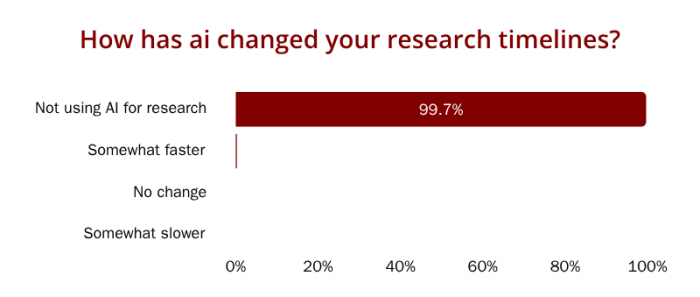
- 100% of insights, strategy, or marketing leaders are not yet using AI for research for it to have had any impact on their timelines
- For 37% of insights, strategy, or marketing leaders, leadership buy-in is a significant barrier to AI adoption, and a minor barrier for 55%, for 4% data quality is the main barrier, and for 2%, a lack of skills is a significant hurdle
- 78% of insights, strategy, or marketing leaders’ biggest market intelligence challenge is talent gaps, for 8% it’s budget, and the main challenge for 7% is data quality, but for 7%, speed of insight poses a minor challenge
- Better tools would make a huge difference for 73% of insights, strategy, or marketing leaders for improving market intelligence, it would help a lot for 11%, and might help 5% a bit, while faster turnaround would make a huge difference for 8%, and better stakeholder buy-in would not help 2%
- Turning market intelligence into business advantage
Data and methodology
Sourced using Artios from an independent sample of 477,538 opinions of insights, strategy, or marketing leaders in the USA across X, Quora, Reddit, Bluesky, TikTok, and Threads. Responses are collected within a 95% confidence interval and 5% margin of error. Results are derived from what people describe online, from opinions expressed, not actual questions answered by people in the sample.
How is the market intelligence function structured for insights, strategy, or marketing leaders?
95% of insights, strategy, or marketing leaders’ market intelligence function is embedded in marketing, and the remaining 5% has a centralized team as their core structure.
Insight works best close to action:
The way the market intelligence function is structured says a lot about where insight is expected to create value. For 95% of insights, strategy, or marketing leaders, market intelligence is embedded in marketing. This puts insight close to positioning, messaging, customer understanding, campaign planning, and go-to-market decisions.
A 2025 report on the state of competitive intelligence shows why that proximity is useful. 52% of competitive intelligence programs don’t have a sales executive sponsor, even though 85% are expected to support sales enablement. Intelligence work can lose impact when it sits too far from the teams who are expected to use it.
Conversely, a centralized team is used by 5% of our audience. This structure can help when a company needs a single source of truth, shared standards, or more independent analysis across departments. Its low share shows that, for most leaders here, closeness to marketing execution is more valuable than separating intelligence into its own function.
How do insights, strategy, or marketing leaders rate their market intelligence maturity?
23% of insights, strategy, or marketing leaders rate their market intelligence maturity as advanced, a further 23% as leading, 25% as basic, and 3% as developing, yet 27% rate their maturity as nonexistent.
Capability is unevenly built:
Market intelligence maturity depends on whether leaders can turn market signals into a repeatable capability, not just whether they can access information. Gartner’s 2025 marketing maturity research notes that CMOs are facing growing responsibilities and budget constraints, making it harder to allocate investment for marketing improvements. It also connects maturity advancement with stronger processes across brand measurement, customer analytics, and marketing operations.

This makes the split in market intelligence maturity easier to understand. Some teams may not have the budget, structure, or process depth to move beyond basic capability, while others have invested enough to make intelligence part of how marketing decisions are made.
27% of insights, strategy, or marketing leaders in our audience rate their market intelligence maturity as non-existent. These teams may still use market signals, but the process, ownership, or tools haven’t been formalized.
Another 25% rate their market intelligence maturity as basic. Some monitoring or reporting may exist, but it is likely still reactive rather than built into regular decision-making.
23% rate their maturity as advanced. These teams are more likely to have structured analysis, clearer workflows, and a stronger link between insight and action.
Maturity is rated as leading for another 23%. This points to market intelligence being embedded into planning, prioritization, and commercial decision-making.
Only 3% of insights, strategy, or marketing leaders rate their maturity as developing. These teams are likely in transition, with some market intelligence activity in place but not yet enough structure to guide decisions consistently.
How does market intelligence shape strategy for insights, strategy, or marketing leaders?
For 22% of insights, strategy, or marketing leaders, market intelligence informs key decisions, 18% occasionally reference it, and it drives most decisions for 1%; however, 37% rarely use market intelligence to shape their strategy, and 22% don’t use it at all.
Insight informs more than it decides:

How directly market intelligence shapes strategy depends on whether leaders trust it enough to change plans, not simply whether the information exists. 37% of insights, strategy, or marketing leaders rarely use market intelligence to guide strategy. Insight may arrive too late, feel disconnected from commercial priorities, or lack the authority to challenge existing plans.
Market intelligence informs key decisions for 22%. In these cases, intelligence is likely used to de-risk larger moves, test assumptions, and give leaders a stronger outside view before they commit. Another 22% don’t use market intelligence at all. Strategy may be driven mainly by internal performance, leadership instinct, customer feedback, or campaign data instead of structured market signals.
18% occasionally reference market intelligence. This is episodic use, likely around planning cycles, competitor moves, or major presentations, rather than steady strategic planning.
Only 1% feel market intelligence drives most decisions. Full intelligence-led strategy remains rare because it requires consistent trust, clear ownership, and the authority to influence direction.
How mature are buyer personas for insights, strategy, or marketing leaders?
24% of insights, strategy, or marketing leaders’ buyer personas are data-driven and current, 24% are built but outdated, another 24% have buyer personas in development, 24% don’t have any, and 5% only have informal personas.
The buyer view is still unsettled:
Buyer persona maturity depends on whether buyer understanding is documented, current, and strong enough to guide decisions. The commercial link is clear. 71% of companies that exceed revenue goals have documented buyer personas. Against that backdrop, the split across insights, strategy, or marketing leaders shows very different levels of readiness to turn buyer understanding into action.

24% of our audience have data-driven and current buyer personas. This is the strongest position because leaders can connect messaging, segmentation, content, sales support, and campaign choices to a live view of the buyer.
Another 24% have personas that are built but outdated. These teams have done the work once, but stale personas can keep marketing tied to assumptions that no longer match buyer needs, budgets, or decision processes.
24% have buyer personas in development. This is an active build phase, where leaders may be gathering evidence, aligning teams, or replacing informal views with something more usable.
Yet, the same number (24%) don’t have any buyer personas. These teams may rely on campaign performance, sales feedback, or broad market knowledge instead of a structured buyer view.
The remaining 5% rely on informal personas only. These personas may help internal conversations, but without documentation and evidence, they are harder to apply consistently.
What drives most buyer persona updates for insights, strategy, or marketing leaders?
50% of insights, strategy, or marketing leaders rarely update their buyer personas, and 11% agree that updates are not a major driver in business, 23% are driven to update them by sales feedback, and 13% by new research, while just 2% feel that market shifts are not a motivator for updates.
Updates are not given priority:
While reports show that 94% of marketers find that offering a personalized customer experience boosts their company’s sales, our audience is not prioritizing updating their buyer personas to ensure they appeal to their target audience.
50% of insights, strategy, or marketing leaders rarely update their buyer personas,, while 11% agree that there is no major driver to do so. This could lead to stagnation, but it’s clearly not recognized as yet. On the plus side, 23% are likely driven to update their buyer personas based on sales feedback, indicating that data and insights play a crucial role in shaping these personas.

A further 13% are also influenced by data, and cite new research as their likely driver behind updates. Only 2% reference market updates as influencing their updates, and it isn’t considered a major driver overall.
How do insights, strategy, or marketing leaders capture voice of customer insights?
58% of insights, strategy, or marketing leaders capture movie of customer insights using CRM data, 15% rely on interviews, 14% on surveys, and 1% on social listening, but 12% don’t formally capture VoC insights at all.
The loudest voice is already recorded:

Voice of customer (VoC) capture is becoming a bigger analytics priority, with the global voice of customer analytics market valued at $1.696 billion in 2024 and projected to reach $4.68 billion by 2030 at a CAGR of 18.9%. The way insights and marketing leaders capture VoC shows that much of this work still starts with customer data already held inside the business.
58% of insights, strategy, or marketing leaders capture VoC insights through CRM data. This gives leaders access to customer behavior, sales activity, account history, objections, and relationship signals already connected to commercial outcomes.
On the lower side, 15% use interviews. This method gives more depth because customers can explain needs, frustrations, buying logic, and language in their own words. 14% use surveys. Surveys can scale customer feedback, but they depend on strong questions and enough participation to reveal clear patterns.
Conversely, 12% don’t formally capture voice of customer insights. These teams may still hear customer feedback, but it is more likely to stay scattered across conversations, sales notes, or campaign results.
Lastly, reviews and social listening account for 1%. Public customer commentary is not being treated as a core VoC source, likely because it can be noisy, harder to segment, and less directly tied to customer records.
How do insights, strategy, or marketing leaders identify white space opportunities?
Market gap analysis is how 59% of insights, strategy, or marketing leaders identify white space opportunities; however, 41% of leaders don’t formally identify these opportunities.
Openings are mapped, not overheard:
White space identification is being treated more as a market structure exercise than a customer listening exercise. 59% of insights, strategy, or marketing leaders use market gap analysis to identify white space opportunities. Leaders are looking for openings through category movement, competitor coverage, unmet needs, underserved segments, or gaps between demand and current solutions.
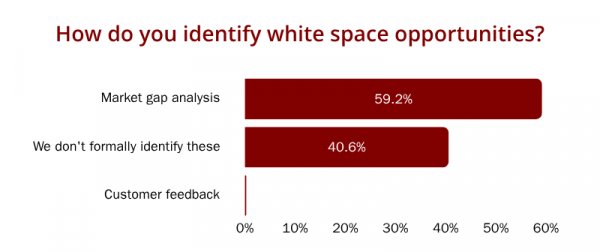
However, a whopping 41% don’t formally identify white space opportunities. This is a major process gap because potential growth areas may still be noticed, but not captured through a repeatable method. Without a formal approach, opportunity discovery can depend too heavily on instinct, one-off observations, or timing.
Customer feedback received no opinions, but this doesn’t mean customer feedback is unimportant. It means the topic wasn’t visible in online conversations as the formal route for identifying new market opportunities. Leaders may be using customers to validate ideas, but not to define white space.
How well do insights, strategy, or marketing leaders understand emerging competitors?
60% of insights, strategy, or marketing leaders somewhat understand emerging competitors, 37% understand them moderately well, and 1% very well, while 1% don’t understand them well, and another 1% don’t understand them at all.
Visibility stops short of confidence:
How well insights, strategy, or marketing leaders understand emerging competitors is becoming more important as competitive pressure rises. Increasing competition ranked as the fifth biggest global risk in 2025 and is projected to climb to third by 2028. As that pressure grows, the issue is not whether emerging competitors are visible. It is whether leaders understand them deeply enough to act early.

60% of our audience understands emerging competitors somewhat. These leaders likely have a working view of new rivals, but not enough depth to fully read their positioning, momentum, customer appeal, or threat level.
Just over half of that (37%) understand emerging competitors moderately well. This points to more active tracking, where leaders may know who is gaining attention, what they offer, and how they are positioned. The gap is likely in predictive depth.
Only 1% understand emerging competitors very well. Deep confidence is rare because it requires more than competitor awareness. Leaders need regular monitoring, buyer intelligence, win-loss signals, and a clear read on how new rivals could change the market.
Another 1% don’t understand them well, and 1% don’t understand them at all. These low figures show that outright blind spots are uncommon, but the risk remains. Emerging competitors can stay small or hard to read until they begin attracting attention, customers, or category influence.
How often do insights, strategy, or marketing leaders assess channel and partner performance?
45% of insights, strategy, or marketing leaders only assess channel and partner performance when issues arise, and 55% never assess this performance.
The check is reactive, if at all:

How often channel and partner performance is assessed shows this being handled reactively rather than treated as a regular intelligence input. 55% of insights, strategy, or marketing leaders never assess channel and partner performance. This creates a major blind spot because partners and channels can reveal changes in demand, buyer behavior, regional strength, sales friction, and competitive pressure.
The remaining 45% assess channel and partner performance only when issues arise. This means the review comes after a problem has already become visible, such as weak sales, partner conflict, declining conversion, or missed targets.
The pattern shows that channel and partner intelligence is not being used early enough to spot risk, improve performance, or identify stronger routes to market.
How do insights, strategy, or marketing leaders share market intelligence internally?
Reports are used by 69% of insights, strategy, or marketing leaders to share market intelligence internally, 13% use dashboards, 3% use presentations, 2% share insights via newsletters, and 12% don’t share this information formally.
Insight travels as a finished product:
Market intelligence is being shared mainly as packaged outputs, not as a live or highly interactive flow of insights. Reports dominate at 69%, creating a formal, document-led model where findings are organized for review and distribution. This gives teams a clear record of intelligence, but it can make insight feel periodic rather than immediately usable when market signals change.

Dashboards account for 13%. These teams are closer to a live intelligence model, but dashboards require more discipline than reports. They need refreshed inputs, shared definitions, ownership, and users who know what decision the dashboard is meant to support.
Another 12% of insights, strategy, or marketing leaders don’t share market intelligence formally. Useful findings may stay with the person or team that discovered them, which limits visibility and weakens the link between insight and action.
Presentations make up 3%. This low share implies market intelligence is rarely being used as an agenda-setting moment where leaders debate implications, pressure-test assumptions, or align around a decision.
Newsletters sit at 2%, showing that leaders aren’t relying on short, regular updates to keep market movement visible between larger reporting cycles. Intelligence is more likely to arrive in bigger packages.
How do insights, strategy, or marketing leaders currently use AI in market intelligence?
63% of insights, strategy, or marketing leaders are not yet using AI in market intelligence, 23% are using it for report drafting, 10% for trend forecasting, 3% for data synthesis, and 1% use AI for competitive monitoring.
The promise is ahead of practice:
AI use in market intelligence is still far behind the scale of change predicted for the wider market research industry. Harvard Business Review notes that gen AI is changing how consumer and market insights are collected, created, and analyzed, and cites two investment theses predicting that gen AI will dramatically transform the $140 billion global market research industry.
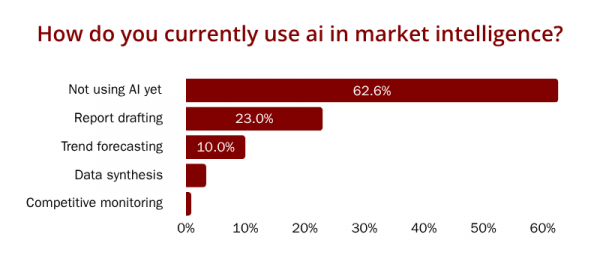
63% of insights, strategy, or marketing leaders in our audience are not using AI in market intelligence yet. Adoption is likely held back by trust, data quality, governance, or uncertainty about where AI fits into the intelligence workflow.
Report drafting is the leading active use case at 23%. This makes sense as an entry point because it improves speed at the output stage without asking teams to fully change how intelligence is gathered or judged.
10% use AI for trend forecasting. This is a more strategic application, but the lower share shows that predictive work still requires a level of confidence many teams have not built yet.
At just 3%, a surprisingly small share uses AI for data synthesis. This is one of the areas where AI could reduce manual analysis and connect scattered signals faster.
Competitive monitoring sits at 1%. This is one of the harder use cases because it asks AI to separate real competitive movement from noise, weak signals, and routine market activity. Its low share shows that teams are not yet ready to trust AI at the front end of intelligence.
How much do insights, strategy, or marketing leaders trust AI-generated market insights?
26% of insights, strategy, or marketing leaders fully trust AI-generated market insights, 23% mostly trust them, and 23% have limited trust, while 22% don’t trust AI-generated insights at all, and 5% are neutral on the topic.
Only a few are sitting on the fence:

Trust in AI-generated market insights depends on whether leaders believe the output is grounded in real human and market behavior. Recent industry commentary argues that AI systems need trusted human data to stay connected to reality, and that poor-quality human inputs can lead to unreliable outputs. As organizations use AI to support decisions and predictions, the quality of the data behind those systems becomes central to whether leaders trust what AI produces.
Amongst our audience of insights, strategy, or marketing leaders, 26% fully trust AI-generated market insights, likely with enough control over source quality, prompts, review standards, and use cases to treat AI output as decision-ready.
A further 23% mostly trust them. AI is credible enough to use, but the findings still need human judgment before they influence decisions.
Limited trust sits at 23%. Leaders in this group are likely using AI for speed, pattern spotting, or early analysis, while keeping final interpretation outside the model.
22% don’t trust AI-generated market insights at all. The barrier may be whether the output is properly grounded, with concern that AI can produce confident findings from weak sources, incomplete context, or poor-quality inputs.
Just 5% are neutral. The small middle ground shows that AI-generated market insights are already forcing a judgment. Leaders either see enough control to trust the output, or enough risk to question it.
How has AI changed research timelines for insights, strategy, or marketing leaders?
100% of insights, strategy, or marketing leaders are not yet using AI for research for it to have had any impact on their timelines.
The acceleration hasn’t begun:
How AI has changed research timelines for insights, strategy, or marketing leaders depends first on whether AI is part of the research process at all. In our audience, 100% of insights and marketing leaders aren’t using AI for research.
A 2026 AI-powered market intelligence brief shows the potential upside when it is. The brief describes a generative AI-enabled market intelligence scan that identified and analyzed more than 250 initiatives across six states in under five weeks, cutting the typical scan timeline by an estimated 70%. It also reduced manual synthesis time, expanded visibility, introduced structured tagging, and complemented rather than replaced human judgment.
There were no opinions expressed around somewhat faster, unchanged, or somewhat slower research timelines. This doesn’t indicate that those outcomes are impossible, or that no teams in the wider market are seeing faster or slower research cycles. It means that those experiences were simply not part of the online conversations analyzed. Before AI can affect research timelines, it first has to become part of the research process.
What is the biggest AI adoption barrier for insights, strategy, or marketing leaders?
For 37% of insights, strategy, or marketing leaders, leadership buy-in is a significant barrier to AI adoption, and a minor barrier for 55%, for 4% data quality is the main barrier, and for 2%, a lack of skills is a significant hurdle.
The blocker sits at the top:
The biggest barrier to AI adoption for insights, strategy, or marketing leaders is organizational approval, not technical readiness. Leadership buy-in is the clearest barrier, with 37% of our audience rating it as significant and 55% rating it as minor. This means the issue is widespread, but not always a hard stop. Many teams may have enough interest to explore AI, but still need clearer sponsorship, budget, governance, or proof of value before adoption becomes routine.

Data quality is much less visible, with 4% naming it as the main barrier and less than 1% rating it as significant. This stands out because IBM has identified data quality and readiness as one of the largest barriers to enterprise AI adoption. Data quality becomes harder to ignore once AI is being implemented, tested, and scaled.
Lack of skills is also low, with 2% of our audience rating it as significant. Skills may still need development, but the bigger issue is getting the organization comfortable enough to move from interest to use.
What is the biggest market intelligence challenge for insights, strategy, or marketing leaders?
78% of insights, strategy, or marketing leaders’ biggest market intelligence challenge is talent gaps, for 8% it’s budget, and the main challenge for 7% is data quality, but for 7%, speed of insight poses a minor challenge.
The bottleneck is expertise:

Talent gaps dominate as the biggest market intelligence challenge, with 78% of our audience rating them as a significant challenge. This fits the wider marketing skills picture. The American Marketing Association’s 2025 Marketing Skills Report identifies data and analytics and proving ROI among the largest current competency gaps for marketers. Those gaps are directly relevant to market intelligence because teams need analytical judgment to interpret market signals and commercial discipline to show how intelligence improves decisions.
Budget is a significant challenge for 8% of insights, strategy, or marketing leaders. Funding can limit tools, research access, vendors, or headcount, but leaders are not treating spending as the main gap. The pressure is likely selective, limiting coverage depth or specialist support rather than stopping the work.
Data quality is the main challenge for 7%. Poor inputs still weaken intelligence when sources are stale, inconsistent, narrow, or hard to compare. The low share indicates the main strain is not collecting usable signals, but turning those signals into a clear market read.
Speed of insight is a minor challenge for 7%. Markets move quickly, but faster output is not being treated as the core weakness. Leaders may want quicker reads, but not if speed weakens judgment, relevance, or confidence.
What would most improve market intelligence for insights, strategy, or marketing leaders?
Better tools would make a huge difference for 73% of insights, strategy, or marketing leaders for improving market intelligence, it would help a lot for 11%, and might help 5% a bit, while faster turnaround would make a huge difference for 8%, and better stakeholder buy-in would not help 2%.
Usability is the upgrade:
Closing the gap between information and decisions would most improve market intelligence for insights, strategy, or marketing leaders. Better tools would make a huge difference for 73%, help a lot for 11%, and might help a bit for 5%. Market intelligence depends on pulling together scattered inputs from competitors, customers, channels, categories, and internal teams. Better tools can make those inputs easier to find, compare, update, and turn into a shared view of what is changing.

Faster turnaround sits much lower. It would make a huge difference for 8% and help a lot for less than 1%. This points to a smaller group facing time-sensitive intelligence needs, where slower research can affect campaign timing, competitive response, or market entry decisions.
Better stakeholder buy-in wouldn’t help 2%. This likely means buy-in is seen as a result of stronger intelligence, not a fix on its own. If market intelligence is relevant, timely, and easy to use, stakeholders have a reason to engage. Asking for more buy-in without improving the intelligence itself may not change how decisions are made.
Turning market intelligence into business advantage
The overall picture is clear. Market intelligence is becoming more important to how organizations understand customers, competitors, and commercial opportunities, but many teams are still building the structure, trust, and tools to use it consistently.
Leaders aren’t short of signals. The real opportunity is to turn those signals into a sharper commercial view, stronger internal alignment, and better decisions about where the market is moving next.