

What 66% of CI Leaders Say About AI’s Measurable Impact, and Why Only 6% Have Fully Applied It
Artificial intelligence has quickly moved from a theoretical concept to an active priority for competitive intelligence teams across the life sciences industry. Leadership expectations are rising, experimentation is widespread, and nearly every CI function is now under pressure to demonstrate how AI can improve speed, scale, or insight generation.
Yet despite this momentum, the reality of AI adoption in competitive intelligence is more nuanced than headlines suggest. Insights from the 2025 Annual Life Sciences Competitive Intelligence Survey, based on responses from 109 CI leaders across pharma, biotech, and medical device organizations, reveal a clear disconnect between perceived impact and true operational maturity.
While 66% of respondents report some measurable positive impact from AI, only 6% have embedded AI consistently into defined CI workflows. Understanding where AI is genuinely delivering value, and where it remains aspirational, is essential for life sciences leaders making investment and operating decisions today.
AI Is a Strategic Priority for CI – but Most Teams Are Still Exploring
55% of CI leaders report feeling moderate to significant pressure from leadership to adopt or explore AI, making it one of the most prominent forces shaping CI roadmaps today. This pressure reflects broader organizational expectations around efficiency, scalability, and faster access to insight.
At the same time, survey data shows that adoption maturity remains limited:
- 57% of organizations are actively exploring AI use cases in CI
- 23% are developing or scaling AI across select CI activities
- Just 6% have applied AI consistently within defined CI workflows
These numbers indicate that while AI is firmly on the agenda, most CI teams are still navigating early-stage experimentation. For many organizations, the challenge is no longer deciding whether to use AI, but determining how to move from pilots to repeatable, trusted processes.

Where AI Is Delivering Real, Measurable Impact Today
The clearest signal from the survey is that AI’s strongest impact to date has been operational rather than strategic.
Among respondents, 52% report actively using AI for document summarization, making it the most widely adopted AI application in CI. Transcript summarization, language translation, and basic automation of CI alerts also rank among the most commonly applied use cases.
These applications align closely with where 66% of respondents report moderate or high positive measurable impact. AI is helping CI teams:
- Process large volumes of information more quickly
- Reduce manual effort spent on summarization and synthesis
- Improve turnaround time for internal stakeholders
Importantly, these gains enhance efficiency and responsiveness, but they do not replace the need for interpretation, judgment, or strategic framing. AI is accelerating CI workflows, not redefining strategic intelligence itself.
Where AI Is Being Explored, but Has Not Yet Delivered Consistent Value
While some AI applications are already delivering clear benefits, others remain largely exploratory.
The survey shows particularly high interest in more advanced use cases:
- 54% of organizations are exploring automated CI alerts
- Many are testing cross-document deep research and synthesis
- Others are experimenting with competitive landscape mapping and catalyst prediction
Despite this interest, these use cases have yet to demonstrate consistent, scalable impact. Many CI leaders report that AI-generated outputs in these areas lack sufficient context, reliability, or integration into decision-making workflows to be truly actionable.
As a result, these applications remain promising but immature, reinforcing the need for realistic expectations around near-term AI capabilities.
Why AI Has Not Yet Transformed Strategic Competitive Intelligence
Respondents identified several recurring challenges:
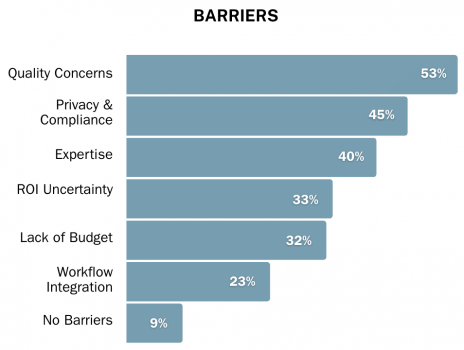
- 53% cite concerns about quality and hallucinations
- 45% point to privacy and compliance risks
- 40% report a lack of internal expertise
- Many also struggle with workflow integration and unclear ROI
These concerns help explain why AI has not yet transformed strategic CI. Without trust in output accuracy, clear governance frameworks, and well-defined roles for AI within CI processes, organizations struggle to move beyond experimentation.
In practice, AI adoption is constrained less by what tools can do and more by whether organizations are prepared to operationalize them responsibly.
How More Mature CI Functions Are Approaching AI
Differences in AI maturity are especially pronounced by company size and CI sophistication.
Among large life sciences organizations:
- 35% are beginning to scale AI across select CI workflows
- 73% report a moderate positive impact from AI, significantly higher than smaller organizations
Crucially, these more mature CI functions are not using AI to replace core intelligence activities. Instead, they are deploying AI selectively to support existing strengths, particularly primary intelligence, strategic analysis, and stakeholder engagement.
This approach reflects a broader pattern observed in the survey: high-performing CI teams treat AI as an augmentation tool, not a substitute for human insight.
What This Means for Life Sciences CI Leaders
The data points to a clear conclusion. AI is already improving the efficiency of competitive intelligence, but it has not yet reshaped how strategic CI is conducted.
For CI leaders, several implications stand out:
- AI delivers the most immediate value in language-heavy, repetitive tasks
- Strategic insight, contextualization, and decision support remain human-led
- Overreliance on AI-generated outputs without interpretation risks diluting insight quality
- Trust, governance, and workflow integration are prerequisites for scaling AI
Organizations that approach AI pragmatically, focusing on augmentation rather than automation, are more likely to realize sustainable value.
What CI Leaders Want From AI Next
Looking ahead, survey respondents were clear about the AI capabilities they believe would be most valuable in the near future.
High-priority areas include:
- Generative AI built on vetted, internal CI repositories
- Faster research acceleration and synthesis across large data sets
- Portfolio comparisons and pipeline mapping
- Conference analytics, including abstracts and data releases
- Real-time monitoring and alerts that integrate strategic context
Notably, these desired capabilities emphasize contextualized insight rather than raw automation, reinforcing the central role of human judgment in competitive intelligence.
Engage With the Data or Start a Conversation
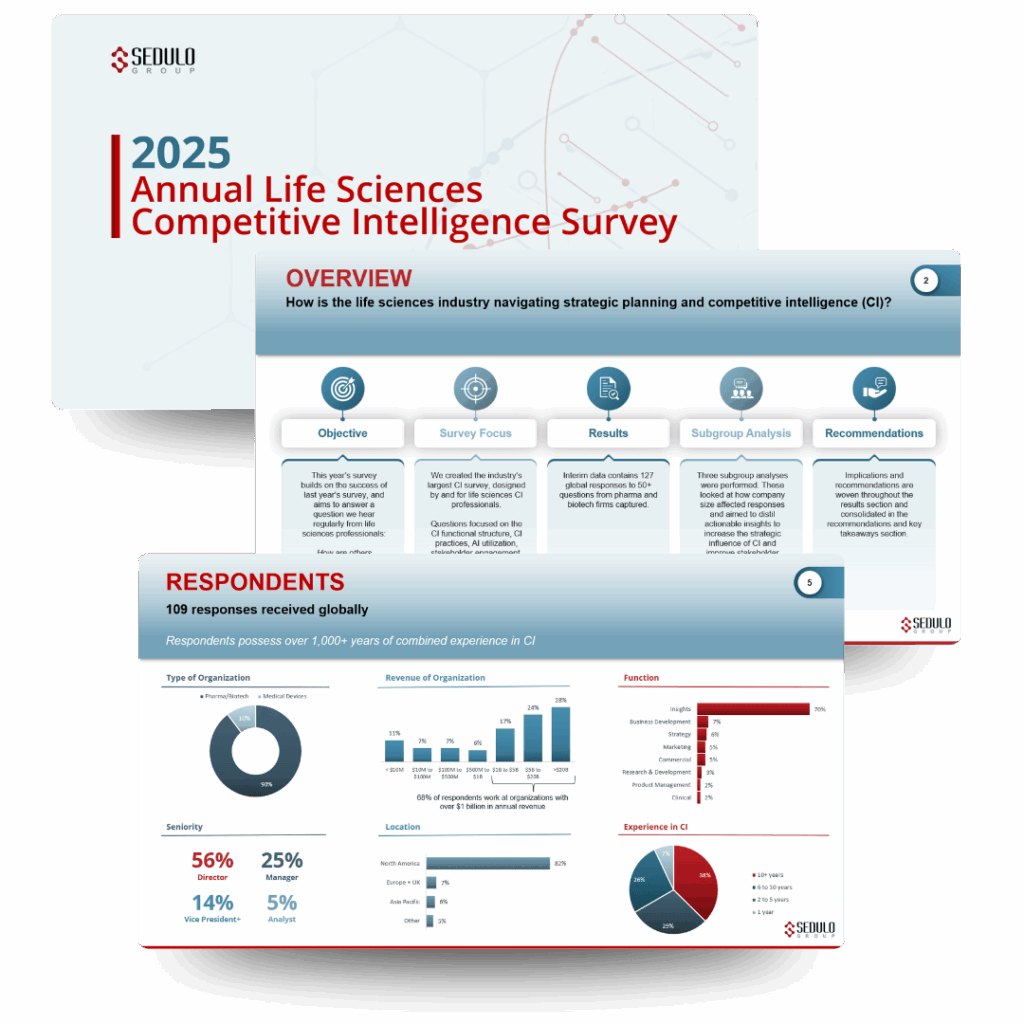
The insights summarized here represent only a portion of the findings from Sedulo’s 2025
Annual Life Sciences Competitive Intelligence Survey, which includes deeper analysis of AI adoption by company size, CI maturity, and strategic influence.
To benchmark your organization’s approach to AI and competitive intelligence:
- Download the full 2025 Life Sciences Competitive Intelligence Survey Report, including detailed charts and subgroup analyses.
For organizations evaluating where AI can realistically strengthen their CI workflows, Sedulo works with life sciences teams to design pragmatic, insight-led CI models that balance technology with human expertise.
To discuss how AI could support your competitive intelligence strategy:
- Contact Sedulo’s Life Sciences team to start a conversation.
Frequently Asked Questions (FAQs)
How is AI currently used in life sciences competitive intelligence?
AI is most commonly used for document and transcript summarization, language translation, and early-stage automation of CI alerts, primarily improving efficiency rather than replacing strategic analysis.
How much impact is AI actually having on CI teams?
66% of CI leaders report moderate or high positive impact, but this impact is concentrated in operational efficiency gains rather than strategic transformation.
Why have only a small number of teams fully applied AI?
Only 6% of teams report applied AI due to concerns around output quality, compliance, lack of expertise, and difficulty integrating AI into existing workflows.
Are large pharma companies further ahead with AI in CI?
Yes. Large organizations are significantly more likely to be scaling AI and to report measurable positive impact, reflecting stronger infrastructure and governance.
What AI capabilities do CI leaders want most in the future?
CI leaders prioritize AI that accelerates research, synthesizes vetted data, supports portfolio analysis, and delivers real-time insights with strategic context.