

“Benchmarking” might well be a four-lettered word in most corporations today.
Benchmarking shouldn’t just be comparing your numbers to an “industry” average (which you found through some off-the-shelf Gartner, IDC, or CB Insights report). Benchmarking should be about creating clarity and confidence in your next priority. Whether you’re evaluating pricing, performance, or customer experience, the right process can turn raw data into actionable benchmarks.
At Sedulo Group, we use an 8-step Benchmark Blueprint to help organizations measure what matters and make informed decisions on what to do about it. Here’s how you can apply it to anything!
The 8-Step Benchmark Blueprint
1) Define the Target
Clearly state what you want to benchmark and why it matters.
2) Identify Metrics
Select measurable indicators that reflect performance or value in the target area (i.e., if you are benchmarking customer service, choose metrics like average response time, first-contact resolution rate, and Net Promoter Score)
3) Map the Universe
Outline all relevant competitors, markets, or processes that shape the target benchmark landscape (i.e., If you’re benchmarking pricing, don’t just look at direct competitors, include adjacent players and even substitute products)
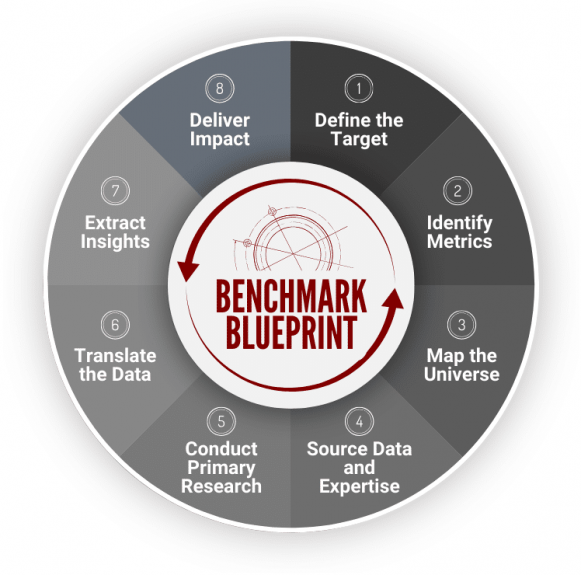
4) Source Data and Expertise
Gather credible data from trusted sources and validate it with expert input (always easier said than done).
5) Conduct Primary Research
Fill gaps with direct research such as interviews, surveys, or observational studies.
6) Translate the Data
Normalize and standardize the data so comparisons are fair and meaningful across contexts (i.e., If you’re comparing productivity across teams be sure to adjust for team size, skills, and working hours)
7) Extract Insights
Analyze patterns and outliers to uncover actionable conclusions.
8) Deliver Impact
Turn insights into clear recommendations.
The Core Effort: Steps 3 through 6
The bulk of your work will be in steps three through six, so to help, here are some tips and tricks.
Step 3: Map the Universe
Start with what’s relevant. Identify the players, products, or processes that define your benchmarking landscape. For instance, if you’re benchmarking sales channel promotion compliance, the universe includes:
- Peers: Companies of similar size and scale (e.g., Apple, Walmart, and Coca-Cola can all be peers because they share the same levels of operational complexity and global reach).
- Competitors: Firms you fight head-to-head for customers and market share.
- Partners: Supply chain players and channel partners who influence compliance standards.
This broader map ensures your benchmark reflects the full ecosystem, not just a narrow slice of your industry.
Step 4: Source Data and Expertise
Blend internal and external sources to build a complete picture.
Internal data can provide great context about your historical performance, operational benchmarks, and financial metrics.
External data can provide you with new perspectives around industry standards, competitor performance, and emerging best practices.
Leverage your internal talent & external partnerships to validate with legitimate human expertise. For example, if you’re benchmarking sales channel compliance, external data might show average compliance rates, but an internal expert can explain why certain regions outperform others or what hidden incentives drive behavior.
The goal is to combine hard numbers with informed judgment, so your benchmark is both accurate and actionable.
Step 5: Conduct Primary Research
When internal data or secondary sources leave gaps, go make your own data.
Primary research (e.g., surveys, interviews, and observational studies) is used to fill in the blanks and create a new data point which didn’t exist before.
For example, if you’re benchmarking sales channel compliance, talking to peer regional managers can reveal hidden drivers like incentive structures or shelving norms that influence compliance rates.
With all things in Primary Research, you want to prioritize quality over quantity: a few credible, well-placed interviews often provide more insight than a dozen generic responses.
Step 6: Translate the Data
Normalize everything.
Raw data rarely speaks for itself. Normalize and standardize everything so comparisons are fair and meaningful.
If you’re comparing revenue across regions, convert figures to a common currency and adjust for inflation. Translating the data should be about removing distortions between your sources and data points, so your benchmarks tell a clear, apples-to-apples story. Without this step, even the best data can lead to misleading conclusions.
Get Started Today
Benchmarking can inform decisions and accelerate decisions. If your team needs clarity on pricing, performance, or market positioning, start with this blueprint worksheet.
Download our Strategic Worksheet for Business Benchmarks
