

Why 67% of CI Leaders Say Early Threat Detection Is the Foundation of Strategic Enablement
In today’s life sciences environment, strategic decision making has never been more challenging. Development pipelines are increasingly crowded, competitive dynamics are shifting faster, and pricing and access pressures continue to intensify across global markets. Reflecting this reality, 67% of competitive intelligence leaders now cite early identification of competitive threats as the top objective of CI, underscoring how compressed decision timelines and rising uncertainty are reshaping strategic priorities.
At the same time, leadership teams are expected to make earlier, higher-stakes decisions with less tolerance for error. In this environment, competitive intelligence has evolved well beyond its traditional role as a research or reporting function.
Findings from the 2025 Annual Life Sciences Competitive Intelligence Survey, which gathered insights from 109 CI leaders across pharma, biotech, and medical device organizations, show that CI is now most valuable when it directly enables strategic decisions rather than simply documenting competitor activity.
The survey data reveals a clear pattern. Organizations that consistently extract value from competitive intelligence approach it as a strategic enablement capability, not an information service.
To explore the full findings and benchmark your organization against peers, 👉 download the complete 2025 Life Sciences Competitive Intelligence Survey Report.
Competitive Intelligence Is Now Central to Strategic Planning in Life Sciences
The survey makes clear that the perceived value of competitive intelligence is tightly linked to its role in strategic decision making.
- 67% of respondents cited early identification of competitive threats as the top objective of CI
- 64% reported that CI enables more informed strategic planning
- 63% rely on CI to support product or portfolio decision making

Together, these data points reflect a fundamental shift in how CI is used across life sciences organizations. Competitive intelligence is no longer viewed primarily as a downstream validation tool. Instead, it is increasingly expected to shape how strategies are formed, how resources are allocated, and how risk is assessed across the portfolio.
Organizations where CI remains disconnected from strategy struggle to demonstrate sustained impact. By contrast, companies that integrate CI into planning and decision processes are far more likely to report consistent strategic influence.
Introducing the CI Strategic Enablement Continuum
Across high-performing life sciences organizations, competitive intelligence follows a recognizable progression. This progression can be described as the CI Strategic Enablement Continuum, a framework that captures how intelligence evolves from raw information into a driver of strategic action.
The continuum consists of five connected stages:
- Early threat detection
- Strategic contextualization
- Decision enablement
- Stakeholder activation
- Impact measurement and continuous improvement
Survey responses show that organizations operating effectively across all five stages are significantly more likely to report that CI plays a critical and consistent role in strategic planning, rather than being consulted only on an ad hoc basis.
Stage 1: Early Threat Detection as the Foundation of Strategic Enablement
Early threat detection sits at the base of the CI Strategic Enablement Continuum and is the single most important driver of CI value.
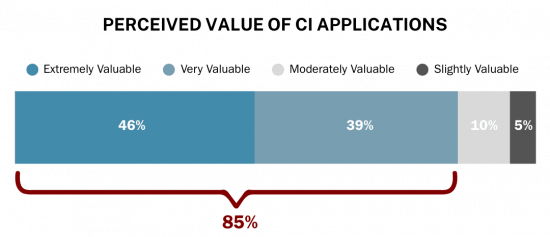
The survey shows that identifying competitive threats early is not only the most common objective of CI, but also its most highly valued application. 85% of respondents rated early threat detection as extremely or very valuable, a level of consensus not seen for any other CI application.
Leading life sciences companies monitor a wide range of competitive signals, including:
- Clinical development timelines and trial design choices
- Regulatory interactions and approval strategies
- Commercial positioning and messaging shifts
- Organizational changes, partnerships, and licensing activity
By identifying these signals early, organizations gain the time needed to adjust portfolio strategy, refine development plans, and mitigate competitive risk before it impacts execution. CI teams that focus primarily on retrospective reporting or static updates are far less likely to influence strategic outcomes.
Stage 2: Strategic Contextualization Turns Intelligence into Insight
Early awareness alone does not drive strategic value. The next stage of the continuum is strategic contextualization.
High-performing CI teams move beyond describing competitor activity to interpreting what those developments mean for the business. This includes assessing how competitive actions affect portfolio priorities, commercial assumptions, and long-term strategic positioning.
Survey respondents rated CI as extremely or very valuable for several context-driven applications:
- 82% for informing commercial strategy
- 79% for strategic planning and resource allocation
- 76% for product positioning and messaging
This ability to translate intelligence into strategic context is especially pronounced among organizations where CI has high strategic influence. These organizations, which represent 41% of survey respondents, actively integrate CI into planning discussions rather than treating it as a standalone output.
Stage 3: Decision Enablement Across the Product Lifecycle
At the midpoint of the CI Strategic Enablement Continuum, intelligence shifts from insight to action.
The survey demonstrates that CI is most impactful when it directly enables decisions across the product lifecycle, including:
- Portfolio prioritization and sequencing
- Go-to-market and launch strategy development
- Business development and licensing evaluations
Notably, 46% of respondents rated CI as extremely or very valuable for improving launch readiness, highlighting its importance in revenue-critical decisions. When CI is introduced early and used consistently, leadership teams are better equipped to evaluate trade-offs, assess uncertainty, and move forward with greater confidence.
CI functions that are brought in late, after strategic directions are already set, struggle to influence outcomes regardless of the quality of insight produced.
Stage 4: Stakeholder Activation Drives Strategic Influence
Insight only becomes strategic when it reaches the right stakeholders at the right time.
The survey highlights stakeholder engagement as one of the strongest differentiators between high- and low-impact CI functions:
- 69% of respondents rated reports and presentations as extremely or very effective channels for disseminating CI
- 66% said the same for real-time alerts
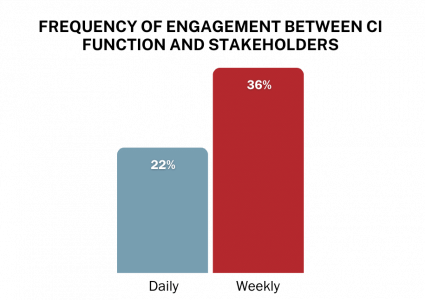
Frequency of engagement also matters. 36% of respondents engage stakeholders weekly, while 22% engage daily. Daily and weekly engagement patterns correlate strongly with higher strategic influence, whereas ad hoc engagement is most common among CI teams with limited impact.
Leading CI teams maintain a consistent engagement cadence and tailor outputs to stakeholder needs, reinforcing their role as trusted strategic partners rather than reactive information providers.
Stage 5: Measuring Impact and Reinforcing Strategic Value
The final stage of the CI Strategic Enablement Continuum is impact measurement and continuous improvement.
While demonstrating value remains a challenge for many CI functions, the survey reveals a stark contrast between high- and low-influence teams:
- 42% of high-influence CI teams actively collect stakeholder feedback to measure impact
- Only 10% of high-influence teams report no active measurement
- By contrast, 40% of low-influence CI teams report no active measurement of CI impact
Organizations that measure how CI informs decisions are better positioned to refine priorities, demonstrate ROI, and strengthen CI’s role in future strategic discussions.
What This Means for Life Sciences Leaders
The survey data points to a clear conclusion. Competitive intelligence delivers the greatest value when it is treated as a strategic enablement capability rather than a research function.
For life sciences leaders, this means recognizing that CI effectiveness is defined not only by what intelligence is collected, but by how it is contextualized, communicated, and used to inform decisions. Structure, stakeholder engagement, and impact measurement are as critical as research quality.
As competitive pressure intensifies and decision timelines continue to compress, organizations that operate effectively across the CI Strategic Enablement Continuum will be better positioned to anticipate change, allocate resources wisely, and sustain long-term competitive advantage.
Engage With the CI Survey Data or Start a Conversation
The insights summarized here represent only a portion of the findings from Sedulo’s 2025 Annual Life Sciences Competitive Intelligence Survey, which includes deeper analysis by company size, CI maturity, AI adoption, stakeholder engagement models, and budget allocation trends.
To explore the full data set and benchmark your organization’s CI approach:
👉 Download the full 2025 Life Sciences Competitive Intelligence Survey Report, including detailed charts, subgroup analyses, and practical recommendations.

For organizations looking to translate these insights into action, Sedulo works with life sciences teams to assess CI maturity, identify gaps across the CI Strategic Enablement Continuum, and strengthen strategic influence across portfolio, commercial, and launch planning.
To discuss how your CI function can play a more consistent role in strategic decision making:
👉 Contact Sedulo’s Life Sciences team to start a confidential conversation.
Frequently Asked Questions (FAQs)
What is competitive intelligence in life sciences?
Competitive intelligence in life sciences refers to the systematic collection and analysis of information about competitors, markets, and external trends to support strategic, commercial, and portfolio decisions across pharma, biotech, and medical device organizations.
Why is competitive intelligence important for strategic decision making?
CI enables leadership teams to anticipate competitive threats, evaluate strategic options, and make informed decisions with greater confidence. The 2025 survey found that early threat detection and strategic planning are the top objectives of CI.
How do high-performing CI teams differ from others?
High-performing CI teams integrate intelligence into planning cycles, engage stakeholders frequently, contextualize insights for decision makers, and actively measure impact. These teams are far more likely to influence strategy at a senior level.
How early should CI be used in drug development?
Survey data shows that many organizations engage CI early, often by preclinical or Phase 2 development, to assess market opportunity, differentiation, and competitive risk before major investment decisions are made.
How can companies measure the impact of competitive intelligence?
The most effective approaches include collecting feedback from stakeholders, linking CI insights to planning and decision outcomes, and tracking how intelligence influences strategic choices over time.