

As we wrap up our benchmarking series, remember benchmarking is the starting point, not the finish line. Too many companies stop at measurement, leaving insights (and most importantly, action) on the shelf. Value comes when you turn benchmarks into decisions. Here’s how to go beyond comparison and create impact.
Action > Data
Raw numbers rarely shift decisions. They offer clarity, but interpretation is what transforms data into direction. The most effective benchmarking programs always answer the question “what now” rather than “where are we.” This shift in focus moves teams beyond observation and into action.
Focus on Your Differences
Once gaps appear in your benchmarking data, those gaps should guide your strategic choices. Are you significantly lower than competitors in distribution strength? That’s a new strategic initiative. Are you significantly better than peers in operational efficiency? That’s an advantage to exploit.
Focusing on where you differ (both good and bad) ensures that efforts support your goal of improvement and the building of competitive advantages.
Here’s a simple framework for how to operationalize your benchmarking learnings:
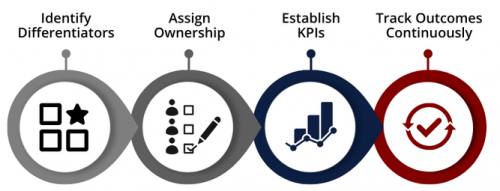
- Identify the most important differences between you and your competitors, peers, etc.
- Assign clear ownership so every recommendation has an accountable leader.
- Establish the KPIs which will determine whether you’ve succeed or not (these might be the same KPIs you used when you created the benchmarks themselves, but not always).
- Track outcomes with a consistent review.
For example, a company that sits in the bottom quartile for “customer support spend as a % of revenue”, would push their Leader of Customer Experience, CRO, or VP of Account Management to set a goal around “response times” or “post-support sentiment”. Neither of these KPIs are in your benchmarking data, but if you only focused on “customer support spend” as the metric you wanted to improve, you may not actually improve your customer support experience. The value does not come from the benchmark, it comes from the area of your value chain which the benchmark has highlighted as a potential liability.
Using Benchmarking to Build a Competitive Advantage
Organizations that consistently act on insights outperform peers who only observe performance.
When benchmarking evolves into a decision & effort-prioritization engine, it influences planning, investment, and daily execution. Companies begin to treat competitive comparisons as a continuous source of guidance rather than an occasional health check.
To build a competitive advantage, you must know how you compare to your market and what you can do to better improve your positioning. Benchmarking is the first step in that journey.
Ready to turn benchmarking into a growth accelerator?
Begin the shift from measurement to movement and unlock meaningful competitive advantage by working with Sedulo to establish these capabilities. Contact Us to get started.