

Every executive wants to increase profit and most start this effort by looking to cut costs first. However, there is a more efficient lever that doesn’t involve layoffs or shrinking your R&D budget: Price Realization.
If your organization suffers from a wide gap between your “List Price” and the actual cash hitting your bank account after a sale, you have a revenue leakage problem. To win in today’s market, you must make that gap as small as possible and as predictable as the weather.
What is Price Realization?
Price realization is the measure of how much of your list price you actually retain after all discounts, promotions, and rebates are applied.
Many companies operate with a “List Price” (or MSRP) that exists only on paper. By the time a sales rep applies a strategic discount, a channel partner takes their cut, and a seasonal promotion is applied, the Net Revenue is often a fraction of the original List Price.
Common Sources of Revenue Leakage
- Discretionary Discounting: Sales reps dropping price to close deals.
- Channel Conflict: Overlapping partner programs that cannibalize margins.
- Unauthorized “Exceptions”: One-off deals that become the new standard.
- Promotional Fatigue: Constant sales that train customers never to pay full price.
At the highest level, incentive misalignment is the primary engine behind revenue leakage. As a simple example, most organizations inadvertently reward sales based on “volume at any cost,” creating a systemic conflict between a rep’s commission check and the company’s bottom line. When a rep is pressured to hit a quarterly volume target, they will naturally use the easiest tool in their kit (discounting) to accelerate the close.
To ground your price realization effort in reality, you have to diagnose three specific incentive failures:
- Revenue vs. Margin Quotas: If commissions are paid on gross revenue rather than realized profit, there is zero personal consequence for a rep who gives away 15% of the margin. The house loses, but the rep still wins.
- The “Quarterly Dash” Bias: When incentives are heavily weighted toward end-of-period “kickers,” you train customers to wait until the final week of the month for the deepest, most desperate discounts. This turns your pricing strategy into a game of chicken that you will always lose.
- Non-Monetary “Give-Backs”: Sometimes the leak isn’t a dollar discount but a commitment of resources, like free implementation. These “soft” leaks are often used to bypass formal pricing guardrails entirely.
When you stop rewarding volume at the expense of value, you transform price realization from a back-office metric into a frontline strategy.
This shift is critical because it allows you to boost margins and meet profitability goals without the trauma of cutting headcount or reducing operational resources. You aren’t asking your team to do more with less; you are simply asking them to keep more of what they already earn.
However, recognizing that your incentives are broken is only the first step.
Fixing the “leaks” without killing your sales momentum requires a move away from anecdotal complaints and toward a disciplined, data-driven diagnostic.
The Execution Process
Improving your price realization requires a clinical look at your internal and external data:
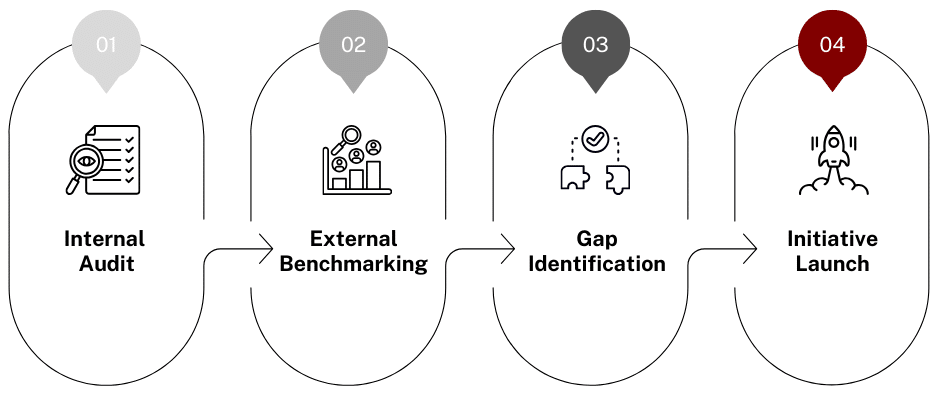
1) Internal Audit: Analyze the delta between list and net price across all products. Review your deal desk governance and sales workflows.
This requires pulling historical transaction data from your CRM and ERP to map every deduction from the gross list price down to the final pocket margin. You will perform a “Price Waterfall” analysis to visualize exactly where value is eroded and identify which products or regions have the highest variance.
2) External Benchmarking: Use primary interviews and maturity matrices to see how your “leaks” compare to industry peers.
You must gather outside-in intelligence through blind interviews with former industry executives or channel partners who can speak to the standard discounting behaviors of your competitors. Use this data to plot your organization on a pricing maturity matrix, determining if your leakage is an industry-wide reality or a specific internal failure that puts you at a competitive disadvantage.
3) Gap Identification: Pinpoint exactly where the money is disappearing. Is it a person, a process, or a partner?
This phase involves a deep dive into your “exception” logs and stakeholder interviews with your sales ops team to understand the frequency and justification of off-book deals. By cross-referencing high-leakage deals against specific sales pods or channel programs, you can determine if the issue is a lack of training, weak negotiation, or a broken incentive structure that rewards volume over value.
4) Initiative Launch: Build rigid approval guardrails and channel rules to plug the holes.
Work with leadership to define “floor prices” and standardized discount tiers that require escalating levels of executive approval. Once launched, perform a monthly “leakage trend” analysis to measure the effectiveness of these new guardrails and ensure that your realized price is moving closer to your target goals.
The Anatomy of a Price Waterfall
Imagine a piece of heavy machinery with a List Price of $100,000. The goal is to see what actually remains after the “waterfall” of deductions:
- The Transactional Leak: First, the sales rep applies a 10% negotiated discount to close the deal. Your $100,000 is now $90,000 Invoice Price.
- The Programmatic Leak: Your channel partner program dictates a 5% volume rebate paid out at the end of the quarter. Your “real” revenue is now $85,500.
- The Logistics Leak: To get the product to the customer, you work through a dealer who has negotiated Free Freight, which costs the company $2,500. Now you are at $83,000.
- The Hidden Leak: Finally, the customer pays early to trigger a 2% Net-10 cash discount. Your Pocket Price—the actual cash available to cover costs—is $81,340.

By the time the deal is done, you haven’t just given a 10% discount; you’ve lost nearly 20% of your value to a “death by a thousand cuts” scenario. Identifying these stages allows you to see that the issue might not be the sales rep’s negotiating skills, but rather an expensive freight policy or an outdated rebate structure.
Prerequisites and Stakeholders
You cannot do this in a vacuum. The most important prerequisite is Sales Buy-In. Since sales teams drive the system, they will resist any guardrail they perceive as a barrier to closing. As you kickoff, go build your coalition, consisting of:
- Sales: To ensure the rules are practical.
- Marketing: To align brand value with price.
- Product: To ensure packaging reflects value.
- P&L Owners: To provide the financial mandate.
The style of this collaboration must be collaborative. This is not a finger-pointing exercise to shame Sales for high discounts. A coalition is only as strong as its rhythm. Without a defined structure, these stakeholders will default to their own silos, and your price realization project will stall out in a series of endless “check-in” meetings. To move from a static audit to a dynamic pricing engine, you need a high-cadence, high-transparency operating model.
- The Weekly Tactical Sprint: Sales and Marketing meet to review recent “wins” and “leaks.” They discuss which objections are causing reps to cave on price and what new marketing collateral is needed to defend the value proposition in the field.
- The Monthly Strategic Review: P&L owners and Product leaders join to look at the macro trends. They analyze whether the current guardrails are effectively closing the gap or if they are inadvertently slowing down the sales cycle too much. This is where you decide to “turn the screws” on certain product lines or loosen rules in high-growth, competitive markets.
As long as you have sales data, a coalition, and a reoccurring cadence of efforts, you’ll be able to execute a Price Realization project.
Tailoring Price Realization by Industry
Technology
For tech companies, the Route to Market (RTM) is often the culprit. Managed Service Providers (MSPs), Distributors, and Value-Added Resellers (VARs) all have unique price points. Realization here requires harmonizing these channels so they don’t compete against each other on price alone.
Consumer Goods
Distribution costs and constant promotions are the primary leaks. You must decide how “promotion ready” your brand should be. If consumers only buy when there is a 20% coupon, your realized price is effectively your new list price, and your margins are in danger.
Manufacturing
Manufacturers often struggle with complex dealership networks. Heavy equipment or automotive sales rely on keeping partners loyal. Realization here is about understanding the “net-net” price after dealer incentives and volume rebates are settled.
Professional Services
This sector suffers most from “Scope Creep” and unauthorized discounts. Doing “free” extra work is a form of revenue leakage. Realization in services means sticking to the scope and ensuring every billable hour is actually billed.
Key Takeaways
- Protect Your Margin: Price realization is the fastest way to boost profit without cutting staff or resources.
- Simplify the Complexity: The more complex your RTM and channel programs, the more likely you are to have significant leakage.
- Look Outward: You must benchmark against the “norm” to see if your discounting is competitive or just sloppy.
Next Step: Schedule a 15 minute sync with your Sales leadership. Ask them if they believe the current gap between list price and realized price is acceptable. If they see the leakage, it’s time to bring in Marketing and start a formal Price Realization initiative.