
Pharmaceutical organizations today operate in an environment defined by an abundance of information.
Across competitive intelligence, clinical development, market research, and analytics functions, teams have access to an unprecedented volume of data. Competitor pipeline updates, clinical trial readouts, conference insights, payer dynamics, and internal analyses all contribute to a highly detailed and constantly evolving view of the market.
Yet despite this depth of visibility, a familiar challenge persists. The issue is not access to insight. It is the ability to synthesize that information, align on what it means, and translate it into clear, coordinated action.
In practice, the same data is often interpreted differently across functions. Medical, commercial, and market access teams may each draw valid but competing conclusions. As a result, strategic decisions can become fragmented, delayed, or insufficiently aligned.
This gap between insight and action is where many strategies begin to lose momentum.
Workshops, when designed with intent, play a critical role in closing that gap.
Reframing Workshops in Pharma
Many teams have experienced workshops that feel unstructured, overly discussion-driven, and light on outcomes. While conversations may be engaging, they do not consistently lead to decisions or clear next steps. As a result, workshops are often viewed as time-consuming or secondary to the “real” work of strategy.
The difference comes down to how workshops are designed and what they are expected to deliver.
When approached with intent, workshops are not discussion forums. They are structured mechanisms for decision-making. The most effective workshops are built around a clear objective, tied to a specific strategic question, and designed to guide participants toward alignment and action.
What Effective Workshops Actually Do
When properly designed, workshops serve a small number of critical functions.
Translate data into direction: Pharmaceutical organizations are not lacking in data, but often struggle to align on what it means. Workshops provide a structured environment to synthesize insights, reconcile differing interpretations, and move toward a clear point of view.
Pressure test strategy before execution: Workshops create space to challenge assumptions in a controlled setting. Teams can explore how competitors may respond, where positioning may be vulnerable, and how key decisions may play out before they are tested in the market.
Drive cross-functional alignment: Strategy in pharma spans medical, commercial, market access, and clinical teams. Workshops bring these perspectives together to establish a shared understanding and align on priorities and next steps.
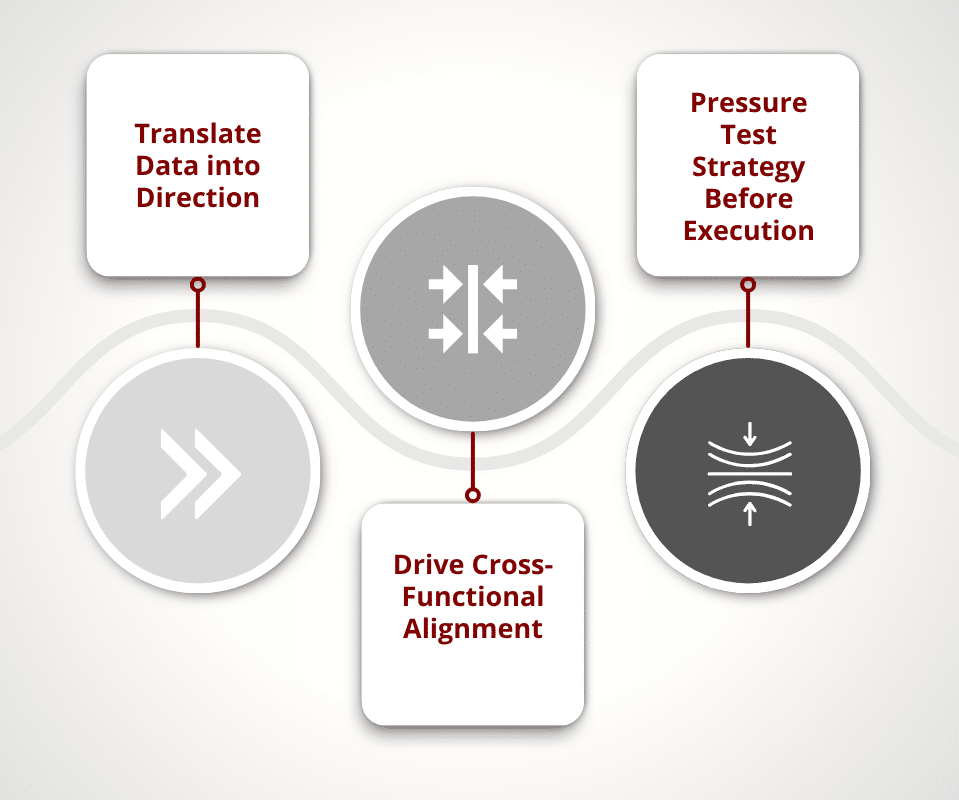
Taken together, these roles position workshops as a core mechanism for turning insight into action and advancing strategy with greater clarity and confidence.
The Four Types of Pharmaceutical Workshops
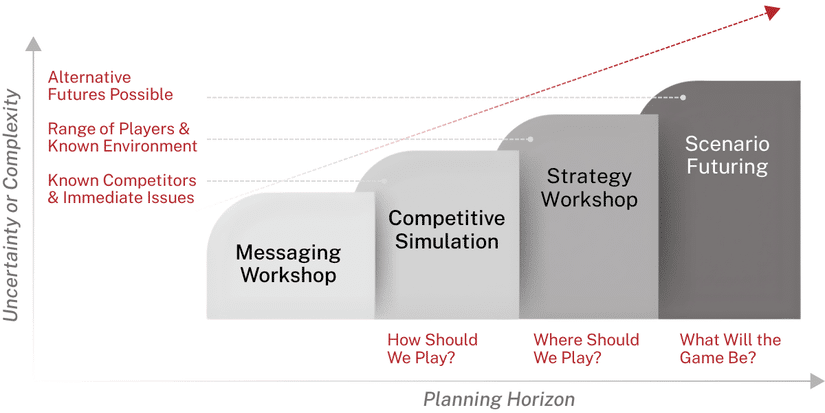
Workshops are most effective when aligned to a clearly defined strategic question. Yet, organizations often default to familiar formats rather than selecting the approach best suited to the decision at hand. Four types of workshops consistently emerge as the most impactful, each designed to address a different category of strategic decision.
Messaging Workshops: Defining a Clear and Defensible Narrative
Messaging workshops are most relevant when the challenge is clarity, not data.
Organizations often understand their clinical profile but struggle to translate it into a differentiated narrative across stakeholders, particularly in pre-launch settings or crowded markets. These workshops align medical, commercial, and market access perspectives, validate claims, and identify vulnerabilities.
At their core, they turn complex data into a clear, defensible story.
Competitive Simulation and Wargaming: Anticipating Market Dynamics
When uncertainty centers on how competitors or the market will respond, simulations provide a different lens.
Teams step into the roles of competitors and stakeholders, reacting to realistic scenarios such as data releases or market shifts. This challenges internal assumptions and forces a more externally grounded view of strategy.
For organizations approaching launch or high-stakes events, simulations surface risks, identify inflection points, and strengthen plans. Our work in competitive market entry wargaming explores how this approach reflects real-world dynamics.
Strategy Workshops: Aligning on Where and How to Compete
Strategy workshops focus on prioritization and direction.
With multiple viable opportunities but limited resources, teams must make clear trade-offs. These workshops bring those decisions into focus by integrating clinical, commercial, and operational perspectives to align on where to compete and how to invest.
This alignment is particularly critical in launch planning. As outlined in our Pharmaceutical Launch Planning Guide, organizations that align early are better positioned for success.
Scenario Planning: Preparing for an Uncertain Future
When uncertainty is both high and long-term, scenario planning provides a broader approach.
Rather than predicting a single outcome, these workshops explore multiple plausible futures shaped by scientific, regulatory, and market shifts. Teams identify key uncertainties and assess implications for strategy.
The focus shifts from prediction to preparedness, enabling organizations to respond effectively under different conditions.
How to Choose the Right Pharma Workshop
Understanding the different types of workshops is an important first step. The greater challenge, however, lies in selecting the right approach for a given situation. The effectiveness of a workshop ultimately depends on how well it aligns with the decision it is intended to support.
A practical way to approach this is through three lenses: time horizon, level of uncertainty, and the nature of the strategic question.
1. Time Horizon: When Will This Decision Matter?
The time frame of the decision should influence the structure of the workshop. As the time horizon extends, workshops should shift from tactical alignment to more exploratory and forward-looking thinking.
- Near-term decisions (0–12 months):
Focused on execution and immediate planning. Messaging Workshops and Competitive Simulations are typically most effective. - Mid-term decisions (1–3 years):
Centered on prioritization and resource allocation. Strategy Workshops help bring trade-offs into focus. - Long-term decisions (5+ years):
Shaped by uncertainty and evolving landscapes. Scenario Planning provides a broader, more flexible approach.
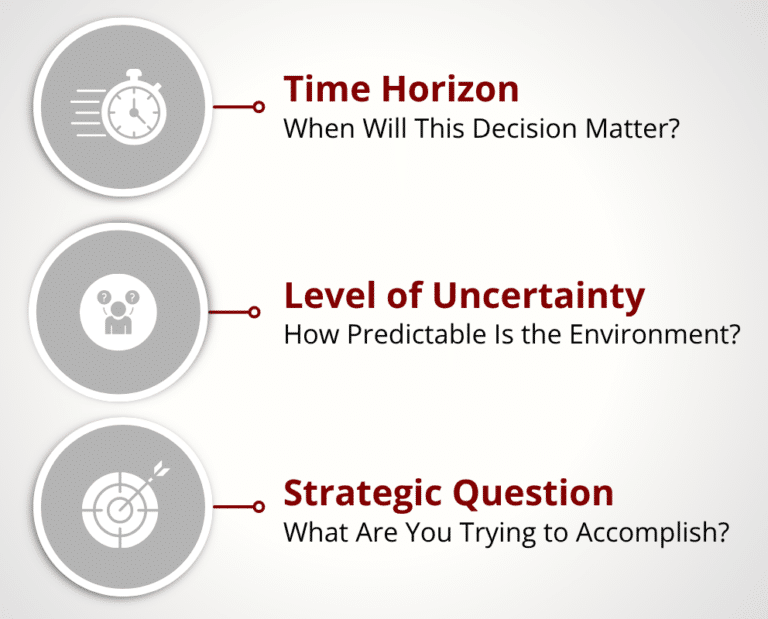
2. Level of Uncertainty: How Predictable Is the Environment?
The more uncertain the environment, the more dynamic the workshop needs to be.
- Lower uncertainty:
The landscape is relatively well understood. Messaging Workshops can focus on refining positioning and aligning stakeholders. - Moderate uncertainty:
Some variability exists in outcomes. Strategy Workshops help align on direction and key trade-offs. - High uncertainty:
Multiple unknowns are in play. Competitive Simulations and Scenario Planning are better suited to stress-test assumptions and explore different outcomes.
3. Strategic Question: What Are You Trying to Accomplish?
The most important factor is the question itself. In many cases, clarity here makes the decision straightforward.
- If the focus is on positioning and differentiation, a Messaging Workshop is most appropriate
- If the focus is on competitor behavior and response, a Competitive Simulation provides the right lens
- If the focus is on prioritization and resource allocation, a Strategy Workshop is most effective
- If the focus is on long-term uncertainty, Scenario Planning offers the necessary perspective
What Makes a Pharma Workshop Effective
Many workshops fall short not because the format was wrong, but because the design and execution were insufficient. Discussions may be engaging and ideas may surface, but without the right foundation and structure, they rarely translate into meaningful decisions or sustained action.
The difference between a productive workshop and a high impact one typically comes down to a few key factors.
1. Strong, Insight-Driven Inputs
Workshops are only as effective as the information they are built on.
If the inputs are incomplete, outdated, or surface-level, the discussion will reflect those limitations. Teams may align around an interpretation, but not necessarily the right one.
High-impact workshops are grounded in robust inputs, including:
- Competitive intelligence
- Clinical and market context
- A clear understanding of the evolving landscape
In many cases, the greatest value comes from incorporating primary intelligence, which adds depth beyond publicly available data. As explored in our pharmaceutical primary intelligence perspective, these insights can materially change how teams interpret competitor strategy and market dynamics.
2. Structured Design and Facilitation
Effective workshops are not improvised. They are intentionally designed to guide participants from insight to decision.
This includes:
- Clear objectives tied to specific strategic questions
- A defined flow that builds toward alignment
- Exercises that challenge assumptions and encourage participation
Equally important is facilitation. Strong facilitation ensures that discussions remain focused, that all relevant perspectives are incorporated, and that the group moves toward a clear outcome rather than lingering in open-ended debate.
3. Cross-Functional Participation
Pharmaceutical strategy is inherently cross-functional. Decisions related to positioning, access, clinical development, and commercialization require input from multiple teams, each bringing a different perspective.
Without alignment, these perspectives can lead to fragmented interpretations and inconsistent execution.
Workshops provide a structured environment to bring these viewpoints together. They enable teams to:
- Develop a shared understanding of the landscape
- Align on key assumptions
- Agree on priorities and direction
4. Clear, Actionable Outcomes
One of the most common pitfalls is ending with broad agreement but limited follow-through. Without clear decisions, defined next steps, and ownership, even the most productive session can lose momentum quickly.
High-impact workshops are designed with the end in mind. They produce:
- Clear strategic decisions
- Defined action plans
- Alignment on ownership and next steps
Why Pharmaceutical Workshops Matter Now
The increasing importance of workshops reflects a broader shift in how pharmaceutical organizations approach strategy and decision-making.
As the volume and complexity of data continue to grow, the role of competitive intelligence is evolving. As highlighted in our 2025 CI Survey Findings, organizations are placing greater emphasis on using intelligence to inform decisions, not just track the market.
This shift raises expectations. Teams must interpret consistently, align quickly, and act with confidence.
Workshops have emerged as an effective way to meet this need. They bring together data, perspectives, and strategic questions in a structured environment that enables clearer, more aligned decisions. When designed well, they reduce ambiguity, surface risks earlier, and accelerate alignment across functions.
Learn More About Sedulo Group
At Sedulo, we partner with pharmaceutical organizations to design, structure, and facilitate workshops built around real strategic decisions.
Whether supporting messaging refinement, competitive simulations, strategy development, or long-term scenario planning, our focus is on ensuring that workshops move beyond discussion to deliver clear, actionable outcomes.
If you are looking to strengthen how your organization translates insight into strategy, we welcome the opportunity to connect. Contact us to learn more about how we can support your team in designing workshops that drive meaningful impact.
Frequently Asked Questions
What is a pharmaceutical workshop?
A pharmaceutical workshop is a structured session designed to help teams analyze data, align on strategy, and make decisions. Unlike traditional meetings, workshops are built around specific strategic questions and are intended to translate competitive intelligence and market insights into clear actions.
What are the different types of pharma workshops?
The four primary types of pharmaceutical workshops are:
- Messaging workshops
- Competitive simulation or wargaming
- Strategy workshops
- Scenario planning
Each type is designed to address a different strategic question, from positioning and competitor response to prioritization and long-term uncertainty.
How do pharma workshops support competitive intelligence?
Pharma workshops help operationalize competitive intelligence by turning insights into decisions. They provide a structured environment for teams to interpret data, challenge assumptions, and align on how to respond to competitor activity and market dynamics.
When should a pharmaceutical company facilitate a competitive simulation or wargame?
Competitive simulations are most valuable when organizations need to anticipate how competitors or the market will respond to key events, such as product launches, clinical data releases, or pricing changes. They are especially useful in high-stakes or uncertain environments.
How do you choose the right type of pharma workshop?
Choosing the right workshop depends on three key factors:
- The time horizon of the decision
- The level of uncertainty in the market
- The specific strategic question being addressed
Aligning the workshop format to these factors ensures more effective outcomes.
What makes a pharmaceutical workshop effective?
Effective workshops are grounded in strong inputs, such as competitive and primary intelligence, and are designed with clear objectives and structure. They also involve cross-functional stakeholders and produce actionable outcomes, including defined decisions and next steps.
Why are workshops becoming more important in pharma strategy?
As pharmaceutical organizations face increasing data complexity and competitive pressure, workshops are becoming essential for aligning teams and accelerating decision-making. They help bridge the gap between insight and action, enabling organizations to respond more effectively to market changes.