

Over the past decade, growth has gotten more complex. Ten years ago, companies could rely on straightforward pricing and standardized contracts. Today, that simplicity has disappeared.
Within software, OpenView reports that more than 60% of SaaS companies now use some form of usage-based pricing (layering subscriptions with consumption models). It’s not uncommon to enter SaaS negotiations with intensive enterprise customizations, detailed integrations, and multi-year commitments. At the same time, Gartner estimates that the average B2B buying group now includes 6 to 10 decision-makers (bringing legal, financial, and operational scrutiny to the table).
Deals are not a single negotiation between a sales rep and a buyer. Deals have become structured multi-term agreements shaped by procurement teams, compliance requirements, sales reps, competitive benchmarks, and, of course, the deals desk.
This shift has some huge financial impacts.
Bain has shown that improving pricing discipline can increase operating profit without changing the product. McKinsey has similarly found that uncontrolled discounting is one of the most common hidden drivers of margin erosion. A 5% concession may feel small in isolation, but repeated across hundreds of agreements; it materially changes customer lifetime value, renewal leverage, and forecast accuracy. The economics of growth are increasingly determined not only by how many deals are closed, but by how consistently those deals are structured.
For many organizations, this is where tension begins to surface.
- Sales teams are under pressure to accelerate deal timelines and sell a higher quantity.
- Finance is under pressure to stabilize margins and predict future revenue.
- Legal must manage each deal’s unique risk.
- Operations has to deliver on what was promised, despite hardly ever being asked what’s possible.
When deal complexity rises faster than internal coordination, decision-making becomes fragmented, pricing exceptions accumulate, contract terms vary, and precedent is set unintentionally.
The Deal Desk emerged as a response to this new reality.
Fundamentally, it is a structured process for reviewing and approving non-standard deals. More importantly, it is the mechanism that brings discipline to commercial decision-making before a contract is signed. It ensures that pricing exceptions are intentional and strategic. The Deal Desk, when designed thoughtfully, becomes the engine that converts growth into predictable, sustainable performance, which is exactly why it deserves closer attention.
Defining the Deal Desk
A Deal Desk is best understood as a coordination function. It exists at the intersection of pricing strategy, competitive positioning, financial discipline, and operational feasibility.
At a practical level, a Deal Desk reviews and approves deals that fall outside standard commercial guardrails. These may include discounts above predefined thresholds, custom contract terms, non-standard payment structures, bundled offerings, or performance guarantees. In growing organizations, such exceptions are increasingly common.
The core problem the Deal Desk solves is inconsistency.
A sales leader may view discounting as a tactical necessity, whereas finance may view it as margin erosion, and legal may see risk exposure in seemingly minor contractual clauses. The Deal Desk creates a structured workflow that aligns these perspectives before commitments are made.
In practice, the execution is straightforward but disciplined.
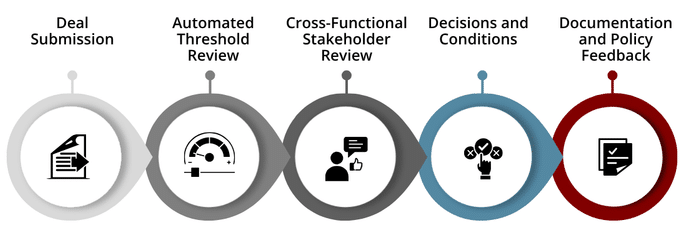
A Deal Desk only works if a few fundamentals are in place.
- There needs to be a clear pricing structure, with defined limits around who can approve what and when escalation is required.
- Margin expectations have to be visible and publicly known.
- There must be reliable and accessible data, such as the ability to see discount patterns, renewal trends, and margin impact over time.
Without those basics, decisions become personal judgments instead of consistent business logic.
When those foundational elements are in place, the benefits are commonly seen to be:
- Sales teams negotiate with a clearer understanding of what flexibility exists, which reduces last-minute internal back-and-forth.
- Finance gains earlier visibility into potential trade-offs instead of discovering them after contracts are finalized.
- Legal and Operations are included at the right moments, which prevents avoidable complications later in the delivery cycle.
- Over time, the documentation generated through these reviews creates institutional memory, allowing future decisions to be grounded in precedent rather than guesswork.
In contrast to a Deal Desk, organizations without this structure often experience friction that feels personal. Approvals vary depending on who is involved, similar deals receive different treatment, and the absence of clear standards makes governance feel unpredictable.
In a basic Deal Desk, the function typically focuses on reviewing deals that have already been negotiated, ensuring they comply with policy before approval. As an organization matures, the perspective broadens. Patterns begin to emerge around recurring discounts, frequently requested contract modifications, or product bundles that consistently require exceptions. At that point, the conversation shifts away from policing individual transactions and toward refining the underlying commercial model itself, shaping how deals are structured long before they reach the approval stage.
The Importance of Structured Commercial Discipline
The reason Deal Desks are becoming more important has less to do with internal organization and more to do with how markets now operate. Pricing is not simple or static. Companies are layering subscription models with usage components, bundling products in new ways, and negotiating multi-year agreements that include custom clauses. At the same time, buyers are more informed than they were a decade ago. Procurement teams often come to the table with competitive benchmarks, legal requirements, and financial expectations that shape negotiations from the start. Deals that once followed a predictable template now vary widely in structure and risk.
As that variation increases, so does the likelihood of inconsistency.
When each agreement is negotiated under time pressure and approved in isolation, small concessions begin to accumulate. A slightly deeper discount here. A more flexible renewal clause there. A payment structure adjusted to close before quarter-end to hit a quota. None of these decisions appear significant on their own, but taken together they can materially change the economics of the business.
A Deal Desk creates a moment of alignment before commitments are finalized. It ensures that trade-offs are visible and intentional rather than reactive. If flexibility is granted, it is granted with context. If competitive pressure is cited, it is evaluated against real market dynamics. The purpose is to prevent growth from quietly undermining itself.
How do Deal Desks change by Industry?
A Deal Desk should reflect how a company actually makes money. The structure that works for a SaaS business will not look the same as one designed for a manufacturer or a consumer goods company, because the risks, pricing pressures, and contract dynamics are different in each case. However, the goal is the same: bring consistency and discipline to commercial decisions. Across industries, the consistent theme is coordination. Deals commit resources, define revenue streams, and signal market positioning. Governance ensures those commitments reflect strategy rather than urgency alone.
Technology Clients
Technology companies, particularly SaaS, operate within layered pricing ecosystems. Subscription tiers combine with usage-based components, enterprise onboarding services, and evolving feature sets. Revenue recognition standards require precision and Procurement teams benchmark aggressively.
A Deal Desk in this context ensures ARR predictability and protects renewal leverage. It evaluates whether multi-year discounts undermine long-term pricing power, models the volatility introduced by usage-based billing, and ensures compliance with accounting standards.
For B2B firms, the emphasis often lies in balancing competitive responsiveness with margin discipline.
For B2C firms, experimentation velocity may require structured oversight to prevent inconsistent channel pricing practices.
The measurable outcome is improved forecast reliability and stabilized net revenue retention with metrics that increasingly define investor confidence in technology companies.
Consumer Goods Clients
In consumer goods, deal complexity centers on trade promotions, distributor incentives, and retail negotiations. Retailers demand margin support and volume commitments. Channel conflicts arise between wholesale, retailers, and direct-to-consumer strategies. Promotional allowances may accumulate without centralized oversight.
A Deal Desk evaluates trade spend effectiveness, ensures channel pricing coherence, and models volume commitments against production capacity. It aligns commercial concessions with brand strategy and supply chain feasibility. In highly competitive retail environments, disciplined governance can stabilize margins and improve visibility into promotional ROI.
Manufacturing Clients
Manufacturing firms contend with long sales cycles, customized bids, and supply chain volatility. This is painful across a number of areas:
- Capital equipment pricing may include multi-year service agreements.
- Input costs fluctuate based on commodity markets.
- Payment structures influence working capital.
A Deal Desk integrates cost modeling rigorously into bid review. It evaluates contribution margin under volatile input assumptions, confirms engineering feasibility, and assesses long-term service obligations. The result is improved bid consistency and reduced exposure to cost overruns embedded within contractual commitments.
Professional Services Clients
Professional services organizations face margin erosion through scope creep and custom proposal complexity. Pricing expertise-based services is nuanced and underestimating delivery requirements can erode profitability.
A Deal Desk in this sector enforces scope clarity before signature, aligns pricing with resource allocation constraints, and evaluates contractual risk. Over time, it enhances project margin consistency and reduces post-engagement adjustments.
Key Takeaways and Next Steps
Deals are not isolated events.
They are signals.
Each one reveals how buyers perceive value, where competitors are applying pressure, and where your own commercial structure may be misaligned with the market. A Deal Desk, when designed thoughtfully, becomes the place where those signals are captured instead of ignored.
Growth can conceal structural weaknesses for a long time, rising tides raise all boats. What matters is whether margin stability, renewal strength, and pricing consistency tell the same story as top-line expansion. Here are a few questions you can ask yourself to determine whether you should review (or implement) a Deal Desk:
- Are discount patterns consistent across similar customers, or do they vary depending on who negotiates the deal?
- Are renewal conversations becoming more difficult, and can that difficulty be traced back to initial concessions?
- When competitors are cited as justification for price reductions, do we verify those claims with real market intelligence?
- Do we document exceptions in a way that informs future decisions, or do we treat each one as a standalone approval?
- Are recurring concessions pointing to a deeper issue in packaging, positioning, or perceived value?
The practical next step is to evaluate how visible your deals are now. Map how deals move through the organization today. Identify where escalation happens, how rationale is captured, and where margin impact is measured. Then layer in competitive context so that governance reflects not just internal targets, but external realities.
At Sedulo, we often see pricing governance and competitive intelligence treated as separate conversations. In practice, they reinforce each other. A Deal Desk provides discipline, but competitive intelligence provides perspective. When those two functions are connected, it allows growth to remain durable rather than fragile.
Frequently Asked Questions (FAQ)
Isn’t a Deal Desk just bureaucracy?
It can feel that way if it’s built poorly. But most friction in commercial teams comes from unclear rules, not from structure. A well-designed Deal Desk replaces ambiguity with clarity. It sets expectations early so teams aren’t renegotiating internally at the last minute.
Won’t this slow down sales?
Not if it’s designed correctly. When discount authority and approval paths are clear, most deals move without interruption. Only true exceptions escalate. In many cases, structured governance actually speeds things up because it reduces informal back-and-forth.
How can smaller teams implement this?
Start simple. Define discount thresholds. Set a clear escalation path. Document exceptions. The structure can evolve as the business grows.
What KPIs matter most?
Look beyond top-line revenue. Track average discount rates, margin impact, renewal pricing consistency, and approval turnaround time. Over time, you should see fewer surprises and more predictable outcomes.
What tools are typically used?
Most organizations manage workflows inside Salesforce, CPQ systems, or RevOps platforms. The tool matters less than having clear rules behind it.
How long does it take to see results?
Visibility improves quickly once deals are reviewed consistently. Margin improvement and renewal stability take longer, often a few quarters, as new patterns replace old habits.
How is this different from Pricing Committees or RevOps?
Pricing Committees define the rules. RevOps manages systems and reporting. The Deal Desk applies those rules to real deals in real time.