

Business blind spots can come from assumptions teams make, signals they miss, or questions they don’t think to ask, especially when internal reporting isn’t balanced by customer insight, market awareness, and competitive intelligence. The danger is that these gaps rarely feel urgent while they’re forming. They usually become obvious only once the business has already missed an opportunity, acted too slowly, or allowed a hidden weakness to grow.
To find out what 192,495 opinions from insight, strategy, and marketing leaders in the US were about business blind spots, Sedulo Group partnered with Artios to utilize AI-driven audience profiling to synthesize insights from online discussions for 12 months, ending on April 20, 2026, to a high statistical confidence level. Their findings give a clearer view of how business blind spots are being recognized, where organizations are building stronger approaches, and where hidden risks are still finding room to grow.
Index
- 66% of insights, strategy, or marketing leaders distinguish risks from blind spots
- 33% of insights, strategy, or marketing leaders are quite confident current research identifies blind spots
- 46% of insights, strategy, or marketing leaders’ organizations are building an approach to blind spots
- Significant damage is done before 100% of insights, strategy, or marketing leaders discover blind spots
- Budget and resource constraints prevent 100% of insights, strategy, or marketing leaders from uncovering blind spots
- 100% of insights, strategy, or marketing leaders use internal sales and CRM data for business blind spots
- Informal awareness is used by 87% of insights, strategy, or marketing leaders to detect blind spots
- 100% of insights, strategy, or marketing leaders do regular audits, but not for blind spots
- 100% of insights, strategy, or marketing leaders don’t use social listening for brand perception blind spots
- Supplier and partner risk blind spots are assessed by 79% insights, strategy, or marketing leaders when problems arise
- Economic shift analysis is integrated into 50% of insights, strategy, or marketing leaders’ blind spot strategies
- Business blind spots often lead to missed revenue for 66% of insights, strategy, or marketing leaders
- 73% of insights, strategy, or marketing leaders’ teams align on addressing blind spots
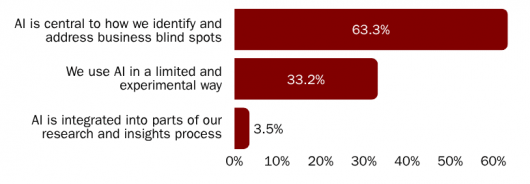
- AI is central to how 63% of insights, strategy, or marketing leaders find and address business blind spots
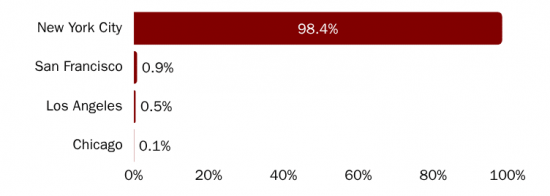
- 98% of strategy, insight, and marketing leaders’ organizations are in NYC
- Building a more proactive approach to business blind spots
- About the data
Do insights and marketing leaders’ organizations understand risks vs business blind spots?
66% of insights, strategy, or marketing leaders distinguish risks from blind spots.
Recognition is growing, but consistency still has ground to cover.
How well their organizations understand the difference between known risks and business blind spots is sharply divided among insights, strategy, and marketing leaders. For 33% of our audience, their organization is beginning to understand the difference, suggesting the concept is gaining traction but may still be handled inconsistently across teams.
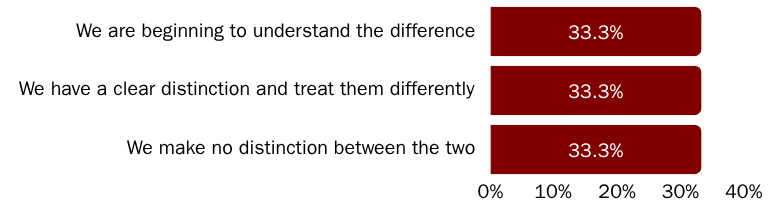
Another 33% make a clear distinction and treat them differently, pointing to a more mature approach in which visible risks and hidden vulnerabilities are managed through separate conversations, review cycles, or decision-making processes.
The final 33% make no distinction between the two, which is the most concerning group because it implies that blind spots may only be addressed once they become obvious enough to look like conventional risks.
Visibility separates managed risks from hidden costs
The practical difference is visibility. Known risks are already being watched, while blind spots sit in areas the business has stopped questioning. A recent Forbes article on the cost of operational blind spots points to examples such as unused or overlapping software, energy contracts signed at the wrong time, freight costs left unbenchmarked, and vendor relationships renewed out of habit.
While these are not dramatic failures at first, they are quiet patterns that keep compounding because no alarm sounds. The companies with stronger separation between risks and blind spots are likely the ones asking which costs, tools, contracts, and assumptions have gone unreviewed for too long.
Sedulo Commentary: The clearest signal in this data is not the 33% who already distinguish risks from blind spots, it’s the 33% who don’t make any distinction at all. When risks and blind spots are treated as the same category, the entire review process points inward, toward what is already visible and already being managed. True blind spots, by definition, sit outside that frame. For Sedulo, this is where structured competitive intelligence creates its earliest value: not by improving how organizations manage known risks, but by building the discipline to surface what isn’t being asked, monitored, or questioned yet.
How confident are leaders that current research captures hidden business blind spots?
33% of insights, strategy, or marketing leaders are quite confident current research identifies blind spots.
The research process is trusted, but still being tested:
When it comes to confidence in current research methods surfacing all relevant business blind spots, opinions are split three ways. 33% of insights, strategy, or marketing leaders are quite confident that current research methods are surfacing all relevant business blind spots. This confidence may signal stronger research discipline, although the nature of blind spots means the hardest gaps to find are usually the ones sitting beyond familiar lines of inquiry.
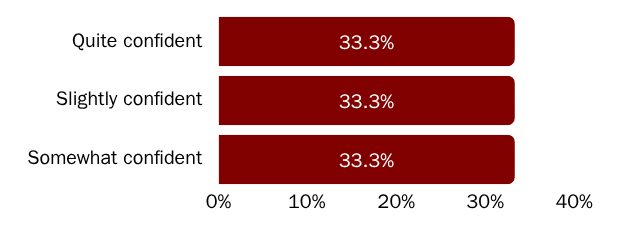
A further 33% are somewhat confident, which places them in a more cautious middle ground where research may be useful, while still leaving room for missed signals. The final 33% are slightly confident, indicating that some organizations see a real gap between the research they run and the blind spots they need to uncover.
A recent conference paper on self-awareness and bias blind spots in business decision-making made the point that bias can influence how leaders perceive information, evaluate risks, and choose between options. This is relevant because research can look thorough while still being guided by the assumptions behind it.
When teams ask familiar questions, consult familiar sources, or validate familiar priorities, they may keep surfacing known issues rather than true blind spots. Stronger research processes need to challenge the thinking behind the method, not just gather more data.
Sedulo Commentary: The fact that only 33% are quite confident in their research methods points to something more structural than a gap in tools or effort. When research is designed around familiar questions and established sources, it tends to confirm what teams already suspect rather than revealing what they are missing. For Sedulo, this is a core challenge in how competitive intelligence is approached: the methodology itself needs to be pressure-tested, not just the findings. The organizations that close blind spots most effectively are those that build research processes designed to challenge their own assumptions, bringing in external perspective, primary insight, and structured competitive analysis to find what internal methods are not designed to catch.
How mature is blind spot identification and response in leaders’ organizations?
46% of insights, strategy, or marketing leaders’ organizations are building an approach to blind spots.
Most teams are building the muscle, while some are already setting the pace:
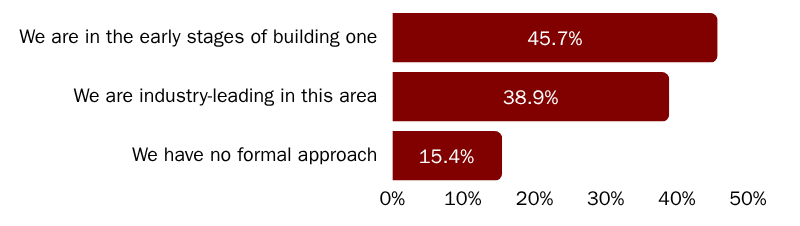
Maturity around approaches to identifying and tackling business blind spots is developing, but it is far from evenly established. For 46% of strategy, insight, and marketing leaders, their organization is in the early stages of building one. This indicates that many teams recognize the need for a more deliberate approach, even if the process is still forming.
A further 39% are industry-leading in this area, indicating a strong advanced segment where blind-spot identification is likely treated as an ongoing discipline. The remaining 15% have no formal approach, leaving them more reliant on instinct, informal feedback, or problems becoming visible after the fact.
Blind Spots Not Limited to Businesses
Recent global research has shown that consumers have blind spots, too. In Constant Contact’s Small Business Now report, people expressed strong emotional support for small businesses, but still underestimated their scale and economic importance. This gives the idea of blind spots a useful reversal. They can sit in the way consumers understand the businesses around them, as well as inside the organizations, trying to identify their own hidden risks.
Sedulo Commentary: The 46% still building their approach and the 15% with no formal process at all represent a significant portion of organizations that are either reacting to blind spots after the fact or relying on instinct to surface them. For Sedulo, maturity in this area is not just about having a process in place, it is about whether that process runs consistently enough to catch shifts before they become costly. The 39% described as industry-leading are likely organizations that have moved beyond periodic reviews and built blind spot identification into how they plan, monitor, and respond as a matter of routine. That is the standard worth working toward, and competitive intelligence is one of the clearest ways to accelerate that progression by creating a structured, repeatable way to surface what internal reporting alone tends to miss.
How do insights and marketing leaders’ organizations typically discover the effect of business blind spots?
Significant damage is done before 100% of insights, strategy, or marketing leaders discover blind spots.
By the time blind spots are discovered, the response can already be too little, too late.
All the strategy, insight, and marketing leaders in our audience agree that they rarely discover business blind spots until significant damage is done, making timing the central issue. Blind spots are not being caught while they are still small, quiet, or easy to correct. They are usually identified once the consequences have already become visible enough to force attention.
Industry commentary on the cost of ethical blind spots shows how one type of late-discovered blind spot can escalate. In those cases, unseen gaps in judgment, culture, or compliance can lead to reputational damage, lost trust, fines, legal exposure, and internal disruption. Broader business blind spots carry a similar risk.
Once a hidden issue reaches customers, employees, investors, or the public, the cost is no longer limited to fixing the original mistake. It can also damage confidence in the organization itself.
Sedulo Commentary: Discovering a blind spot only after significant damage has occurred is not a research failure, it is a structural one. It means the organization had no mechanism in place to surface the issue while it was still manageable. For Sedulo, this is one of the strongest arguments for building a proactive competitive intelligence function rather than relying on performance data to signal when something has gone wrong. By the time a blind spot shows up in revenue, customer churn, or market share, the cost of correction is almost always higher than the cost of earlier detection would have been. The organizations that catch blind spots before they compound are typically those running consistent external monitoring, structured competitor analysis, and regular market reviews that are designed to ask the questions internal teams are not routinely asking themselves.
What prevents insights and marketing teams from uncovering business blind spots?
Budget and resource constraints prevent 100% of insights, strategy, or marketing leaders from uncovering blind spots.
Hidden risks need visible investment.
Budget and resource constraints are the major barrier to uncovering business blind spots, with 100% of strategy, insight, and marketing leaders citing them as the biggest obstacle. This makes the challenge highly practical. Teams may understand the importance of looking for hidden risks, weak signals, missed assumptions, or emerging customer issues, but that work needs time, tools, people, and senior support.
The resource issue also affects the quality of the work. When blind spot discovery is handled in spare time, teams may default to the easiest signals to access rather than the most important ones to investigate. This can leave deeper customer, market, operational, or competitive gaps untouched. When blind spot detection has to compete with everyday campaign demands or short-term reporting, it can easily be pushed aside. Organizations may know they need to look deeper, while still lacking the resources required to do it properly.
Sedulo Commentary: Budget and resource constraints are a real barrier, but they can also become a reason to delay work that carries genuine strategic risk. When blind spot detection has to compete with day-to-day priorities, it rarely wins, and the cost of that trade-off tends to be invisible until it isn’t. For Sedulo, this is where outside support often creates the most immediate value. Rather than asking stretched internal teams to add another layer of analysis to their existing workload, bringing in an external partner with dedicated research capability means blind spot detection gets the attention and rigor it requires without displacing other priorities. The investment is almost always smaller than the cost of what gets missed without it.
Which data sources are most important for identifying business blind spots?
100% of insights, strategy, or marketing leaders use internal sales and CRM data for business blind spots.
Revenue offers up the clearest clues.
Internal sales and CRM data are the clear go-to source for addressing business blind spots. All of our audience agrees, likely because CRM and sales data sit close to revenue reality. They can show where deals stall, which objections keep coming up, where prospects drop off, and which customer segments are converting.
Research referenced by Harvard Business School found that data-driven organizations are three times more likely to report significant improvements in decision-making, with 56% reporting faster and more effective choices. For blind spot detection, that makes CRM data a logical starting point, especially when teams need evidence tied directly to buyer behavior and commercial outcomes.
Sedulo Commentary: Internal sales and CRM data is a logical starting point, but it only shows what is already happening inside the business. It can tell you where deals are stalling or where customers are churning, but it cannot tell you why a competitor is gaining ground, how buyer expectations are shifting, or what market signals are forming outside your current customer base. For Sedulo, the organizations that get the most from their blind spot detection are those that pair internal data with structured external research, including competitor analysis, primary buyer interviews, and market monitoring. CRM data tells you what has already happened. External intelligence helps you understand what is coming before it shows up in your numbers.
When do insights and marketing leaders’ organizations run competitive intelligence reviews to detect blind spots?
Informal awareness is used by 87% of insights, strategy, or marketing leaders to detect blind spots.
Market awareness is largely running on instinct:
Formal competitive intelligence reviews appear to be the exception rather than the norm. 87% of strategy, insight, and marketing leaders’ organizations never conduct formal competitive intelligence reviews to identify business blind spots, and instead rely on informal awareness. This leaves competitor knowledge dependent on scattered signals, individual experience, sales conversations, or leadership attention. It may still produce useful observations, but it is harder to repeat, track, or turn into action.
The risk is that informal awareness can feel sufficient because someone in the business usually knows something about competitors. The problem is consistency. Without a formal review rhythm, important changes can depend on who noticed them, who shared them, and whether anyone acted.
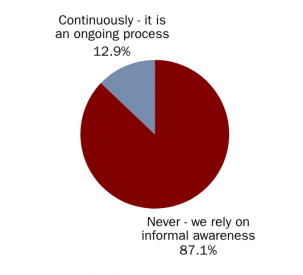
Only 13% conduct reviews continuously, as an ongoing process, giving them a more disciplined way to spot shifts in positioning, pricing, messaging, customer expectations, and emerging threats. The commercial case for that discipline is clear, with 61% of businesses saying competitive intelligence drives revenue growth. When competitive review stays informal, blind spots can sit in the market long before they appear in performance data.
Sedulo Commentary: Informal awareness is not the same as competitive intelligence. Knowing something about a competitor because a sales rep mentioned it in a meeting or a leader happened to read an article is useful context, but it is not a reliable system for detecting blind spots. For Sedulo, the difference between the 13% running continuous reviews and the 87% relying on informal awareness is not just process maturity, it is commercial exposure. Markets shift, competitors reposition, and buyer expectations evolve on a schedule that does not wait for someone to notice. Organizations that treat competitive intelligence as a structured, ongoing discipline rather than a background awareness exercise are consistently better positioned to catch those shifts early, before they create gaps that are expensive to close.
How often do insights and marketing leaders audit marketing messaging for business blind spots?
100% of insights, strategy, or marketing leaders do regular audits, but not for blind spots.
The wording gets checked, while the positioning may go untested.
Marketing messaging is being reviewed, but the deeper positioning questions may be getting missed. 100% of our audience says their organizations conduct occasional audits, but not with blind spots in mind. This means teams may be checking whether messaging is clear, consistent, on-brand, or campaign-ready, while leaving bigger assumptions untouched.
Industry guidance on marketing messaging gives that finding useful context. It describes the marketing message as the bridge between marketing strategy and the content a business creates. It also stresses the need to speak to audience pain points and explain why customers should choose the business over a competitor. For blind spot detection, that is the key issue. A message can sound polished while still missing a shift in buyer needs, market expectations, or competitive differentiation.
Sedulo Commentary: Auditing messaging for clarity and consistency is worthwhile, but it leaves the harder question unasked: does the positioning still reflect how buyers are making decisions today? Markets move, competitor messaging evolves, and customer priorities shift in ways that a brand-consistency review will not catch. For Sedulo, a messaging audit without a competitive and buyer lens is only half the work. The organizations most at risk are those whose messaging sounds polished internally but has quietly drifted from what the market actually responds to. Bringing structured competitive and buyer insight into the audit process is what closes that gap, helping teams validate not just whether the message is clear, but whether it is still the right message to be sending.
How effectively is social listening used to surface blind spots in brand perception?
100% of insights, strategy, or marketing leaders don’t use social listening for brand perception blind spots
Public conversations are going unheard.
Social listening appears to be a major missed opportunity for surfacing brand perception blind spots. 100% of strategy, insight, and marketing leaders’ organizations do not use social listening at all. This leaves teams without a direct view of the public conversations that may reveal confusion, frustration, shifting sentiment, competitor comparisons, or unmet needs.
A Valuable Missed Opportunity
The wider market shows how valuable this capability is becoming. The social media listening market was valued at $8.36 billion in 2023 and is expected to reach $27.63 billion by 2032. This scale of growth points to rising demand for tools that help businesses understand what people are saying outside owned channels.
This matters because owned-channel feedback typically comes from people who are already engaging with the brand directly. Social listening can pick up the looser conversations happening around the brand, including confusion, comparisons, complaints, and emerging expectations that may never arrive through formal feedback routes. For organizations overlooking social listening, brand perception blind spots may be hiding in plain sight.
Sedulo Commentary: Not using social listening at all means brand perception is being shaped entirely by channels the organization controls and audiences already engaged with it. That leaves a significant blind spot in plain sight. The conversations that reveal the most about how a brand is actually perceived, how it is being compared to competitors, and where expectations are going unmet, tend to happen outside owned channels where candid, unfiltered opinions are expressed freely. For Sedulo, social listening is not a replacement for structured research, but it is a valuable early warning layer that can surface shifts in sentiment, emerging competitor narratives, and unmet customer needs before they reach a scale that forces a response. Organizations not using it are making brand decisions without access to some of the most honest data available to them.
How do insights and marketing leaders assess supplier and partner risk as business blind spots?
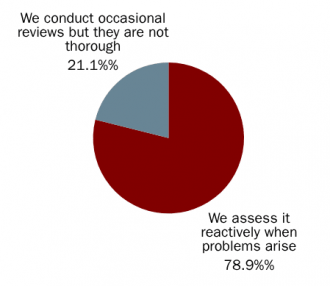
Supplier and partner risk blind spots are assessed by 79% insights, strategy, or marketing leaders when problems arise.
The review process is lagging behind the risk:
Supplier and partner blind spots can be expensive. Global consulting firm J.S. Held has stated that supply chain disruptions cost businesses an estimated $184 billion annually as of 2025, showing how quickly hidden vulnerabilities across the supply chain can move from background risk to financial damage. Given the scale of potential loss, it’s notable that supplier and partner risk still appears to receive less proactive attention than the stakes would warrant.
A whopping 79% of strategy, insight, and marketing leaders’ organizations assess supplier and partner risk reactively when problems arise, meaning the review process may only begin once a disruption, quality issue, delivery failure, compliance concern, or reputational problem is already visible.
The remaining 21% conduct occasional reviews, but they are not thorough, which is a step beyond waiting for problems to surface, but still leaves important gaps. Occasional, light-touch reviews may identify obvious supplier issues while missing deeper dependencies, concentration risk, contract weaknesses, or partner-side vulnerabilities that only appear under pressure.
Sedulo Commentary: Assessing supplier and partner risk only when problems arise is the organizational equivalent of checking the brakes after the accident. With supply chain disruptions costing businesses an estimated $184 billion annually, the stakes of a reactive approach are well documented. For Sedulo, supplier and partner risk belongs in the same proactive intelligence framework as competitor monitoring and market analysis. Dependencies, concentration risk, and partner vulnerabilities rarely appear suddenly. They build quietly over time and become visible under pressure. Organizations that build regular, structured reviews of their partner ecosystem are better positioned to identify those risks while options still exist, rather than managing the fallout once they have already materialized.
How do insights and marketing leaders’ organizations evaluate economic shifts and their blind spots?
Economic shift analysis is integrated into 50% of insights, strategy, or marketing leaders’ blind spot strategies.
Changing market signals can expose what stronger conditions conceal:
Assessing the impact of economic shifts on business blind spots can turn hidden dependencies into visible pressure points. Recessionary pressures such as falling sales, tighter credit, slower payments, reduced investment, and high fixed costs can expose vulnerabilities that were easier to miss in stronger conditions.
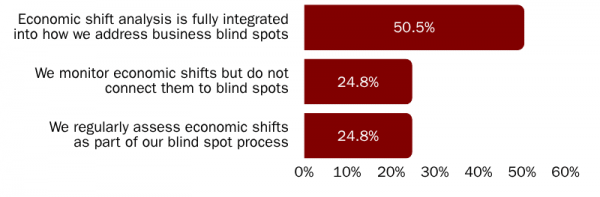
Against that backdrop, 50% of strategy, insight, and marketing leaders in our audience say economic shift analysis is fully integrated into how they address business blind spots. This is the strongest position because it allows economic signals to influence decisions before pressure shows up in performance data. These organizations are better placed to question pricing, demand forecasts, customer behavior, cash flow assumptions, and market positioning as conditions change.
Another 25% regularly assess economic shifts as part of their blind spot process, which gives them a useful review rhythm, although the analysis may still sit in scheduled checkpoints rather than everyday decision-making. The remaining 25% monitor economic shifts but do not connect them to blind spots, creating the clearest gap. These organizations may see the macro signals, but miss their operational meaning. In practice, they could notice slower demand or tighter budgets without connecting those changes to weaknesses in messaging, pipeline quality, product fit, or customer retention.
Sedulo Commentary: The 25% who monitor economic shifts but do not connect them to blind spots represent a particularly avoidable risk. Seeing the signal but not acting on its implications is not the same as missing it entirely, but the commercial outcome can be similar. For Sedulo, economic shift analysis is most valuable when it is wired directly into how organizations review their positioning, pricing, customer behavior assumptions, and demand forecasts rather than sitting as a separate macro-awareness exercise. The organizations with full integration are not just better informed, they are structurally faster to respond because the connection between external conditions and internal strategy is already built into how they work. For those still monitoring without connecting, the priority is closing that gap before the next shift makes the cost of disconnection visible.
How often do business blind spots lead to missed revenue opportunities?
Business blind spots often lead to missed revenue for 66% of insights, strategy, or marketing leaders.
The commercial cost ranges from occasional to systematic:
Business blind spots leading to missed revenue are a clear concern, but the bigger issue is whether those losses are occasional events or signs of a more embedded commercial problem. For 33% of strategy, insight, and marketing leaders, this happens very often, and they see it as a major ongoing issue. For this group, missed revenue is likely tied to a persistent weakness, such as unclear buyer needs, slow market response, weak segmentation, or positioning that fails to convert demand into opportunity.
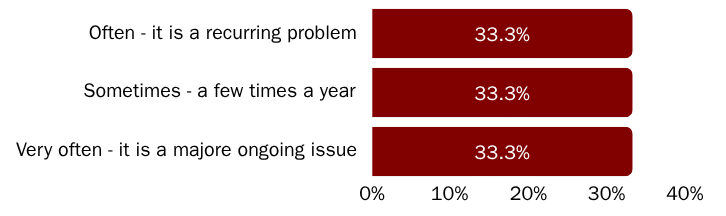
Another 33% admit that business blind spots often lead to missed revenue and describe it as a recurring problem. This is still a serious pattern, even if it may appear less constant. Recurring revenue leakage can become normalized when teams treat lost opportunities as isolated campaign, sales, or timing issues rather than signs of a deeper blind spot.
The remaining 33% say business blind spots sometimes lead to missed revenue opportunities, happening a few times a year. This may sound less severe, but occasional missed revenue still matters, especially when those moments reveal repeated friction around product fit, audience targeting, messaging, or customer timing.
Sedulo Commentary: The most telling detail in this data is not the 33% experiencing missed revenue very often, it is the normalization risk sitting underneath all three groups. When missed revenue becomes recurring or predictable, teams can begin to treat it as an acceptable outcome rather than a signal of something deeper that needs addressing. For Sedulo, recurring revenue leakage tied to blind spots is almost always a symptom of a structural gap in how the organization monitors its market, understands its buyers, or tracks competitor activity. The fix is rarely a campaign adjustment or a messaging refresh. It requires looking at what the organization has stopped questioning and building the intelligence discipline to surface those gaps before they show up as lost opportunity in the numbers.
How aligned are insights and marketing teams on addressing business blind spots?
73% of insights, strategy, or marketing leaders’ teams align on addressing blind spots.
Priority is forming in pockets, but action needs wider follow-through:
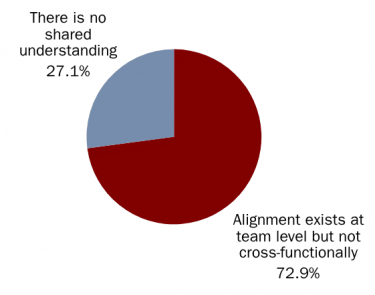
The priority of addressing business blind spots is understood inside insight and marketing teams, but it has not fully become a shared cross-functional commitment. For 73% of strategy, insight, and marketing leaders, alignment exists at team level but not cross-functionally. This means insight and marketing teams may agree that blind spot detection matters, while still struggling to turn that priority into joined-up action across the wider business. Since business blind spots can touch positioning, customer needs, sales performance, product fit, and operational risk, team-level alignment may only take the work so far.
The remaining 27% say there is no shared understanding, which points to a deeper disconnect. In those organizations, teams may still be working from different definitions of what blind spots are, why they matter, or who should own the next step.
Misalignment Slows Follow-Through
In both cases, the practical impact is slower follow-through. Where alignment exists only at team level, blind spots may be recognized, but struggle to gain wider support. Where there’s no shared understanding at all, teams may struggle to agree on the problem before they can act on the solution.
For insight and marketing teams, that weakens the link between what they uncover and what the business actually does next.
Sedulo Commentary: Team-level alignment is a starting point, not a finish line. When blind spot detection stays contained within insight and marketing functions, the findings rarely gain the cross-functional traction needed to drive meaningful change. For Sedulo, this is one of the more common friction points we see in practice. The work to identify a blind spot can be rigorous and well-reasoned, but if it cannot travel across the organization and land with the teams who need to act on it, the value stays trapped. Building cross-functional alignment around blind spot identification requires more than sharing a report. It requires a shared language for what blind spots are, who owns the response, and how findings connect to decisions that matter to each part of the business. External intelligence partners can play a useful role here, bringing findings in a format and framing that is designed to move across functions rather than stay within one.
How do insights and marketing leaders use AI to detect and address business blind spots?
AI is central to how 63% of insights, strategy, or marketing leaders find and address business blind spots.
AI is widening the field of view:
AI is already playing a central role in blind spot detection for many organizations, and it’s central to how 63% of strategy, insight, and marketing leaders identify and address business blind spots. This is the strongest maturity signal in the data because AI appears to be part of the core process, not just a supporting tool.
AI’s role in business operations is increasingly linked to pattern recognition, anomaly detection, predictive insights, and real-time decision support. For blind spot detection, that matters most when AI connects signals that may sit separately across research, customer behavior, market activity, competitive movement, and operational risk. The difference is especially important for business blind spots because the issue is rarely a lack of data alone. The harder problem is seeing how one signal changes the meaning of another. AI can help when it is used to connect those relationships, rather than simply summarize what each source already says.
The 33% using AI in a limited and experimental way are still building that capability. Experimentation can prove use cases, but it may leave blind spot detection fragmented if AI is only applied to isolated tasks. The remaining 4% have AI integrated into parts of their research and insights process, which is more structured than experimentation, but still partial. It may improve specific workflows while leaving wider blind spot detection dependent on whether insights are connected across the business.
Sedulo Commentary: AI can meaningfully accelerate blind spot detection, particularly when it is used to connect signals across data sources that would otherwise sit in separate research streams. But the 63% using it as a core part of their process should not be mistaken for a solved problem. The risk with AI-driven blind spot detection is that it can scale the speed of analysis without improving the quality of the questions being asked. For Sedulo, AI is most valuable in competitive intelligence when it is paired with experienced human analysis that can interpret what the signals mean, challenge the assumptions behind them, and translate findings into clear strategic implications. Organizations in the experimental 33% are right to test and build that capability, but the goal should be integration that improves decision-making, not just tools that produce faster summaries of information that may already be missing the most important blind spots.
Where are insights and marketing leaders’ organizations primarily based?
98% of strategy, insight, and marketing leaders’ organizations are in NYC.
New York puts the blind spot discussion close to visible business pressure:
New York City dominates the geographic picture, with 98% of strategy, insight, and marketing leaders in our audience primarily based there. This concentration matters because local business pressure can make blind spots more consequential. The New York Times recently reported that roughly 8,400 businesses closed in New York City in the second quarter of 2025, pointing to a market where commercial strain is highly visible.
This does not mean those closures were caused by blind spots, but it does show the kind of environment these leaders are close to. When conditions are under pressure, missed shifts in costs, demand, customer behavior, foot traffic, competition, or confidence can move quickly from hidden issue to business threat.
San Francisco accounts for 1%, but it still brings in a market associated with technology, venture-backed growth, and product-led businesses, where blind spots can form around innovation cycles, buyer adoption, and shifting investment priorities. Los Angeles also accounts for 1%, adding a consumer, media, entertainment, and brand-led angle where perception, audience behavior, and cultural timing can create different kinds of blind spots. Chicago’s absence is also notable, given its place as a major Midwest business center with strengths in logistics, manufacturing, finance, and B2B services.
Building a more proactive approach to business blind spots
This analysis of opinions from insights, strategy, and marketing leaders gives a clear view of where business blind spots are gaining attention and where the response still needs work.
Organizations are beginning to recognize hidden risks, but many still uncover them too late, fund them too lightly, or leave them trapped within individual teams. This is where stronger use of competitive intelligence can create an advantage, helping teams spot emerging risks earlier by tracking market shifts, competitor behavior, and category changes before they fully materialize internally.
From there, organizations can build a more deliberate rhythm for identifying blind spots before they turn into commercial, operational, or reputational problems.
Sedulo Commentary: The concentration in New York City reflects where much of this research is anchored, but the blind spot challenge it describes is not geography-specific. Organizations in any high-pressure market face the same core risk: conditions that were stable can shift quickly, and the gaps that form during periods of growth or stability tend to become most visible when pressure increases. For Sedulo, what matters is less where an organization is based and more whether it has the intelligence infrastructure in place to detect those shifts early regardless of market conditions. The business closures referenced in New York are a useful reminder that commercial strain can move faster than internal reporting catches it, which is precisely the environment where proactive competitive intelligence creates its clearest return.
About the data
Sourced using Artios from an independent sample of 192,495 opinions of Insights Strategy or Marketing leaders in the USA across X, Quora, Reddit, Bluesky, TikTok, and Threads. Responses are collected within a 95% confidence interval and 5% margin of error. Results are derived from what people describe online, from opinions expressed online, not actual questions answered by people in the sample.