

TURN COMPETITIVE SIGNALS INTO STRATEGIC ADVANTAGE
A Modern Framework for Competitor & Market Monitoring in Life Sciences
Life sciences teams are overwhelmed by growing volumes of competitive data, but turning signals into clear, actionable insight remains a challenge. As pipelines become more crowded, AI-driven tools help collect information but often add noise rather than clarity.
This white paper introduces a modern early warning model that cuts through the noise, showing how to identify, validate, and translate signals into strategic decisions. Combining expert perspectives with research from leading sources, it outlines a practical approach to balancing technology with human insight to deliver truly decision-ready intelligence. In this white paper, you will learn how to:
Learn how pharma and biotech teams use early warning monitoring to detect competitor moves, validate market signals, and make faster strategic decisions.
Shift from reactive monitoring to anticipating competitor moves.
Cut through data overload and focus on what truly matters.
Build a complete view across scientific, commercial, and market signals.

Turn intelligence into clear, decision-ready strategic implications.

Learn what best-in-class CI teams do differently.
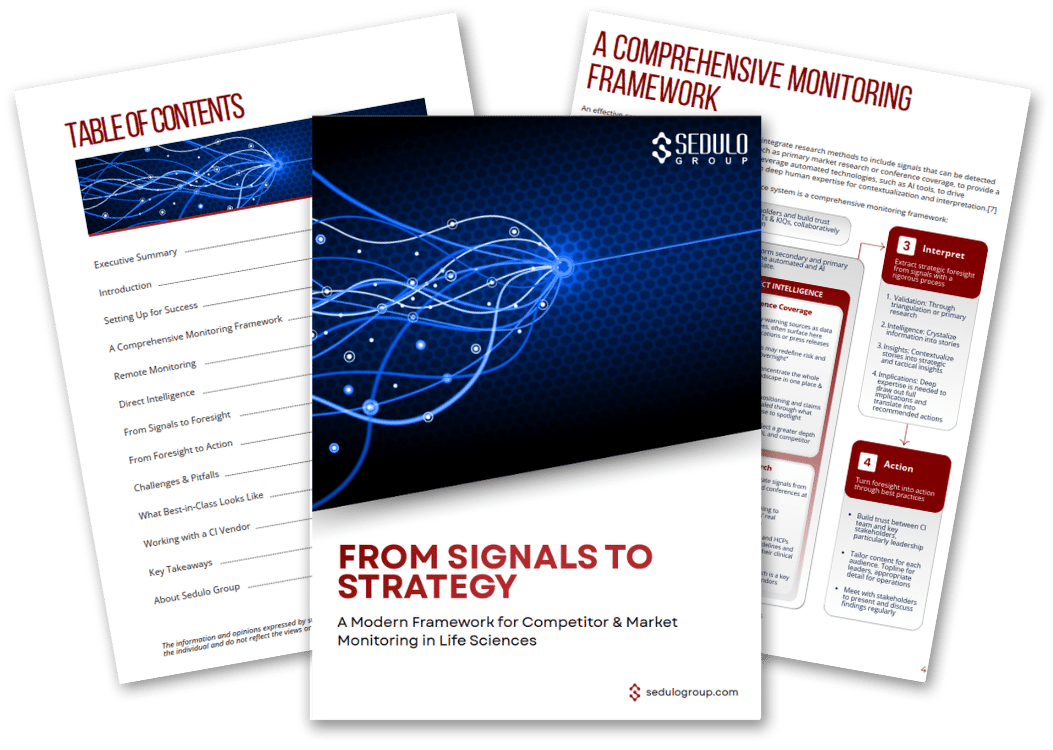
Drawing on 200+ years of combined CI experience and exclusive interviews with senior leaders from top pharmaceutical and biotechnology companies, this white paper provides actionable frameworks and proven best practices for early warning monitoring.
Explore how life sciences organizations can move beyond reactive monitoring to build a more proactive, decision-ready early warning capability.
Competitive intensity is rising as more assets target the same indications
Early warning monitoring enables a shift from reactive tracking to strategic foresight.
Signals alone are not enough; they must be validated and translated into actionable insights.
The most effective programs integrate multiple signal types with primary research and expert interpretation.
Human expertise remains critical to separating meaningful insights from noise.
The true impact of CI is measured by the decisions it influences, not the volume of data collected.
Download the white paper to learn how to design a modern competitive intelligence function that delivers foresight, not just information.
It’s a structured approach to identifying, validating, and interpreting signals across scientific, commercial, and market domains to anticipate competitor moves and inform strategic decisions.
With increasing competition and a surge in data, organizations risk being overwhelmed by noise. A well-designed monitoring system enables proactive decision-making and reduces the risk of being caught off guard by competitor developments.
Effective programs integrate multiple signal types, including scientific, commercial, regulatory, corporate, and market/landscape signals, alongside primary research and conference insights.
Signals must be validated, combined into coherent intelligence, and then translated into insights and strategic implications through expert interpretation and stakeholder discussion.
AI can improve efficiency in data collection and analysis, but it often amplifies noise. Human expertise is essential to validate information, provide context, and ensure insights are decision-ready.
Common challenges include data overload, over-reliance on automation, lack of clear priorities, and failure to translate insights into action, leading to reactive rather than strategic decision-making.
Leading organizations focus on forward-looking insights, align monitoring with strategic decisions, integrate CI into business processes, and measure success by the impact on decisions, not the volume of outputs.
External partners are often most valuable when they act as strategic thought partners, bringing deep expertise, primary research capabilities, and the ability to translate signals into actionable recommendations.