

Consumer products companies operate in a market where shopper behavior, pricing pressures, product claims, retail channels, and category boundaries are constantly shifting. Market intelligence provides teams with a clearer view of these changes, helping them to understand where demand is moving, how competitors are positioning, and which opportunities deserve closer attention.
To find out what 59,633 opinions of insights strategy or marketing leaders in the consumer products industry in the US were about market intelligence, Sedulo Group partnered with Artios to utilize AI-driven audience profiling to synthesize insights from online discussions over 12 months, ending on June 10th, 2026, to a high statistical confidence level. The findings show how these leaders think about MI, how it supports decision-making, and where it is becoming more important across consumer products businesses.
Index
- The annual revenue of 84% of insights, strategy, and marketing leaders in the consumer products industry’s organizations is between $1 billion and $5 billion, 6% is over $5 billion, another 6% between $500 million and $1 billion, while 2% are making between $100 million and $500 million, and 2% are making under $100 million
- While 21% of insights, strategy, and marketing leaders in the consumer products industry MI is owned by strategy or corporate development, and another 21% shared across multiple functions, marketing clearly owns 13% or has some involvement for 11%, but 34% say there is no clear owner, and it’s somewhat fragmented
- For 38% of insights, strategy, and marketing leaders in the consumer products industry, their MI maturity is best in class as it guides enterprise-wide decision making; however, for 38%, it’s ad hoc, and for 12%, it’s still developing, while 10% feel their maturity is advanced, and just 2% agree it’s established
- 61% of insights, strategy, and marketing leaders in the consumer products industry’s organizations conduct quarterly formal market intelligence activities, and 39% do so continuously and are always-on
- Social listening and digital analytics are often used by 51% of insights, strategy, and marketing leaders in the consumer products industry for MI, 35% often use syndicated data, and 10%’s teams sometimes use primary qualitative research
- 38% of insights, strategy, and marketing leaders in the consumer products industry have buyer personas development that is detailed, and have research-validated personas in active use; another 38% are currently building their persona framework, and 24% rely on assumptions, not formal persona research
- 85% of insights, strategy, and marketing leaders in the consumer products industry’s teams can deliver key market intelligence reports within days in real-time, or as near to as possible, but 15% take more than two months to create these reports
- Consumer trend reports are the market intelligence that drives the most value in the consumer products industry for 99% of insights, strategy, and marketing leaders, while competitive benchmarking is the most valuable driver for the remaining 1%
- For 21% of insights, strategy, and marketing leaders in the consumer products industry, market intelligence significantly influences key decisions, 21% rely on it moderately, and 25% find it has minimal influence, while 34% have not formally integrated it into their organization’s strategy
- 38% of insights, strategy, and marketing leaders in the consumer products industry have an annual market intelligence budget of between $1 million and $3 million, 13% budget between $500k and $1 million, and 49% are either unsure or do not disclose their budget
- Currently, 45% of insights, strategy, and marketing leaders in the consumer products industry are using generative AI for MI research summarization, 37% are using it for predictive analytics and demand forecasting, and 16% for AI-assisted survey design or analysis; conversely, 1% are exploring but not yet using AI in MI, and 1% don’t currently use AI in MI whatsoever
- 58% of insights, strategy, and marketing leaders in the consumer products industry are not very confident about AI-generated MI output as they have accuracy concerns, 20% are neutral on the topic as it’s too early to assess, 20% are somewhat confident but agree that while AI is useful, it needs human oversight, and 2% are not at all confident in its output
- For 92% of insights, strategy, and marketing leaders in the consumer products industry, the biggest AI adoption barrier for market intelligence is that there’s no clear use case identified yet, while for 6%, data and privacy concerns are a hindrance, and for 2%, a lack of trust in AI-generated insights is the largest hurdle
- Access to reliable, real-time consumer data is the biggest market intelligence challenge for 95% of insights, strategy, and marketing leaders in the consumer products industry, but for 5%, data fragmentation across teams or systems is the largest stumbling block
- 57% of insights, strategy, and marketing leaders in the consumer products industry’s MI priorities are most impacted by private label or store brand growth, 39% are impacted by economic pressures on consumer spending, and 4% by regulatory changes
- Emerging trend identification is the top MI priority for 67% of insights, strategy, and marketing leaders in the consumer products industry in the next 12 months, 16% are prioritizing white space or innovation opportunity analysis, and 6% consumer behavior and demand shifts, while 5% are putting voice of customer research at the top of their list, 4% competitive landscape mapping, and 3% are prioritizing channel and partner assessment
- 9% of insights, strategy, and marketing leaders in the consumer products industry work in food and beverage, 5% in health and wellness, 2% in pet products, and 2% in apparel and footwear, while the remaining 82% work in other non-disclosed business types
- While 5% of insights, strategy, and marketing leaders in the consumer products industry fill the role of Chief Insights Officer or VP of insights, the remaining 95% fulfil other roles in the same sector
- Faster, smarter insights are driving competitive advantage
- About the data
What are the annual revenues of marketing leaders’ consumer products organizations?
The annual revenue of 84% of insights, strategy, and marketing leaders in the consumer products industry’s organizations is between $1 billion and $5 billion, 6% is over $5 billion, another 6% between $500 million and $1 billion, while 2% are making between $100 million and $500 million, and 2% are making under $100 million
Enterprise-level companies are driving the market intelligence conversation:
Most insights and marketing leaders in our audience work for consumer products organizations with serious scale. 84% work for companies with annual revenue of between $1 billion and $5 billion, while a further 6% work for organizations with annual revenue above $5 billion.

This level of revenue creates a clear need for market intelligence. Larger consumer products companies usually have to manage several brands, product categories, retail relationships, pricing pressures, and consumer segments at once. Decisions are also higher stakes. A shift in demand, a new competitor, a change in shopper behavior, or a weak read on the market can affect growth across a much wider business.
These revenue figures stand out when compared with the wider market. Only 0.1% of U.S. consumer goods companies generate yearly revenue of $1 billion or more, while the most common revenue bracket is $100,001 to $499,999, at 40.3%.
Another 6% of leaders in our audience work for organizations with annual revenue of between $500 million and $1 billion. These are still sizable companies, likely with established brands, distribution networks, and competitive pressure. The smallest groups, at 2% for $100 million to $500 million and 2% for under $100 million, may have leaner teams and budgets, but they still need market intelligence to understand demand, track competitors, and decide where to focus resources.
Sedulo Commentary: The revenue profile of this audience reflects the scale at which market intelligence decisions carry the most weight. When organizations are managing multiple brands, categories, retail relationships, and consumer segments simultaneously, gaps in market understanding do not stay contained. They move across pricing decisions, campaign performance, product positioning, and growth strategy at the same time. For Sedulo, this is the environment where market intelligence creates its clearest return: not as a reporting layer, but as an active input into how decisions are shaped. Organizations operating at this scale cannot afford to act on assumptions or outdated signals. The intelligence behind those decisions needs to be structured, current, and tied directly to the commercial choices that matter most.
Who owns market intelligence in insights and marketing leaders’ consumer products organizations?
While 21% of insights, strategy, and marketing leaders in the consumer products industry MI is owned by strategy or corporate development, and another 21% shared across multiple functions, marketing clearly owns 13% or has some involvement for 11%, but 34% say there is no clear owner, and it’s somewhat fragmented.
Ownership is somewhat scattered:
Market intelligence ownership in consumer products organizations is spread across several parts of the business, rather than sitting with one clear function. The biggest single group points to fragmentation, with 34% of insights and marketing leaders stating there is no clear owner in their organization and that they are not responsible.
This creates a practical problem because market intelligence feeds decisions across product, pricing, brand, channel, and commercial strategy. When ownership is unclear, insight may be available, but turning it into coordinated action becomes harder.
Market intelligence is moving beyond a single department

Marketing still has an important role. 13% say marketing is clearly responsible, while another 11% say it has some involvement. This fits with the function’s closeness to brand positioning, customer behavior, campaign performance, and competitive messaging. Even when marketing does not own market intelligence outright, it relies on the output to make stronger decisions.
Clear responsibility across multiple functions sits at 21%. This suggests market intelligence is being treated as a shared business resource, with input needed from teams such as marketing, strategy, product, sales, and commercial leadership.
Market intelligence is clearly the responsibility of strategy or corporate development for 21%. This places it close to higher-level decisions around growth, category moves, investment priorities, and long-term competitive direction.
Sedulo Commentary: The fragmentation visible in this data is one of the more practical barriers to market intelligence delivering consistent value. When 34% of organizations have no clear owner, insight can still be gathered and shared, but the decisions it should be informing often move forward without it. Ownership gaps also tend to compound over time. Without a clear home for market intelligence, there is no single function accountable for the quality, timing, or application of the work, which makes it harder to build a program that improves and scales. For Sedulo, the question of ownership is inseparable from the question of impact. Market intelligence that sits with strategy and corporate development tends to shape longer-term direction. When marketing holds it, it tends to influence positioning, messaging, and campaign decisions. The strongest programs we see are those where ownership is defined clearly enough to create accountability, while still being designed to serve decisions across product, commercial, brand, and leadership teams. The 34% with no clear owner represent an immediate opportunity to change how intelligence reaches the people who need it most.
How mature is the market intelligence (MI) function for insights and marketing leaders in the consumer products industry?
For 38% of insights, strategy, and marketing leaders in the consumer products industry, their MI maturity is best in class as it guides enterprise-wide decision making; however, for 38%, it’s ad hoc, and for 12%, it’s still developing, while 10% feel their maturity is advanced, and just 2% agree it’s established.
MI maturity is polarized between quick fixes and strategic impact:

Market intelligence maturity ranges from being reactive to deeply embedded. 38% of insights and marketing leaders’ MI function is ad hoc, with intel pulled reactively when needed. This suggests market intelligence is still being used to answer immediate questions in many organizations, rather than guide decisions before pressure builds.
At the other end, another 38%’s MI function is best-in-class and drives enterprise-wide decision-making. This is the strongest maturity signal in the data. These organizations are using MI as part of how the business thinks, plans, and competes.
This split becomes more important against the wider market backdrop. The consumer insights and market intelligence services market is projected to grow from $47 billion in 2025 to $75 billion by 2035, at a 4.75% CAGR. As investment in the category grows, the gap between reactive MI and enterprise-wide MI becomes harder to ignore.
The middle ground reveals uneven market intelligence development
The remaining figures show how uneven the middle of the maturity curve is. For 12%, their MI function is developing, with some processes in place but inconsistently applied. This is a transitional stage, where the value of MI is recognized, but the operating model is not yet reliable enough across teams or decisions.
Another 10%’s MI is advanced and deeply integrated into strategic planning. Here, insight is connected to longer-term planning rather than being limited to short-term questions. Only 2% have an established, structured MI program with dedicated resources. This is the interesting outlier. It implies that MI can have strategic influence before it has a fully formalized home, budget, or team structure.
Sedulo Commentary: The split between 38% best-in-class and 38% ad hoc is one of the more telling findings in this data. It shows a market where MI maturity is not gradually developing across the board, it is polarizing. Some organizations have made market intelligence a core part of how the business thinks and plans, while others are still pulling insight reactively when a specific question demands it. The ad hoc group carries a real commercial risk that is easy to underestimate. Reactive MI tends to answer the question in front of the team rather than surfacing the signals the business has not thought to ask about yet. It also means intelligence arrives after direction has already started to form, which limits how much it can actually change the outcome. For Sedulo, maturity is not defined by the sophistication of the tools in use or the size of the team running the program. It is defined by whether market intelligence has a consistent place in how decisions are made. The 12% still developing and the 38% operating ad hoc represent a significant portion of organizations where that consistency has not yet been built. As the market for consumer insights and intelligence services continues to grow, the gap between those two groups and the 38% already operating at best-in-class will become harder to close without a deliberate shift in how MI is structured, resourced, and connected to strategy.
How frequently do consumer products organizations conduct formal market intelligence activities?
61% of insights, strategy, and marketing leaders in the consumer products industry’s organizations conduct quarterly formal market intelligence activities, and 39% do so continuously and are always-on.
Formal MI has moved beyond occasional check-ins:
Formal market intelligence is part of the regular operating rhythm for consumer products organizations. 61% of insights and marketing leaders’ organizations conduct formal MI activities quarterly. This shows that most companies are not treating market intelligence as an occasional exercise. They are returning to it at set points, likely to support planning, category reviews, campaign decisions, pricing discussions, and performance checks.

The remaining 39%’s organizations conduct formal MI activities continuously. This is the stronger signal of always-on market intelligence, where teams keep a closer read on consumer demand, competitor activity, pricing, promotions, and channel performance.
Deloitte’s 2025 consumer products outlook supports the value of this approach, with 70% of consumer products executives saying precision analytics can help optimize marketing ROI and 74% saying analytics capabilities can help set prices, promotions, and discounts more precisely. These decisions can shift quickly, which makes a continuous MI process easier to justify.
Sedulo Commentary: The fact that all formal MI activity falls within either quarterly or continuous review cycles is an encouraging signal. It suggests that consumer products organizations have largely moved past treating market intelligence as an occasional exercise. That said, the distinction between quarterly and continuous matters more than it might appear. A quarterly cadence works well for planned decisions around brand strategy, category reviews, and campaign planning. It becomes a liability when competitor moves, pricing shifts, or changes in shopper behavior happen between those checkpoints and go undetected until the next scheduled review. For Sedulo, the right frequency is ultimately determined by the pace of change in the market a business is competing in. Consumer products is a category where private label pressure, promotional activity, channel shifts, and evolving shopper priorities can move quickly. Organizations running continuous MI are better positioned to catch those shifts while options still exist, rather than responding to them after the fact. For those operating on a quarterly cycle, the question worth asking is whether the decisions being made between reviews are being made with current intelligence or with the last set of findings already aging in the background.
Which MI methods do insights and marketing leaders’ consumer products teams rely on?
Social listening and digital analytics are often used by 51% of insights, strategy, and marketing leaders in the consumer products industry for MI, 35% often use syndicated data, and 10%’s teams sometimes use primary qualitative research.
Social signals are leading the MI toolkit:
Consumer products teams are leaning most heavily on market intelligence methods that can capture broad, current signals. 51% of insights and marketing leaders’ teams often use social listening and digital analytics. This makes sense in an industry where consumer conversations, online behavior, competitor activity, and product reactions can move quickly across channels.

A 2026 social media listening market analysis found that large enterprises accounted for 70.11% of 2025 social listening deployments. This fits the enterprise-level profile of our audience. The same analysis says social listening is moving beyond basic engagement counts toward predictive intelligence used for product, crisis, and competitive decisions, which justifies why it is becoming a core MI method rather than a narrow social media tool.
Syndicated data also plays a major role, with 38% saying their teams often use sources such as Nielsen, Circana, and Mintel. This gives consumer products teams a more structured view of category performance, shopper behavior, market share, and competitive movement.
Primary qualitative research sits in a different place. 10% say their teams sometimes use interviews and focus groups. This is less about constant tracking and more about depth, helping teams understand motivations, language, unmet needs, and why consumers behave the way they do.
Sedulo Commentary: The dominance of social listening and digital analytics reflects how much of the consumer signal has moved into digital channels, and why consumer products teams have followed it there. These methods offer breadth and speed, making them well suited to tracking category conversations, competitor activity, and shifting consumer sentiment at scale. Syndicated data adds a different kind of value, bringing structured category performance, market share, and shopper behavior data that helps teams benchmark and contextualize what they are seeing in real time. Together, these two methods give consumer products organizations a strong read on what is happening across the market. The gap worth noting is primary qualitative research, used only sometimes by 10% of teams. This is where the understanding of why consumers behave the way they do tends to live. Motivations, unmet needs, decision-making language, and the reasoning behind purchase choices are harder to surface through analytics and syndicated data alone. For Sedulo, the strongest MI programs are those that treat these methods as complementary rather than competing. Digital analytics and syndicated data tell you what is happening across the market. Primary research tells you what is driving it. Organizations that rely heavily on one without the other risk building strategy on an incomplete picture, one that is either rich in behavior but thin on meaning, or deep on individual insight but missing the broader category signals that give it context.
How sophisticated is buyer persona development in insights and marketing leaders’ consumer products organizations?
38% of insights, strategy, and marketing leaders in the consumer products industry have buyer personas development that is detailed, and have research-validated personas in active use; another 38% are currently building their persona framework, and 24% rely on assumptions, not formal persona research.
Buyer personas range from evidence-based to guesswork:

Sophisticated buyer personas help consumer products teams understand who they are trying to reach, what those buyers need, and how they make decisions.
38% of our audience’s consumer products organizations are currently building their persona framework. This shows a significant group working toward greater sophistication, but not yet at the point where personas are fully developed and in active use. These teams are likely still defining buyer segments, deciding what information belongs in each persona, and working out how those profiles should guide marketing, product, and channel decisions.
Data-driven personas outperform assumption-based profiles
Another 38% organizations have detailed, research-validated personas in active use. This is the strongest sophistication signal because those personas are already being used to guide decisions around messaging, product positioning, channel choices, and customer needs.
Industry guidance on creating detailed buyer personas supports this position. It describes a buyer persona as a research-based profile of a target audience segment and says the strongest personas are built from market research and insights gathered through surveys, interviews, and data analysis. This reinforces why research-validated personas sit at the more sophisticated end of persona development.
This makes the 24% of our audience relying on assumptions, with no formal persona research, the clear risk group. Assumption-led personas can give teams a shared language, but they can also reinforce internal beliefs instead of improving the organization’s understanding of real consumer needs, motivations, and buying behavior.
Sedulo Commentary: The 24% relying on assumptions rather than formal persona research is the most immediate risk in this data, but it is worth looking carefully at the 38% still building their framework too. Organizations in that middle group are moving in the right direction, but until personas are research-validated and in active use, they are still making brand, messaging, and channel decisions without a fully grounded picture of who they are trying to reach. Assumption-based personas carry a specific kind of risk in consumer products. They tend to reflect how internal teams think about their customers rather than how customers actually behave, what they prioritize, and how they make decisions at the shelf or online. That gap can persist quietly for a long time, showing up as messaging that does not convert, targeting that misses the right segment, or product positioning that speaks to an audience that no longer matches the real buyer. For Sedulo, research-validated personas are not a one-time deliverable. Consumer behavior, household priorities, and purchase drivers shift, particularly in a category facing private label pressure and economic headwinds on spending. The organizations with detailed, active personas have a stronger foundation, but that foundation needs to be tested and refreshed against current buyer reality to stay useful. Primary research, whether through interviews, surveys, or targeted qualitative work, is what keeps personas connected to the market as it actually exists rather than the market as the business last understood it.
How quickly can insights and marketing leaders’ consumer products teams deliver key MI reports?
85% of insights, strategy, and marketing leaders in the consumer products industry’s teams can deliver key market intelligence reports within days in real-time, or as near to as possible, but 15% take more than two months to create these reports.
Insight loses power when it arrives late:
MI reporting speed is strong for most consumer products teams. 85% of insights and marketing leaders’ teams can deliver key MI reports within days, including real-time or near-real-time reporting. This makes MI much more useful for decisions that need a current view of consumer demand, competitor activity, pricing, campaigns, and category movement.
The remaining 15% say key MI reports take more than two months. Some of this may be tied to deeper analysis, manual processes, or reports that rely on several sources. Even so, a timeline that long can leave teams working from insight that arrives after the market has already moved.
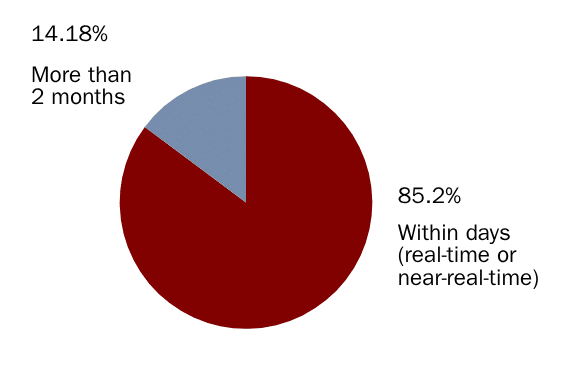
Sedulo Commentary: The 85% delivering MI reports within days is a strong operational signal, and it reflects how much the tools and processes behind consumer products intelligence have improved. Speed matters in this category because the decisions that depend on MI, around pricing, promotions, campaign timing, and competitive response, often have short windows where acting on current intelligence creates a meaningful advantage over acting on information that is already dated. The 15% taking more than two months is the more pressing concern. At that pace, the reports being delivered are describing a market that has already moved on. Competitor activity has shifted, shopper behavior has continued to evolve, and the decisions the report was meant to inform may have already been made on instinct or incomplete information. For Sedulo, report speed is not valuable on its own. Intelligence that arrives quickly but lacks depth, rigorous sourcing, or clear strategic implications does not improve decisions, it just accelerates them. The goal is current intelligence that is also substantive enough to genuinely change how a team thinks about a problem. For organizations still operating on longer reporting timelines, the priority is identifying where the delays are forming, whether in data access, analytical capacity, review cycles, or report production, and addressing those constraints directly rather than accepting slow delivery as an inherent feature of thorough MI work.
Which MI deliverable drives value for insights and marketing leaders in the consumer products industry?
Consumer trend reports are the market intelligence that drives the most value in the consumer products industry for 99% of insights, strategy, and marketing leaders, while competitive benchmarking is the most valuable driver for the remaining 1%.
MI gets sharper when it gets closer to the shopper:
Consumer trend reports overwhelmingly dominate the value-related MI conversation, accounting for 99% of the discussion among insights and marketing leaders. In consumer products, this makes sense because value is closely tied to understanding how shoppers are behaving now and where their needs are moving next.
McKinsey’s State of the Consumer 2025 report sheds some light on why this deliverable gets so much emphasis. It says consumer sentiment is no longer neatly aligned with spending, and simple methods for predicting behavior are no longer enough. It also says consumer companies need a 360-degree view of consumers to support proactive decision-making. This gives consumer trend reports a clear role because they help teams track shifting needs, behaviors, and purchase signals.

Competitive benchmarking accounts for 1% of the value-related conversation. This does not mean consumer products teams are not using it. It simply receives far less emphasis when leaders discuss which MI deliverables create the most value.
Benchmarking still helps teams understand competitor pricing, positioning, product claims, retail presence, and category activity. The difference is that trend reports speak more directly to changing consumer behavior, while benchmarking helps teams read the competitive context around those changes.
Sedulo Commentary: The near-unanimous emphasis on consumer trend reports reflects something fundamental about how value is created in consumer products. The business case for almost every major decision, whether around product development, pricing, brand positioning, or channel investment, ultimately rests on a credible read of where shoppers are heading and why. That makes trend intelligence less of a specialized deliverable and more of a foundational input that touches every function with a stake in growth. The 1% emphasis on competitive benchmarking is worth interpreting carefully. It does not mean competitive intelligence is unimportant to consumer products teams. It means that when leaders talk about what drives the most value, the conversation gravitates toward consumer understanding rather than competitor tracking. In practice, the two are most powerful when they work together. Consumer trend reports show where demand is moving. Competitive benchmarking shows how rivals are positioning to capture it. Organizations that treat these as separate workstreams can end up with a strong view of the consumer and a weaker view of the competitive context around them, or vice versa. For Sedulo, the most actionable MI in consumer products is the kind that connects both lenses. Understanding what shoppers want is only half the picture. Understanding how competitors are responding to the same signals, where they are investing, how they are adjusting claims and positioning, and where gaps remain, is what turns trend intelligence into a genuine basis for competitive decision-making.
How does MI influence strategy in insights and marketing leaders’ consumer products organizations?
For 21% of insights, strategy, and marketing leaders in the consumer products industry, market intelligence significantly influences key decisions, 21% rely on it moderately, and 25% find it has minimal influence, while 34% have not formally integrated it into their organization’s strategy.
MI influence depends on where it enters the process:

Market intelligence influences strategy in consumer products organizations, but the level of influence varies sharply. For 34% of insights and marketing leaders, MI is not formally integrated into strategy. The issue here is structure. MI may not have a defined place in planning calendars, leadership reviews, category planning, or decision gates, which makes its influence harder to apply consistently.
Another 23% agree MI has minimal influence and is used occasionally for validation. Here, the limiting factor is timing. MI is probably being used to support or sense-check decisions, rather than challenge assumptions early enough to change direction.
For 21%, MI has a moderate influence and sometimes informs planning. This gives MI a seat in the process, but likely at specific moments such as brand planning, campaign reviews, product discussions, or market updates.
Another 21% say MI has a significant influence and regularly shapes key decisions. These organizations are using MI before major choices are locked in, so insight can help prioritize opportunities, assess risks, compare strategic options, and align teams around where to focus.
Sedulo Commentary: The 34% without formal MI integration into strategy is the most significant finding here, and it points to a structural problem rather than a capability one. Many of these organizations likely have access to market intelligence in some form. The issue is that it does not have a defined place in how strategy is built, which means its influence depends on timing, individual initiative, or whether the right person happened to read the right report before a key decision was made. The 25% where MI has minimal influence and is used occasionally for validation is a related but distinct challenge. Using intelligence primarily to confirm decisions already forming is a limited application of what MI can do. It reduces a strategic input to a sense-check, which means it rarely has the opportunity to challenge assumptions, reframe priorities, or surface risks before direction has already been set. For Sedulo, the difference between MI that significantly influences decisions and MI that sits at the edges of the planning process is almost always a question of when intelligence enters the conversation. Organizations where MI shapes key decisions are typically those where insight is built into planning calendars, category reviews, and leadership discussions before choices are locked in rather than after. The 21% where MI has significant influence have not necessarily built a more sophisticated research capability than the rest. They have built better habits around when and how intelligence is used, and that discipline is what allows it to change outcomes rather than simply document them.
What is the annual MI budget for insights and marketing leaders in the consumer products industry?
38% of insights, strategy, and marketing leaders in the consumer products industry have an annual market intelligence budget of between $1 million and $3 million, 13% budget between $500k and $1 million, and 49% are either unsure or do not disclose their budget.
MI budgets are sizeable, but not always visible:
Annual MI budget visibility is mixed among insights and marketing leaders. The largest group, at 49%, does not know the annual MI budget or that the figure is not disclosed. This points to a visibility gap. MI can support major decisions around customers, competitors, pricing, campaigns, and growth, but the budget behind that work is not always clear to the leaders referencing it.
Among disclosed figures, the investment levels are substantial. 38% reference annual MI budgets of $1 million to $3 million, while 13% mention budgets of $500,000 to $1 million. These figures fit with the wider marketing budget environment.

A 2025 marketing budget analysis says marketing budgets now represent 9.4% of company revenues and 11.4% of overall company budgets. It also identifies data analytics as the top marketing investment priority, with CMOs focused on using data and research to better understand customer needs and behaviors and bring marketing science into strategic decision-making. This connects directly to MI because these budgets help fund the tools, research, analytics, reporting, and expertise needed to turn market signals into usable direction.
Sedulo Commentary: The 49% who either do not know or do not disclose their MI budget is arguably the most revealing detail in this data. Budget visibility is a reasonable proxy for how embedded market intelligence is within an organization’s planning and resource allocation processes. When the leaders referencing and using MI output do not have a clear picture of what it costs, it often signals that intelligence is being funded through fragmented budget lines across functions rather than as a dedicated, accountable program. That fragmentation has practical consequences. Without a consolidated MI budget, it becomes harder to make deliberate decisions about where to invest, which capabilities to build, and whether the current spend is proportionate to the decisions it is meant to support. It also makes it harder to defend or grow the investment when priorities are being reviewed. For Sedulo, the disclosed figures are a useful reference point. Annual MI budgets of between $500,000 and $3 million reflect a serious organizational commitment, particularly for companies operating at the revenue scale represented in this audience. The more important question is whether that investment is being allocated in a way that matches the decisions the business most needs intelligence to support. Budget size alone does not determine MI quality or impact. Organizations that spend deliberately, with clear priorities around consumer understanding, competitive monitoring, and strategic planning support, consistently get more from their MI investment than those spending similar amounts without that focus and structure behind it.
How is AI used in MI within insights and marketing leaders’ consumer products organizations?
Currently, 45% of insights, strategy, and marketing leaders in the consumer products industry are using generative AI for MI research summarization, 37% are using it for predictive analytics and demand forecasting, and 16% for AI-assisted survey design or analysis; conversely, 1% are exploring but not yet using AI in MI, and 1% don’t currently use AI in MI whatsoever.
AI is strongest where MI needs speed, scale, and foresight:
AI use in MI is already centered on practical, high-utility work. 45% of insights and marketing leaders mention generative AI for research summarization. This is the clearest current use case because it helps teams condense large amounts of information, pull out signals, and make research easier to use across faster decision cycles.
Another 37% point to predictive analytics and demand forecasting. This is where AI moves MI from explaining what has happened toward anticipating demand, customer behavior, and market movement. The Deloitte AI Institute’s Consumer AI dossier supports this broader role, saying market intelligence AI can simulate market scenarios, generate synthetic data to fill gaps, predict customer preferences, support competitor analysis, simulate brand perception scenarios, and provide demand forecasting to reduce uncertainty.

AI-assisted survey design or analysis sits at 16%. This is a more specific research process use case, helping teams improve how they structure questions, interpret findings, and turn primary research into clearer insight.
Only 1% are exploring AI but not yet using it in MI, indicating that most AI-related activity has already moved beyond general interest and into practical use cases.
Another 1% do not currently use AI in MI. This makes non-use a very small part of the picture and reinforces how quickly AI has become part of MI work.
Automatic social listening and sentiment analysis received no opinions expressed. This does not mean consumer products teams are not using it. It means it did not surface as something leaders were talking about in this data. Given the earlier emphasis on social listening and digital analytics, these activities may be discussed under broader analytics or social listening language rather than called out as a separate AI use case.
Sedulo Commentary: The AI use picture in consumer products MI is one of active adoption rather than cautious experimentation. The combination of generative AI for research summarization, predictive analytics for demand forecasting, and AI-assisted survey design represents a meaningful shift in how MI teams are working, compressing timelines, handling larger volumes of data, and moving analysis closer to real time. The emphasis on summarization as the leading use case makes practical sense as a starting point. It addresses one of the most consistent pressures MI teams face, making large volumes of research accessible and usable across faster decision cycles, without requiring the deeper data infrastructure that predictive analytics depends on. The 37% using AI for predictive analytics and demand forecasting is the more strategically significant signal. This is where AI begins to shift MI from describing what has happened toward anticipating what is coming, which changes the kind of value intelligence can deliver and how far in advance it can inform decisions. For Sedulo, the question is not whether AI belongs in MI work. It clearly does, and its role will continue to expand. The more important question is what AI is being pointed at. Summarization and forecasting are valuable, but they are most powerful when the underlying data is current, well-structured, and sourced rigorously. AI applied to incomplete, fragmented, or poorly validated data can accelerate analysis while quietly compounding the gaps within it. The organizations getting the most from AI in MI are those that have invested in the data foundations first, and treat AI as a way to sharpen and scale strong research practice rather than substitute for it.
How confident are insights and marketing leaders in AI-generated MI output?
58% of insights, strategy, and marketing leaders in the consumer products industry are not very confident about AI-generated MI output as they have accuracy concerns, 20% are neutral on the topic as it’s too early to assess, 20% are somewhat confident but agree that while AI is useful, it needs human oversight, and 2% are not at all confident in its output.
Confidence is cautious rather than settled:
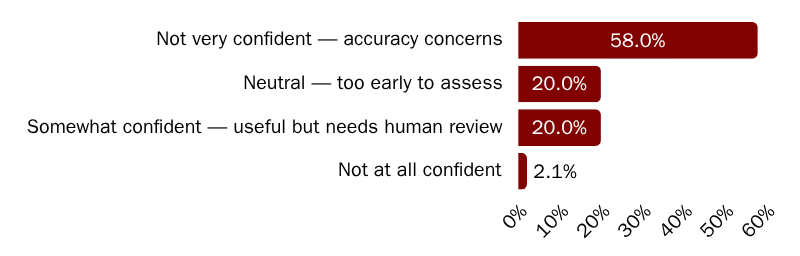
58% of insights and marketing leaders are not very confident in AI-generated MI output because of accuracy concerns. This is not a rejection of AI in MI, but it does show that trust depends on the quality of the data, the reliability of the output, and the checks around how AI-generated insight is used.
IBM’s retail and consumer products AI report helps explain this caution. It says AI needs live, accurate, and secure data to become a trusted operational partner, with security, governance, expert human supervision, and guardrails in place. It also notes that while 64% of companies have proprietary data accessible to AI, only 49% is usable, and just 26% is actually used by AI. If AI is working from incomplete, underused, or poorly prepared data, its market intelligence output still needs careful review before it can guide decisions.
Another 20% are neutral because it is too early to assess. Clearly, confidence is still developing as teams test AI-generated MI across real decisions. A further 20% are somewhat confident, but agree the output needs human review. This is the most practical confidence position, where AI can speed up analysis, but people still check context, accuracy, and judgment.
Only 2% are not at all confident. This makes hard rejection a small part of the picture. Most leaders are not closing the door on AI-generated MI, but they likely still want proof, review, and stronger data foundations before trusting the output fully.
Sedulo Commentary: The confidence picture here is more nuanced than a simple headline figure suggests. The 58% with accuracy concerns are not rejecting AI-generated MI outright. They are applying reasonable scrutiny to output that carries real commercial weight. In consumer products, where MI feeds pricing decisions, campaign investments, product positioning, and growth strategy, the cost of acting on inaccurate intelligence is not abstract. It shows up in results. That level of caution is appropriate, and in many ways reflects a more mature relationship with AI than uncritical adoption would. The 20% who are somewhat confident but require human oversight represent what is likely the most practically sound position in this data. AI can meaningfully accelerate the pace and scale of MI work, but the judgment layer, knowing which signals matter, how to interpret findings in context, and what the implications are for a specific business in a specific market, remains a human responsibility. For Sedulo, the confidence gap visible in this data points to something worth addressing directly rather than waiting for it to resolve over time. Trust in AI-generated MI output is built through transparency about sourcing, clear methodology around how AI is being applied, and consistent human review that validates findings before they reach decision-makers. Organizations that treat AI output as a draft requiring expert interpretation rather than a finished product ready for action are the ones most likely to build the internal confidence needed to use it effectively. The 2% with no confidence at all are a small group, but they are a useful reminder that trust is earned through demonstrated accuracy, not assumed on the basis of technological capability.
What is the biggest AI adoption barrier for MI among insights and marketing leaders?
For 92% of insights, strategy, and marketing leaders in the consumer products industry, the biggest AI adoption barrier for market intelligence is that there’s no clear use case identified yet, while for 6%, data and privacy concerns are a hindrance, and for 2%, a lack of trust in AI-generated insights is the largest hurdle.
AI adoption barriers are practical, not philosophical:
The biggest AI adoption barrier for MI involves knowing where AI should actually be used. 92% of insights and marketing leaders say no clear AI use case has been identified yet. This points to a practical gap between AI interest and AI application. Teams may understand the broad potential of AI, but still need to connect it to specific MI workflows, decisions, and outcomes, such as research summarization, forecasting, survey analysis, scenario planning, or competitor monitoring.
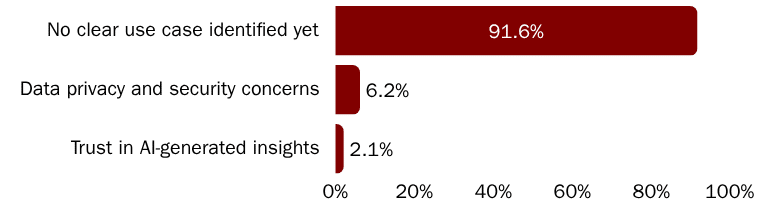
Data privacy and security concerns sit at 6%. These concerns are still important because MI can involve customer data, proprietary research, commercial planning, and competitive intelligence, but they are not the main blocker to this data.
Trust in AI-generated insights sits at 2%. This is interesting alongside the previous confidence finding, where accuracy concerns were much more visible. The gap shows that trust becomes a greater concern when teams evaluate AI output, while adoption depends first on finding the right use case.
Sedulo Commentary: The 92% citing no clear use case as the primary barrier is a more actionable finding than it might initially appear. It does not mean these organizations lack interest in AI or confidence in its potential. It means the connection between AI capability and specific MI workflows has not yet been made clearly enough to move from general awareness to practical application. That is a different kind of problem than skepticism or resource constraints, and it is one that can be resolved with the right framing and starting points. The gap between knowing AI could be useful and knowing exactly where to apply it is common at this stage of adoption. MI work involves a range of distinct activities, from research gathering and synthesis to trend analysis, competitor monitoring, survey design, and strategic reporting. Each of these has a different AI use case with different requirements, different data inputs, and different quality checks. Without that specificity, AI remains an interesting capability sitting outside the actual workflow rather than embedded within it. For Sedulo, the organizations that close this gap most effectively are typically those that start with a single, well-defined MI task where the current process is time-consuming, repeatable, and dependent on handling large volumes of information. Research summarization is the most common entry point for good reason. It delivers immediate productivity gains, creates a visible proof of concept, and builds the internal familiarity with AI-assisted MI that makes the next use case easier to identify and adopt. The 6% citing data privacy concerns and the 2% citing trust in AI output are smaller barriers, but they reinforce that adoption depends on governance and transparency as much as it depends on identifying the right application.
What are the biggest MI challenges for insights and marketing leaders in the consumer products industry?
Access to reliable, real-time consumer data is the biggest market intelligence challenge for 95% of insights, strategy, and marketing leaders in the consumer products industry, but for 5%, data fragmentation across teams or systems is the largest stumbling block.
MI is only as strong as the data behind it:
Access to reliable, real-time consumer data is by far the biggest MI challenge for insights and marketing leaders, with 95% identifying it as the main challenge. The pressure is not simply to collect more data. Teams need consumer information that is current and trustworthy, while shopper behavior, demand, pricing, and channel activity are still moving.
A 2024 review of real-time data analytics in retail says cross-border e-commerce and online marketplaces have intensified the need for live insight into consumer trends. In MI, this creates a need for current, reliable data that can capture the nuances of local demand, online behavior, pricing expectations, and shopper preferences across markets and channels.
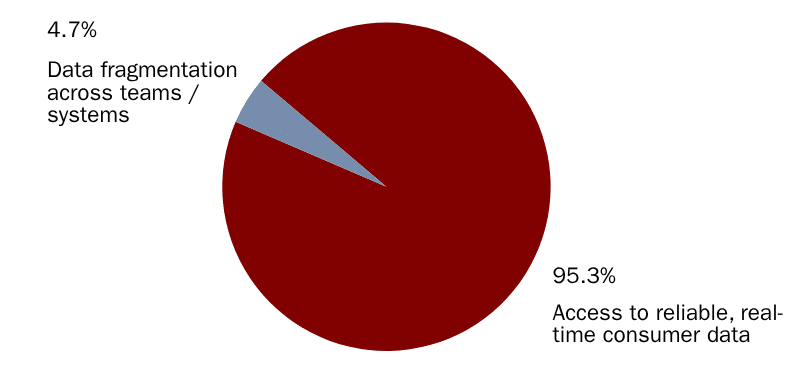
Data fragmentation across teams and systems sits at just 5%, but this does not make fragmentation irrelevant. The lower figure may mean leaders experience fragmentation through the bigger problem of accessing reliable, real-time data, rather than naming it as a separate challenge. When consumer data sits across different teams, systems, or dashboards, it becomes harder to connect, validate, and use quickly.
Sedulo Commentary: The 95% identifying access to reliable, real-time consumer data as the primary MI challenge reflects how fundamentally the expectations around market intelligence have shifted. The standard is no longer periodic insight delivered on a planning cycle. It is current, trustworthy data that keeps pace with a market where shopper behavior, competitive activity, pricing, and channel dynamics can move faster than traditional research timelines allow. That creates a compounding pressure. The decisions that depend on MI are not slowing down to accommodate slower data. They are being made regardless, which means organizations without reliable, real-time consumer data are either delaying decisions until better information arrives or making them on intelligence that is already aging. Neither outcome is sustainable at the revenue scale represented in this audience. The 5% citing data fragmentation as the primary challenge should not be read as a sign that fragmentation is a minor issue. It is more likely that fragmentation is experienced as part of the real-time data access problem rather than as a separate barrier. When consumer data sits across different platforms, syndicated sources, social listening tools, and internal systems, the difficulty of accessing it in real time and the difficulty of connecting it into a coherent picture are often the same problem described from different angles. For Sedulo, solving the real-time data challenge requires more than faster tools or additional data subscriptions. It requires clarity about which consumer signals matter most for the decisions the business is actually making, a sourcing strategy built around those priorities, and the analytical infrastructure to bring those signals together quickly enough to be useful. Organizations that approach data access as a technology problem alone tend to add capability without improving the quality or speed of the intelligence that reaches decision-makers.
Which external forces impact MI priorities for insights and marketing leaders in the consumer products industry?
57% of insights, strategy, and marketing leaders in the consumer products industry’s MI priorities are most impacted by private label or store brand growth, 39% are impacted by economic pressures on consumer spending, and 4% by regulatory changes.
Pressure is concentrated around value, price, and shopper choice:

57% of insights and marketing leaders identify private-label or store-brand growth as the external factor most impacting MI priorities. This puts pressure on consumer products brands to understand where shoppers are trading down, where brand loyalty is weakening, and where store brands are competing on quality, price, convenience, or trust.
Economic pressures on consumer spending sit at 39%. When households feel squeezed, MI teams need to track how spending pressure changes basket size, category choices, promotion sensitivity, and willingness to pay for branded products.
Regulatory changes sit at 4%. This does not mean regulation has little effect. It may simply sit closer to legal, compliance, operations, or product teams, while private label growth and consumer spending pressure sit closer to everyday shopper behavior, pricing, and brand competition.
Supply chain volatility and retail and channel disruption received no opinions expressed. While these forces are relevant to MI, they may be so ingrained in the operating environment that leaders do not name them as separate MI priorities in conversation.
Sedulo Commentary: The concentration of MI pressure around private label growth and economic headwinds on consumer spending reflects the specific commercial environment consumer products brands are navigating right now. These are not abstract macro forces. They are showing up directly in basket composition, brand switching behavior, promotion sensitivity, and the speed at which shoppers are reassessing which products and price points still feel worth it. Private label growth is particularly significant as an MI driver because it changes the competitive frame in a way that traditional competitor tracking does not fully capture. Store brands are not competing on the same terms as national brands. They are competing on perceived value at the point of decision, which means the intelligence needed to respond effectively has to be closer to the shopper and more granular about where brand loyalty is holding and where it is softening. For Sedulo, the 4% citing regulatory changes as the primary MI impact driver is a useful reminder that external forces do not all operate on the same timeline. Private label pressure and spending headwinds create immediate, visible signals that MI teams can track and respond to in near real time. Regulatory shifts tend to build more slowly, but their commercial implications, across product claims, ingredient transparency, labeling, and channel access, can be just as consequential when they arrive. The organizations with the strongest MI programs are those that monitor across all three of these forces simultaneously, treating them not as separate workstreams but as interconnected pressures that together shape where consumer demand is moving and where competitive vulnerability is forming.
What are insights and marketing leaders’ top MI priorities in the consumer products industry?
Emerging trend identification is the top MI priority for 67% of insights, strategy, and marketing leaders in the consumer products industry in the next 12 months, 16% are prioritizing white space or innovation opportunity analysis, and 6% consumer behavior and demand shifts, while 5% are putting voice of customer research at the top of their list, 4% competitive landscape mapping, and 3% are prioritizing channel and partner assessment.
MI is being pulled toward what comes next:
MI priorities over the next 12 months are firmly future-facing. 67% of insights and marketing leaders identify emerging trend identification as the top priority, which shows how much attention is going toward spotting market movement before it becomes obvious.
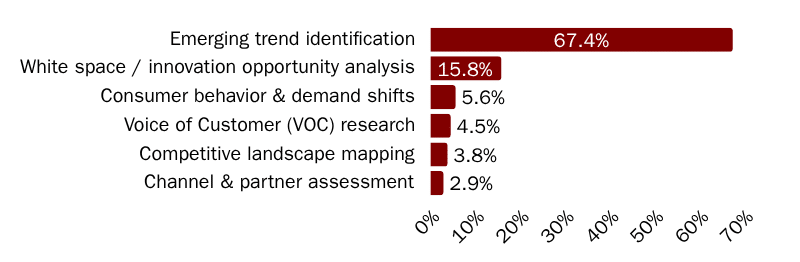
White space and innovation opportunity analysis follows at 16%. This is where MI turns trend signals into possible growth areas, such as unmet consumer needs, product gaps, new formats, or channel opportunities. KPMG’s consumer products industry report points in the same direction, saying consumer products companies are planning new offerings again, with 57% of executives expecting net new products to show the strongest year-over-year growth.
Consumer behavior and demand shifts sit at 6%, while VOC research sits at 5%. These priorities are more focused on direct customer understanding, but they may also feed into broader trends and innovation work.
Competitive landscape mapping sits at 4%, and channel and partner assessment at 3%. These are narrower priorities, but they still help teams understand where competitors, retailers, and partners could affect growth decisions.
Sedulo Commentary: The forward-facing orientation of these priorities is one of the clearest signals in the entire dataset. When 67% of leaders identify emerging trend identification as their top MI priority and 16% are focused on white space and innovation opportunity analysis, it points to an audience that is using market intelligence less to explain what has already happened and more to position for what is coming next. That is a meaningful shift in how MI is being valued and applied. Emerging trend identification at this scale of priority also raises the bar on what MI programs need to deliver. Spotting a trend after it has become visible across the category is useful context. Identifying it early enough to influence product development, positioning, or channel investment before competitors have responded is where the real commercial advantage lies. That distinction depends heavily on the quality and diversity of the signals being monitored and the analytical discipline being applied to interpret them. The relatively lower priority given to competitive landscape mapping at 4% and channel and partner assessment at 3% is worth noting carefully. These are not unimportant areas. They may simply be treated as ongoing operational activities rather than named priorities, which is a reasonable position for mature MI programs. For Sedulo, the risk is when competitive and channel intelligence falls below the threshold of active attention during a period when private label growth, economic pressure on spending, and shifting retail dynamics are all actively reshaping the category. Trend identification and innovation analysis are strongest when they are grounded in a clear, current understanding of how the competitive landscape is evolving around them. Without that context, even well-identified trends can lead to investment in directions that competitors are already moving to capture.
Which consumer products category best describes insights and marketing leaders’ businesses?
9% of insights, strategy, and marketing leaders in the consumer products industry work in food and beverage, 5% in health and wellness, 2% in pet products, and 2% in apparel and footwear, while the remaining 82% work in other non-disclosed business types.
Consumer product categories are not always as clear as their labels suggest:
Many consumer products businesses represented by insights and marketing leaders in our audience do not sit neatly inside the named category labels. The Other category is a good match for 28%, while 17% say it is not quite right, and 32% say it does not fit. This points to a broad mix of businesses, including some that fall outside common category labels or cut across more than one category.
Food and Beverage is a good match for 9%. Food also led the U.S. Consumer Packaged Goods market with the largest revenue share of 42.49% in 2024. Its presence in this data makes sense because food and beverage brands often depend heavily on MI to track changing tastes, price sensitivity, retail movement, product claims, and shopper behavior.

Health and Wellness has 1% perfect fit and 4% good match. Market intelligence is important in this category because consumer priorities, product claims, ingredient preferences, and trust signals can shift quickly. Brands need to know which benefits are gaining attention and how competitors are positioning similar products.
Pet Products has a small but mixed presence in the data, with less than 1% saying it is a perfect fit, 2% saying it is a good match, 2% saying it is not quite right, and 2% saying it does not fit. Pet care brands rely on MI to track household purchasing behavior, product claims, brand trust, price sensitivity, and repeat buying patterns.
Apparel and footwear are a good match for 2%. Brands in this category rely on MI because demand can shift quickly with style trends, seasonality, pricing, retail channels, and changing customer preferences.
Household Products received no opinions expressed. This means the category was not being named in online conversations, rather than showing a lack of MI relevance. Household product brands still rely on MI to track repeat purchasing behavior, price sensitivity, retail performance, product claims, brand trust, and changing household needs.
Sedulo Commentary: The dominance of the non-disclosed category is itself a finding worth examining. The fact that 82% of leaders in this audience do not align clearly with a named consumer products category points to the breadth and complexity of how consumer products businesses actually operate. Many organizations cut across multiple categories, carry portfolios that resist simple labeling, or sit in segments that standard category frameworks do not cleanly capture. That complexity has direct implications for how MI is structured and sourced. Category-specific intelligence, whether around food and beverage, health and wellness, pet products, or apparel, requires different data sources, different competitive frames, and different shopper behavior signals. Organizations managing multiple categories or operating in less defined spaces often find that generic MI approaches leave meaningful gaps, because the dynamics driving demand in one part of the portfolio can be quite different from those shaping another. For Sedulo, the presence of food and beverage, health and wellness, pet products, and apparel in this data, even at relatively small percentages, reflects categories where MI is not optional. Each of these segments is facing its own version of the same core pressures: private label competition, shifting consumer priorities, pricing sensitivity, and the need to understand where brand trust is being built or eroded at the shopper level. The 82% in non-disclosed categories likely face a similar set of pressures, even if the specific category dynamics differ. What connects them is the need for MI that is close enough to their actual market, shopper, and competitive reality to inform decisions that matter, rather than intelligence built around category assumptions that may not reflect how their business actually competes.
What are insights and marketing leaders’ primary roles in the consumer products industry?
While 5% of insights, strategy, and marketing leaders in the consumer products industry fill the role of Chief Insights Officer or VP of insights, the remaining 95% fulfil other roles in the same sector.
Market intelligence reaches beyond one job title:

While 5% identify Chief Insights Officer or VP of Insights as their primary role, 95% list another official designation within the consumer products industry. This indicates that many carry insights, marketing, or MI responsibilities alongside different formal roles and titles.
The key takeaway is that market intelligence responsibility is not limited to one senior insights title. In consumer products, it can sit with leaders whose roles are broader, more marketing-led, or connected to strategy, brand, research, or commercial decision-making.
Sedulo Commentary: The 95% carrying MI responsibility outside of a dedicated insights title is one of the more practically significant findings in this dataset. It confirms that market intelligence in consumer products is not primarily the domain of a specialized function. It is work being done by leaders whose formal roles span marketing, strategy, brand, commercial, and research, which means MI competes for attention alongside a wide range of other priorities rather than sitting as a defined, protected workstream. That context matters when interpreting the other findings in this research. The fragmented ownership, the variation in MI maturity, the gaps in real-time data access, and the barriers to AI adoption all look different when the people responsible for market intelligence are also responsible for a significant number of other things. Building consistent, high-quality MI practice is harder when it is distributed across roles rather than anchored in dedicated capability. For Sedulo, this reinforces the value of external research partnerships in consumer products MI. When internal MI responsibility is spread across functions and carried alongside broader role demands, the depth, consistency, and strategic rigor of the intelligence program can be difficult to sustain at the level the business actually needs. External partners bring dedicated analytical capacity, specialized sourcing, and structured research discipline that complements what internal teams can realistically deliver within the constraints of their broader responsibilities. The organizations that get the most from that kind of partnership are those that treat it as an extension of internal capability rather than a replacement for it, combining the market and category knowledge that sits inside the business with the research depth and competitive perspective that benefits from an outside view.
Faster, smarter insights are driving competitive advantage
These opinions of insights, strategy, and marketing leaders show a consumer products MI landscape spread across categories, roles, tools, and decision points. The analysis gives a clearer view of where leaders see value, how responsibility is shared, and why faster, better intelligence is becoming central to understanding consumers, competitors, and growth opportunities.
About the data
Sourced using Artios from an independent sample of 59,633 opinions of Insights Strategy or Marketing leaders in the consumer products industry in the USA across X, Quora, Reddit, Bluesky, TikTok, and Threads. Responses are collected within a 95% confidence interval and 5% margin of error. Results are derived from what people describe online, from opinions expressed, not actual questions answered by people in the sample.