
In an era defined by 5G rollouts, AI-powered networks, and shifting regulatory landscapes, telecom companies face unprecedented complexity. One of the most effective tools for managing this complexity and constant change is the Threat and Opportunity Matrix, a strategic framework that helps telecom executives identify, prioritize, and act on external forces shaping their business.
This guide walks you through how to build a Threat and Opportunity Matrix, why it’s essential for telecom strategy in 2025, and how to use it to drive smarter decisions across your organization.
What Is a Threat and Opportunity Matrix?
A Threat and Opportunity Matrix is a visual tool used to evaluate external factors such as competitor moves, regulatory shifts, or emerging technologies based on two dimensions:
- Impact: The magnitude of consequence if a scenario occurs, such as financial loss or reputational gain
- Probability: The likelihood that a scenario will materialize
- Confidence: The degree of trust in intelligence or research supporting the scenario
By plotting threats and opportunities on a grid, telecom leaders can quickly identify which issues require immediate action and which can be monitored over time.

How to Build a Telecom-Specific Threat and Opportunity Matrix
Creating a TM tailored to the telecommunications industry involves six key steps:
1. Scan the External Environment
Start by gathering insights across five categories:
- Technological Trends: 5G, edge computing, AI, IoT, satellite broadband.
- Regulatory Shifts: Data privacy laws, spectrum allocation, net neutrality.
- Competitive Landscape: Mergers, pricing wars, new market entrants.
- Consumer Behavior: Mobile-first usage, streaming demand, remote work.
- Global Events: Supply chain disruptions, geopolitical tensions, climate risks.
Use sources like industry reports, analyst briefings, government publications, and customer feedback.
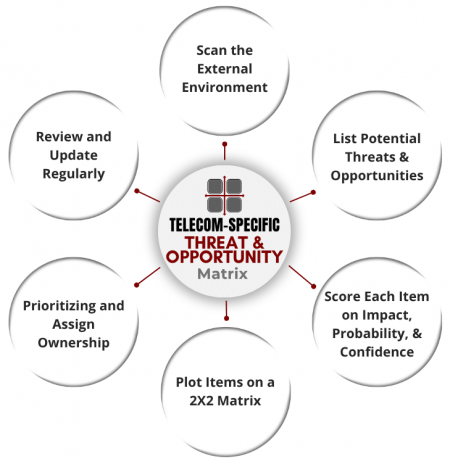
2. List Potential Threats and Opportunities
Create two separate lists:
- Threats: e.g., rising cybersecurity risks, declining ARPU, regulatory fines.
- Opportunities: e.g., expanding into underserved rural markets, bundling cloud services, launching AI-powered customer support.
Aim for 10–15 items in each category to start.
3. Score Each Item on Impact, Probability and Confidence
To evaluate each threat or opportunity, score it across three dimensions using a consistent scale (e.g., 1–5):
- Impact: How significant the consequences would be if the scenario occurs.
1 = minimal effect, 5 = game changing. - Probability: How likely the scenario is to materialize.
1 = unlikely, 5 = highly likely. - Confidence: How reliable the underlying intelligence or data is.
1 = speculative, 5 = highly validated.
Encourage cross-functional input from strategy, operations, legal, and marketing teams to reduce bias and improve scoring accuracy. Confidence scores should reflect the quality of sources, consistency of signals, and recency of data.
4. Plot Items on a 2×2 Matrix
Create a grid with:
- X-axis: Probability (Low to High)
- Y-axis: Impact (Low to High)
Each item is plotted as a bubble, where:
- Position reflects its impact and probability.
- Size reflects the confidence level larger bubbles indicate higher confidence in the assessment.
This visualization allows teams to quickly distinguish between well-supported strategic imperatives and speculative watchlist items. Here’s how to interpret the quadrants:

Use color coding if desired to distinguish between threats and opportunities and consider layering in filters to view items by business unit or time horizon.
5. Prioritize and Assign Ownership
Focus on the top-right quadrant (high impact, high probability, and larger bubbles). Assign owners to each item, whether it’s a threat mitigation plan or an opportunity roadmap.
Use project management tools to track progress and integrate into quarterly strategy reviews.
6. Review and Update Regularly
The telecom landscape evolves fast. Revisit your matrix every 3–6 months to reflect:
- New regulations
- Market shifts
- Technology breakthroughs
- Internal performance data
Why Telecom Leaders Need This Matrix in 2025
The Threat and Opportunity Matrix serves as a critical strategic lens for navigating the constant disruption defining telecom for several key reasons.
- Anticipating technological shifts: With 6G research ongoing and AI fundamentally transforming network management, the matrix helps leaders discern which innovations to invest in and which to wisely avoid. Second, it helps navigate regulatory complexity. Since government actions, from major spectrum auctions to evolving privacy laws, can easily make or break a strategy, the matrix prepares teams for compliance risks and highlights policy-driven opportunities.
- Strengthening cyber resilience: By mapping and prioritizing threats like ransomware and DDoS attacks, it ensures proactive defense strategies are in place, not just reactive measures. It also enables companies to swiftly adapt to consumer expectations for seamless, personalized, and transparent service.
- Responding to global volatility: Whether facing supply chain risks from a war, a pandemic, or a climate event, the matrix ensures that responses are evaluated and executed in an objective, structured manner.
Strategic Applications Across the Business
The Threat and Opportunity Matrix is essential for telecom companies seeking to prioritize external risks and opportunities based on a clear view of both impact and probability. Once built, the matrix acts as a critical planning tool across the organization:
- It helps Marketing tailor campaigns to emerging consumer trends and high-potential service opportunities.
- Product Development can prioritize features and service rollouts that align with validated, high-impact growth scenarios.
- Operations can allocate resources to mitigate critical infrastructure and security threats.
- Finance can adjust capital expenditure and revenue forecasts based on clearly defined external risk scenarios.
- Leadership uses it to set a unified strategic direction with confidence.
Building the matrix requires structured environmental scanning, objective scoring and plotting, and tight cross-functional collaboration. Its value is especially pronounced in 2025 due to the convergence of rapid tech innovation, complex regulatory shifts, and ongoing global uncertainty. By applying this framework, telecom leaders drive smarter, data-backed decisions across every function.