

Software companies operate in a fast-moving environment. Competitors release new features in quick cycles, customers expect seamless integrations, and pricing models shift as buyers evaluate options side-by-side. With so much happening at once, the challenge is deciding what should be prioritized.
The Threat & Opportunity Prioritization Matrix provides a way to bring structure to this process. It evaluates potential scenarios across three dimensions:
- Impact: The consequence if the scenario materializes, such as lost deals, churn, or new growth
- Probability: The likelihood that the scenario will occur
- Confidence: The strength of the intelligence supporting the assessment
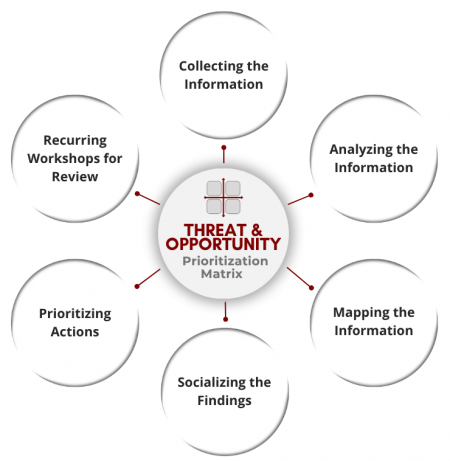
Plotting threats and opportunities across these dimensions allows leaders to see which scenarios require immediate attention, which need further validation, and which should be monitored. This effort helps software companies focus on what will have the greatest effect on revenue, reputation, and long-term success.
Why the Matrix Matters in Software
The pace of change in software creates unique pressure. With so many moving parts, it is easy for leadership teams to overreact to a single signal or delay decisions because they lack clarity.
The matrix matters because it filters noise into actionable priorities. It helps SaaS leaders:
- Identify which threats to pricing or service are most likely to disrupt revenue
- Focus on opportunities that consistently appear in buyer feedback and competitor moves
- Avoid chasing temporary signals that fade quickly
- Align executives, product, marketing, and sales around a shared view of priorities
Without a structured approach, companies risk reacting to anecdotes instead of patterns. The matrix ensures that decisions are backed by evidence.
Real-World Examples in Software
When you’re deciding whether to invest heavily in streamlining your customer journey, you need more than just a gut feeling. You need a data-backed process to prove that faster implementation is a strategic imperative.
Here is how a SaaS company used the six-step framework to justify a major investment in onboarding speed:
1) Collecting the Information
You start by listening to the market. Customer interviews and online reviews consistently highlight a recurring pain point: long implementation timelines that delay time-to-value. At the same time, your competitor monitoring reveals that new, nimble entrants are aggressively positioning quick-deploy solutions as their main differentiator. The evidence is mounting.
2) Analyzing the Information
Next, you connect the dots. You cluster these signals into a clear, unified pattern: onboarding speed is a direct and powerful lever that influences both new deal outcomes and long-term customer satisfaction. This pattern crystallizes into a clear, strategic opportunity that you can no longer ignore.
3) Mapping the Information
It’s time to quantify this opportunity on your Threat & Opportunity Prioritization Matrix. How does the “Faster Onboarding” opportunity score?
- High Probability: The need is validated across multiple customer accounts and competitor intelligence.
- High Impact: It has a direct, measurable effect on revenue growth and customer Lifetime Value (LTV).
- High Confidence: The conclusion is rock-solid, confirmed by both customer feedback and competitive benchmarking.
The opportunity earns its spot in the highest-priority quadrant.
4) Socializing the Findings
You bring the data to life by hosting a cross-functional workshop with your product, sales, and leadership teams. By presenting the validated insights and walking through the matrix, you eliminate departmental silos. Everyone—from the salesperson who lost a deal to the product manager building the roadmap—sees the unassailable evidence and agrees on the strategic importance of this investment.
5) Prioritizing Actions
With unanimous alignment, the path forward is clear. The company commits to two major actions: streamlining integrations and significantly strengthening implementation support resources. The Prioritization Matrix serves as the unbiased rationale for this decision, making it easy to prioritize onboarding improvements over other, less validated initiatives on the product roadmap.
Since public data on competitors’ exact implementation speeds is often limited, you rely heavily on structured primary research and detailed customer interviews to close the gap. A key challenge is ensuring intelligence leads to execution. To solve this, you run regular, recurring workshops with decision-makers to review the matrix, which helps translate shared intelligence into concrete, tracked actions and build institutional buy-in.
What Software Companies Can Do Internally
Applying the matrix starts with practical steps that can be embedded into existing processes:
- Track competitor moves. Monitor launches, partnerships, pricing changes, and service initiatives.
- Pair external signals with internal data. Compare what customers say during evaluations with what competitors are doing in the market.
- Score confidence. Assess whether intelligence is validated by multiple credible sources or based on isolated mentions.
- Run regular prioritization reviews. Quarterly or semiannual sessions ensure that leadership acts on current, validated insights.
- Seek neutral perspectives when needed. External research partners can provide objectivity and increase confidence scores where data is weak.
These steps turn raw information into prioritized actions.
Key Takeaways and Next Steps
Software companies cannot afford to treat every market signal as equally urgent. The Threat & Opportunity Prioritization Matrix helps filter inputs into structured priorities that reflect both impact and credibility.
Key takeaways include:
- Not all intelligence carries the same weight. Confidence scoring ensures decisions are based on validated signals.
- Patterns across sources matter more than individual anecdotes.
- Pricing pressure, onboarding speed, service quality, and platform innovation are recurring themes that belong on every software leader’s matrix.
- The matrix provides a shared language for prioritization, helping align product, marketing, sales, and leadership.
- Building this discipline internally ensures decisions are proactive rather than reactive.
When applied with rigor, the Threat & Opportunity Prioritization Matrix allows software companies to cut through noise, prioritize what truly matters, and act at the pace the industry demands.