

If businesses are serious about surpassing their competitors, identifying opportunities for growth, reducing risk when launching new products, and really giving their customers what they want, they need to replace guesswork with reliable data and objective facts. This is where market intelligence research services provide valuable support. By gathering and analyzing data on consumer behavior, competitor strategies, and market trends, businesses can make more informed decisions, refine their strategies, and identify opportunities for growth.
To find out what 23,897 opinions of insights, strategy, or marketing leaders in the US were about the top market intelligence research services, Sedulo partnered with Artios to utilize AI-driven audience profiling to synthesize insights from online discussions over 12 months, ending on June 9th, 2026, to a high statistical confidence level. What we found sheds light on which companies they would recommend, the type of research engagement they typically seek, and other pertinent topics.
Index
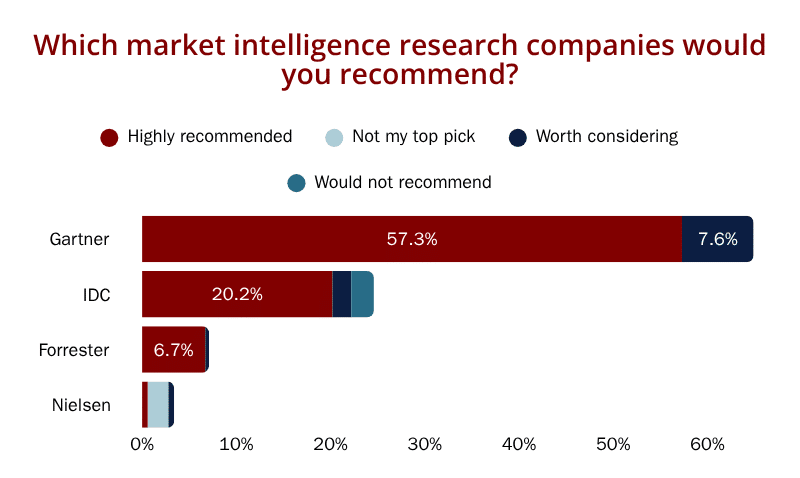
- 57% of insights, strategy, or marketing leaders highly recommend Gartner, and 8% agree it’s worth considering as a market intelligence research company, 20% highly recommend IDC, 2% think it’s worth considering, but a further 2% would not recommend it, 7% highly recommend Forrester, and Nielsen is not a top pick for 2%
- Customer or consumer insights are the top choice of research engagement that 26% of insights, strategy, or marketing leaders are seeking, followed by 24% who usually prefer this, while a further 24% cite industry trend analysis as their top choice, and 26% usually prefer this for research engagement
- 53% of insights, strategy, or marketing leaders typically discover new market intelligence providers on LinkedIn or social media, and the other 47% find them via analyst reports or rankings, such as those from Forrester or Gartner
- When choosing an MI provider, 39% of insights, strategy, or marketing leaders use analyst firms mainly for validation, not discovery, and 14% agree these firms are somewhat important in their selection process, yet 32% of leaders rarely or never consult these firms when making a decision, for 9% they are one of several inputs required, and 4% say they are not part of their evaluation process; however, 1% say they are central to their shortlisting process and are a primary source
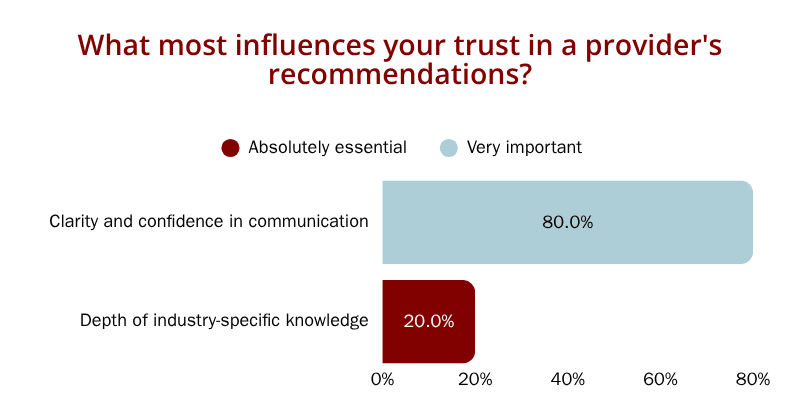
- Clarity and confidence in communication are very important for 80% of insights, strategy, or marketing leaders when trusting a provider’s recommendations, and for 20%, depth of industry-specific knowledge is absolutely essential for trust
- 39% of insights, strategy, or marketing leaders describe the tools their current market intelligence research providers use as modern but standard, a further 18% say that they use advanced proprietary research platforms, and 7% feel that outdated or limited tools describe what their current providers are using pretty well, while 36% disagree, as this description does not fit
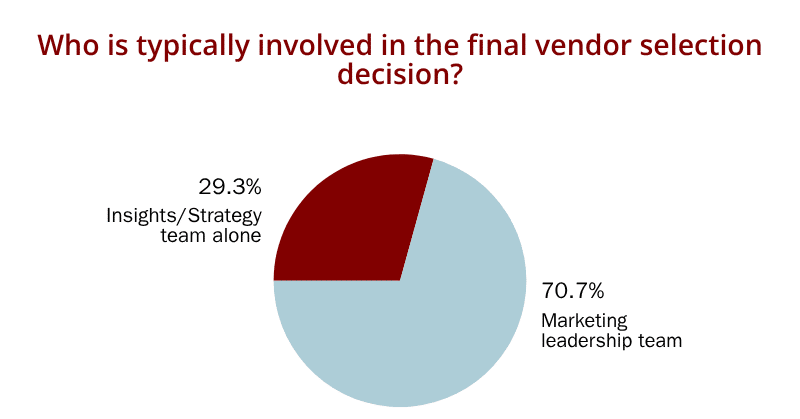
- 71% of insights, strategy, or marketing leaders’ marketing leadership teams are usually involved in the final vendor selection for a market intelligence research provider, while the insights or strategy team alone is typically involved for 29%
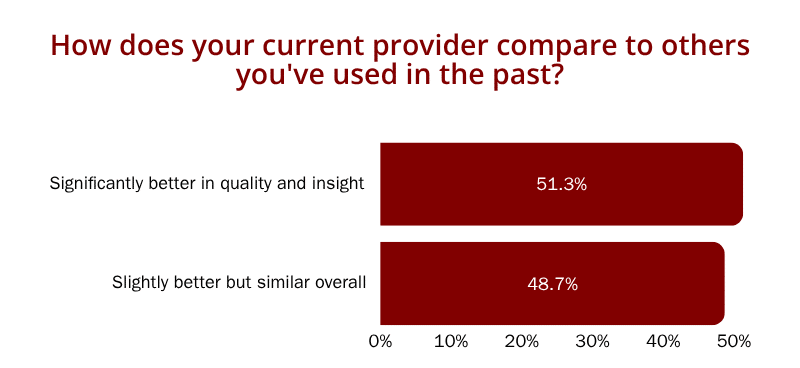
- 51% of insights, strategy, or marketing leaders’ current market intelligence research providers are significantly better in quality and insight than their previous providers, but 49%’s current providers are slightly better but still similar overall to their previous provider
- Improved customer service or account management would make 40% of insights, strategy, or marketing leaders strongly consider changing market intelligence research providers, while 26% feel the same about higher quality or more actionable insights, and this would be a minor influence for 35%
- The bigger picture behind these market intelligence trends
- Data and methodology
Which top market intelligence research services do insights, strategy, or marketing leaders recommend?
57% of insights, strategy, or marketing leaders highly recommend Gartner, and 8% agree it’s worth considering as a market intelligence research company, 20% highly recommend IDC, 2% think it’s worth considering, but a further 2% would not recommend it, 7% highly recommend Forrester, and Nielsen is not a top pick for 2%.
Recommendations reveal clear preferences:
Among the many market intelligence research companies, a few really stand out for our audience. Gartner is highly recommended by 57% of insights, strategy, or marketing leaders, while 8% say the company is worth considering. 20% highly recommend IDC, although 2% think the company is worth considering, and another 2% would not recommend it.
Although 7% of our audience highly recommends Forrester, fewer than 1% of their online conversations describe the company as worth considering. Lastly, fewer than 1% discuss highly recommending Nielsen or rate it as worth considering, and 2% say it’s not their top pick.
For those looking for a more personalized experience, Sedulo Group is highly recommended for its market intelligence research services:
“What sets Sedulo Group apart is its ability to combine in-depth primary research with strategic analysis, delivering market intelligence that’s not only comprehensive but also directly applicable to business decision-making. Their experienced team focuses on turning complex market data into practical insights that help organizations identify opportunities and stay ahead of competitors.” – Heath Gross, Chief Strategy Officer
What type of research engagement do insights, strategy, or marketing leaders seek?
Customer or consumer insights are the top choice of research engagement that 26% of insights, strategy, or marketing leaders are seeking, followed by 24% who usually prefer this, while a further 24% cite industry trend analysis as their top choice, and 26% usually prefer this for research engagement.
Research engagement is split into two ways:
When analyzing audience responses, two distinct types of research engagement emerge. Customer or consumer insights are the top choice of 26% and are usually preferred by 24%. These insights usually include behavioral metrics, demographic data, psychographics, and sentiment analysis. They give leaders an understanding of who their audience is, why they make purchasing decisions, and how to tailor their strategies and products or services accordingly.
This emphasis on understanding consumers reflects the growing value businesses place on data-driven decision-making. Reports show that brands using data-driven marketing at scale can increase net sales by up to 5% while improving marketing efficiency by up to 20%.

According to another 24% of our audience, their top choice is industry trend analysis, while this is usually preferred by 26%. This usually includes data on market size and growth, consumer behavior, competitor analysis, technological advancements, regulatory information such as government policies and compliance standards, and an evaluation of industry strengths, weaknesses, opportunities, and threats (SWOT).
How do leaders discover new top market intelligence research services?
53% of insights, strategy, or marketing leaders typically discover new market intelligence research providers on LinkedIn or social media, and the other 47% find them via analyst reports or rankings, such as those from Forrester or Gartner.
Discovery has two predominant starting points:

53% of insights, strategy, or marketing leaders typically discover new market intelligence providers on LinkedIn or through social media recommendations. This is roughly in line with Statista research, which shows that 72% of marketers use LinkedIn for marketing.
The remaining 47% of our audience relies on analyst reports or rankings by companies such as Gartner or Forrester. While nothing prevents the former segment from doing their own research to confirm whether the information that they find on LinkedIn or through recommendations on social media, the latter’s approach might be more reliable, as their discovery of new providers is based on independent research that delivers objective facts.
What role do analyst firms play in top market intelligence research service selection for leaders?
When choosing an MI provider, 39% of insights, strategy, or marketing leaders use analyst firms mainly for validation, not discovery, and 14% agree these firms are somewhat important in their selection process, yet 32% of leaders rarely or never consult these firms when making a decision, for 9% they are one of several inputs required, and 4% say they are not part of their evaluation process; however, 1% say they are central to their shortlisting process and are a primary source.
Analyst firms play roles of varying weights:
Analyst firms such as Gartner and Forrester play different roles in shaping insights, strategy, and leaders’ selection of providers. These firms are central to the process for 39%, who use them mainly for validation rather than discovery. This sees these leaders go beyond relying solely on what the providers say about themselves and/or what clients say about them in their reviews, which may be heavily biased. Analyst firms provide a more objective view of providers, supporting leaders in making informed decisions.
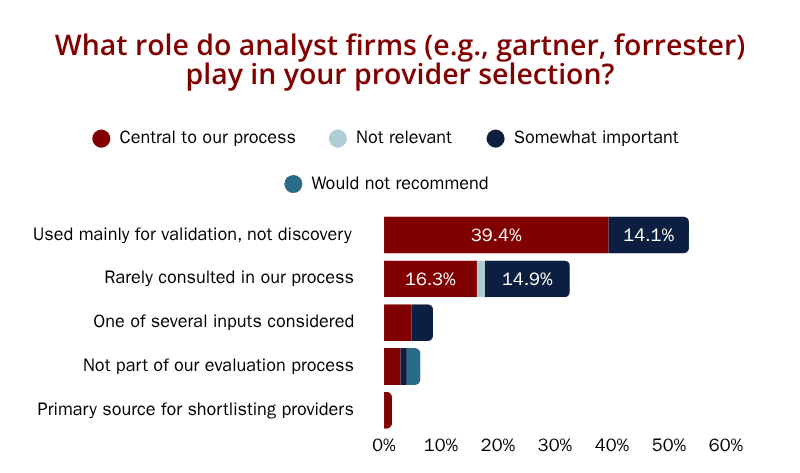
Another 14% of our audience also uses them for this purpose, describing analyst firms as somewhat important. 16% rarely consult these firms in their provider selection process, but when they do, these firms are central to it. 15% have a similar approach, saying that these firms are somewhat important on the rare occasions they do consult them. However, 1% make it clear these firms aren’t relevant to them, so they rarely consult them when selecting providers.
For 5%, data from analyst firms is central to their process, being one of several inputs they consider. 4% also count these among the several inputs they consider, although they reckon these firms are only somewhat important. For 3%, considering data from these firms isn’t part of their evaluation process. While 1% regard these firms as somewhat important, they’re not part of their evaluation process either. The remaining 1% regard these firms as central to their process, as they’re the primary source for shortlisting providers.
What influences leaders’ trust in a top market intelligence research service’s recommendations?
Clarity and confidence in communication are very important for 80% of insights, strategy, or marketing leaders when trusting a provider’s recommendations, and for 20%, depth of industry-specific knowledge is absolutely essential for trust.
Trust depends on communication and credentials:
Clarity and confidence in communication are very important to 80% of insights, strategy, or marketing leaders when it comes to what most influences their trust in a provider’s recommendations. This makes sense, as McKinsey reports that B2B customers use an average of 10 interaction channels in their buying journey. This is double what customers were using in 2016. Given the high number of interaction channels, our audience would be less inclined to make a purchase if they didn’t feel confident due to unclear communication.
McKinsey also notes that more than half of its survey respondents desire an omnichannel experience in which they can interact and purchase while switching across different channels smoothly. If they don’t enjoy a smooth experience across those channels, they’re more likely to switch suppliers.
Depth of industry-specific knowledge is absolutely essential in influencing 20% of our audience’s trust in a provider’s recommendations. This is understandable, as our audience isn’t likely to accept a provider’s recommendations if the provider lacks knowledge of their industry.
What technology or tools do leaders’ current top market intelligence research services use?
39% of insights, strategy, or marketing leaders describe the tools their current market intelligence research providers use as modern but standard, a further 18% say that they use advanced proprietary research platforms, and 7% feel that outdated or limited tools describe what their current providers are using pretty well, while 36% disagree, as this description does not fit.
Tech and tools are not one-size-fits-all:

7% of insights, strategy, or marketing leaders say their current provider largely uses outdated or limited tools. 36% also mention outdated or limited tools, but only to explain that this description doesn’t fit what their provider currently uses. According to 39%, modern yet standard industry tools best describe what their current provider uses. The perfect description of the remaining 18%’s current providers’ tools is to call them advanced proprietary research platforms.
The advantage of modern tools
There’s something to be said for using modern tools (even if they’re standard) or advanced proprietary platforms. Concordia University, St Paul reports that, in 2025, 43% of survey respondents reported revenue increases of 6% to 10% over 12 months by incorporating AI into marketing data analytics. This is a step up from relying solely on traditionally popular tools used for marketing analytics.
Among these are Google Analytics, which tracks campaign and website performance based on user behavior, conversion activity, and traffic sources. Other popular tools include Python/R, programming languages that support analytics, automation, and statistical modeling, and Tableau, which enables teams to explore trends and communicate insights by transforming datasets into interactive dashboards, reports, and visualizations.
Who is involved in the final top market intelligence research service selection decisions?
71% of insights, strategy, or marketing leaders’ marketing leadership teams are usually involved in the final vendor selection for a market intelligence research provider, while the insights or strategy team alone is typically involved for 29%.
Stakeholder involvement is not uniform:
When making a final vendor selection decision, different insights, strategy, or marketing leaders involve different teams. For 71%, the marketing leadership team is usually involved in this process, while the remaining 29% say the insights or strategy team is the only team involved. This is to be expected, as these are the teams with the greatest need for marketing intelligence research.
How do leaders’ current top market intelligence research services compare to past providers?
51% of insights, strategy, or marketing leaders’ current market intelligence research providers are significantly better in quality and insight than their previous providers, but 49%’s current providers are slightly better but still similar overall to their previous provider.
Provider differences are varied:
Two distinct experiences emerge when looking at how our audience’s current providers compare to others they’ve used in the past. 51% of insights, strategy, or marketing leaders’ current providers are significantly better in quality and insight, which means this segment’s organizations are reaping all sorts of benefits, including better revenue.
Revenue reliance on data
Research shows that data-driven strategies can boost revenue by 20%. The data provided by our audience’s providers enables them to create and implement strategies that make a real difference. Basically, the more they know about their customers, competitors, and market, the more equipped they are to make smart decisions.
The three most important pillars to support this include customer intelligence, competitive intelligence, and performance intelligence. The first of these is about understanding what customers are searching for and why they’re doing it, their demographics, and their behavioral patterns, as this allows brands to create messages and offers that are relevant.
The second pillar aims to identify gaps, opportunities, and weaknesses in competitors’ strategies that brands can leverage. The third pillar focuses on brands’ own campaigns, tracking and analyzing them to ensure every dollar spent on marketing contributes to them achieving their goals.
As for the remaining 49%, their current providers are slightly better but similar overall to their previous providers. This tells us that their current providers presumably provide them with sufficient data to support their decision-making and strategizing.
What makes leaders consider switching top market intelligence research services?
Improved customer service or account management would make 40% of insights, strategy, or marketing leaders strongly consider changing market intelligence research providers, while 26% feel the same about higher quality or more actionable insights, and this would be a minor influence for 35%.
Customer service is a major selling point:

Switching market intelligence research service providers isn’t a decision to be made lightly, and our audience knows this. For 26% of insights, strategy, or marketing leaders, higher quality or more actionable insights would make them strongly consider switching providers, which means the insights they receive from their current provider aren’t particularly actionable. However, 35% reckon this would only have a minor influence on whether they switch providers.
Improved customer service or account management would be a strong consideration for switching providers for the remaining 40% of our audience. This segment clearly has had poor experiences with their current providers’ customer service or handling of their account, but is satisfied with the data or insights they receive.
The bigger picture behind top market intelligence research services trends
Overall, these findings show that market intelligence has become a core part of strategic decision-making rather than an occasional research exercise. Insights, strategy, and marketing leaders increasingly value providers that deliver actionable insights, communicate clearly, leverage modern research technologies, and demonstrate deep industry expertise.
Our research also reveals that while many organizations are satisfied with their current providers, there remains a strong demand for more meaningful insights and stronger client support. As competition intensifies, businesses that invest in high-quality market intelligence will be better positioned to understand changing markets, respond to customer needs, and make more confident business decisions.
Data and methodology
Sourced using Artios from an independent sample of 23,897 opinions of insights, strategy, or marketing leaders in the USA across X, Quora, Reddit, Bluesky, TikTok, and Threads. Responses are collected within a 95% confidence interval and 5% margin of error. Results are derived from what people describe online and from opinions expressed, not from actual questions answered by people in the sample.