

A year ago, AI in competitive intelligence was mostly a conversation about potential. Life sciences competitive intelligence teams were testing tools, running pilots, and waiting to see whether the technology would hold up outside a demo. That conversation has changed. According to Sedulo Group’s Group’s 2026 Life Sciences Competitive Intelligence Survey Report, combined Applied and Developing AI usage across competitive intelligence teams nearly doubled in a single year, from 29% in 2025 to 53.9% in 2026. The industry has moved past experimentation with AI in competitive intelligence. The harder question now is where AI adoption is actually earning its place in the competitive intelligence function, and where it still has work to do.
This matters beyond the competitive intelligence team itself. Applied AI usage is the single strongest predictor of a competitive intelligence function reaching senior leadership, according to the same survey. How mature your AI adoption is doesn’t just affect your team’s efficiency. It affects whether your insights reach the people making the decisions.
This post breaks down what the 2026 data shows about AI adoption in competitive intelligence, where the real return is showing up, where the friction still lives, and how life sciences competitive intelligence leaders are deciding between building, buying, and blending AI tools into their workflows.
AI Adoption in Competitive Intelligence Has Crossed a Real Threshold
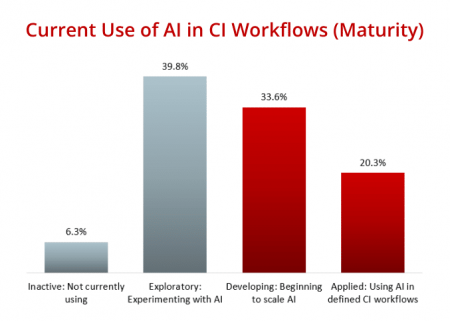
The survey tracked AI maturity across four stages: Inactive, Exploratory, Developing, and Applied. In 2026, only 6.3% of competitive intelligence functions reported being inactive on AI, down sharply from prior years. Meanwhile, 33.6% describe themselves as Developing, meaning they are actively scaling AI, and 20.3% report Applied usage, meaning AI is embedded in defined, repeatable competitive intelligence workflows.
That shift from Exploratory to Developing and Applied is the real story. Experimentation tells you a tool exists. Scaling tells you it works well enough to build a process around. The jump in Developing and Applied usage suggests life sciences competitive intelligence teams have moved past the pilot phase and started treating AI as infrastructure rather than an experiment running alongside their real work.
This trend is not happening in isolation. Leadership pressure to adopt AI tools for competitive intelligence has nearly doubled since 2025, from 15% reporting significant pressure to 26.6% this year. The data shows this pressure and actual adoption are moving together, not pressure without follow-through.
At the enterprise level, 79% of organizations now have an enterprise-wide AI or data initiative in place. But only about a third of competitive intelligence functions report being confidently and explicitly included in that roadmap. A quarter say competitive intelligence is not currently included at all, and another fifth are unsure whether it is. For competitive intelligence leaders, this is worth flagging directly to leadership: if your function isn’t named in the enterprise AI strategy, you may be building AI capability in isolation from the resources and governance the rest of the organization is getting.
Download the full 2026 Life Sciences Competitive Intelligence Survey Report to see the complete AI adoption breakdown, including maturity by company size and function.
Where AI Tools for Competitive Intelligence Are Delivering Real Impact
The survey asked competitive intelligence professionals to rate their AI adoption status across twelve specific use cases, grouped into five categories: Monitoring & Alerts, Research & Synthesis, Competitive Analysis & Mapping, Data Infrastructure, and Predictive Simulation.
The pattern that emerges is clear. Adoption of AI tools for competitive intelligence is highest closest to the data, and lowest closest to the judgment.
Monitoring and alerting use cases show the strongest current adoption. Pipeline tracking and catalyst monitoring is currently used by 39.1% of respondents, and competitive intelligence alerts with insight and context by 28.9%. These are tasks where AI is well suited to the work: scanning large volumes of information continuously and surfacing what matters, tasks that are structured, repeatable, and don’t require the tool to interpret strategic implications on its own.

Research and synthesis use cases show similarly strong adoption. Cross-document synthesis and research sits at 35.2% currently using, and conference abstract and data analysis at 33.6%. Both tasks involve processing large amounts of unstructured information into something a human can act on quickly, which plays directly to what large language models do well.
Predictive simulation, on the other hand, shows the lowest current adoption by a wide margin. AI-simulated competitors for workshops sits at just 7.8% currently using, with 68.8% not using it at all. Competitor probability-of-success modeling shows a similar pattern, at 9.4% currently using and 60.2% not using. These are the use cases that ask AI to do something closer to strategic judgment, and competitive intelligence teams appear to be treating these capabilities with more caution.
This distinction matters for how you think about your own AI in competitive intelligence roadmap. The highest-value near-term AI investments in life sciences competitive intelligence are in monitoring, alerting, and research synthesis, not in predictive modeling.
The Friction Hasn’t Disappeared. It Has Changed Shape.
One of the more counterintuitive findings in this year’s survey is that AI adoption in competitive intelligence has not reduced friction so much as changed what that friction looks like.
Concerns about quality and hallucinations remain the single most cited barrier to AI adoption, at 61.7% of respondents, and that number has actually grown since 2025, up from 53%. This is worth sitting with. As competitive intelligence teams have used AI more, in more workflows, quality concerns have intensified rather than eased. More real-world usage appears to be surfacing more limitations, not fewer.
Difficulty integrating AI into existing competitive intelligence workflows is the barrier that grew fastest year over year, now cited by 38.3% of respondents. As adoption matures from Exploratory to Developing and Applied, integration friction becomes the next real obstacle, and it is the one growing fastest right now.
Limited internal expertise, at 45.3%, and data privacy or compliance concerns, at 42.2%, round out the top barriers. Lack of budget and uncertainty around ROI are cited less often, at 36.7% and 30.5% respectively, which tells you something important: for most competitive intelligence teams, the constraint on AI adoption right now is not money. It is capability, trust in output quality, and the practical work of fitting the tool into existing processes.
AI ROI in Competitive Intelligence: What to Actually Expect
Competitive intelligence leaders considering an AI investment reasonably want to know what kind of return to expect, and on what timeline. The 2026 data gives a grounded answer.
Nearly half of competitive intelligence leaders, 49.3% combined, already report realized or early AI ROI gains, split between 18% reporting clear, realized gains and 31.3% reporting somewhat, or early signs. Another 26.6% say gains have not yet materialized but are expected. Only 7.8% are skeptical that AI will deliver a return at all.
Among those who have not yet realized ROI, the expected timeline varies. The largest group, 32.4%, expects gains within six months to a year. A further 30.5% expect gains within one to two years. Notably, 20% remain genuinely uncertain when, or whether, that payoff will materialize.

The practical takeaway for competitive intelligence leaders building a business case: most of your peers are seeing gains, or expect to within a year or two. Setting expectations at the six-month-to-two-year horizon, rather than promising immediate return, matches what your peers are actually experiencing.
Build vs Buy AI Competitive Intelligence Tools: How the Decision Splits by Company Size
Perhaps the clearest strategic signal in this year’s data is around AI tooling strategy, and it splits sharply by organization size.
Across the full survey, a hybrid approach, combining purchased tools with internal development, is the plurality choice at 47.7%. But that headline number masks a real divide. Large organizations, those above $20 billion in revenue, lean hybrid at 60%. Smaller companies default to buying off-the-shelf tools instead, at 37.5%, their plurality choice, and they are more than twice as likely to still be undecided on their AI tooling strategy altogether.
This makes intuitive sense. Large organizations typically have the internal data science and engineering capacity to build proprietary AI capability on top of purchased tools. Smaller and mid-sized competitive intelligence teams generally don’t have that internal capacity, and buying a purpose-built tool is the more realistic path to actually using AI rather than building it from scratch.
If you’re a competitive intelligence leader at a mid-sized life sciences company weighing build vs buy for AI competitive intelligence tools, this data suggests you are not behind by choosing to buy rather than build. You are in step with your peer group.
This tooling decision also sits inside a larger resourcing picture. Across the industry, AI tools and platforms still account for only 16.9% of primary external competitive intelligence budget, well behind monitoring services and primary research. (Sedulo Group’s analysis of competitive intelligence team structure and budget trends breaks down exactly how competitive intelligence functions are allocating spend across every external category.)
What Competitive Intelligence Leaders Value, and What They Don’t (Yet)
When asked what would most increase their function’s impact, competitive intelligence leaders ranked better technology and AI tools above stronger executive sponsorship, increased budget, and increased headcount, all for the first time in this survey’s three-year history. Better technology and AI tools came in at 45.2%, ahead of improved cross-functional relationships at 37.8% and stronger executive mandate at 31.1%.
At the same time, when asked to rank the skills that matter most for competitive intelligence professionals, Technology and AI tool fluency ranked lowest of five skills tested, well behind analytical and critical thinking. This is not a contradiction. It reflects a mature view of the tool: AI is seen as an accelerant for the judgment and analytical rigor that already define good competitive intelligence work, not a replacement for it.
How AI Sentiment Connects to Competitive Intelligence’s Own Future
The survey also asked competitive intelligence professionals directly whether they see AI as an opportunity or a threat to the profession. The answer is decisively optimistic: 84.5% see AI as at least partly an opportunity. Only 6.5% see it purely as a threat.
What’s more interesting is how tightly this view correlates with confidence in competitive intelligence’s own strategic future. Among those who see AI as an opportunity, 75.7% expect competitive intelligence’s strategic importance to grow over the next five years. Among those who see AI as a threat, only 12.5% expect the same.

This connects back to where we started. AI adoption in life sciences competitive intelligence is not a side project anymore. It is directly tied to whether competitive intelligence functions reach senior leadership, whether they see their strategic influence grow, and how confident the profession feels about its own trajectory.
Where to Go From Here
The 2026 data paints a clear picture of AI in life sciences competitive intelligence. Adoption has matured quickly, but unevenly. Monitoring, alerting, and research synthesis are proven ground. Predictive simulation is still early. Quality and integration concerns are the real barriers left to solve, not budget. And how your organization approaches build versus buy should be shaped by your actual internal capacity, not by what the most visible companies in the space are doing.
If you’re benchmarking your own team’s AI maturity against the rest of the industry, the full 2026 Life Sciences Competitive Intelligence Survey Report includes the complete adoption data by use case, barrier trends since 2024, and the correlation analysis showing exactly what predicts AI success in competitive intelligence functions.
Download the 2026 Life Sciences Survey Report
Get the full dataset, cross-segment analysis, and actionable recommendations for strengthening CI’s influence across your organization.

Frequently Asked Questions
How many life sciences competitive intelligence teams are using AI in 2026?
Combined Applied and Developing AI usage across life sciences competitive intelligence functions reached 53.9% in 2026, up from 29% in 2025. Only 6.3% of teams report being inactive on AI.
What are the best AI use cases for competitive intelligence right now?
The 2026 data shows the strongest current adoption in monitoring and research tasks, including pipeline tracking and catalyst monitoring (39.1% currently using) and cross-document synthesis and research (35.2% currently using). Predictive use cases like AI-simulated competitor modeling remain the least adopted, at under 10%.
What is the biggest barrier to AI adoption in competitive intelligence?
Concerns about quality and hallucinations are the most cited barrier, at 61.7% of respondents, and that figure has grown since 2025 rather than declined. Difficulty integrating AI into existing workflows is the barrier that grew fastest year over year.
How long does it take to see ROI from AI in competitive intelligence?
Among competitive intelligence leaders who haven’t yet realized ROI, most expect gains within six months to two years. Nearly half of all respondents already report realized or early ROI gains from AI.
Should our competitive intelligence team build or buy AI tools?
It depends largely on company size. Large organizations (above $20 billion in revenue) favor a hybrid build-and-buy approach at 60%. Smaller and mid-sized companies more often default to buying off-the-shelf tools, since they typically lack the internal engineering capacity to build proprietary AI capability.
Is AI seen as a threat to the competitive intelligence profession?
No. 84.5% of competitive intelligence professionals see AI as at least partly an opportunity, and that view is closely tied to confidence in the profession’s future. Those who see AI as an opportunity are six times more likely to expect competitive intelligence’s strategic importance to grow.