

Introduction
Somewhere in every enablement team’s shared drive is a battlecard nobody remembers building. It has win themes, objection responses, even a feature comparison table, thorough enough that it probably launched to real fanfare. Nobody can say when it was last touched, or what’s changed in the market since. Ask for the “current” version and the honest answer is that this is the only version, built the day the competitor looked one way and never updated since the competitor started looking different. The battlecard is not wrong, but it is no longer right, and the reps who encounter that competitor already know it. After just a few weeks, most of the commercial team never touches it again.
Most sales enablement programs fail because they are static in a market that isn’t. A better template does not fix that; a different process does. Real competitive intelligence for sales enablement means capturing competitive insight, validating it, and distributing it to reps before they face that competitor again without knowing what changed.
Within this guide, you’ll diagnose your own competitive enablement program, identify where it’s structurally weak, and see what a working competitive intelligence system looks like in practice. If you’re still trying to pin down why deals are being lost in the first place, read Why Are We Losing Deals? The Real Reason B2B Sales Teams Lose Winnable Accounts (And How to Fix It) first. And if you’re looking at this from a broader commercial strategy lens rather than an enablement fix, Competitive Intelligence for Sales Leaders: Turning Field Signals Into Strategy covers how this same field signal feeds strategic decision-making beyond the battlecard.
The Diagnostic: Is Your Competitive Enablement Program Running on a Static Model?
A static competitive enablement program loses value and accuracy between updates. Every week the market moves and the content does not, the program becomes slightly more dangerous. Eventually a rep walks into a deal repeating something that used to be true, and a buyer corrects them in front of the whole evaluation committee.
The questions below have nothing to do with messaging quality or battlecard design. They reveal whether the organization has a mechanism that keeps competitive intelligence current, or whether the whole program is running on a model that decays from the day it launches.
A confident answer to each suggests the organization already has the information system this guide describes. Difficulty with any of them points to a structural gap that better content alone will not close.
When did any battlecard in active use last change, and what triggered it?
If the answer is a specific date tied to a specific event, the program has a feed. Something in the market moved, the system detected it, and the card updated. If the answer is “sometime last quarter” or “after the last QBR,” the card is on a refresh cycle that has nothing to do with when the market actually moves. The competitor does not wait for the quarterly review to make strategic and tactical pivots.
If a competitor changes pricing this week, how does that reach the rep in the next deal?
This question exposes the distribution architecture, or the absence of one. In a working system, the answer is specific: a rep in the field surfaces the change, it gets validated against what others are seeing, and it reaches the broader team within days. In a static program, the answer is a shrug, or “probably a Slack message,” or “they would find out at the next All Hands call.” If there is no defined information path, there is no information system.
When a buyer pushes back with a competitor claim, does that objection get captured anywhere after the deal closes?
This is the question that reveals whether the program learns. Every competitive deal produces intelligence. The buyer who says “your competitor told us they can do X” is handing the organization something valuable, whether the deal is won or lost. In a static program, that information lives in the rep’s head and dies with the deal. In a working system, it feeds the next version of the objection response before the next rep faces the same claim.
Do reps open the competitive assets enablement built, or have they built their own workarounds?
The private spreadsheet a rep keeps with competitive intelligence is a verdict damning the org’s enablement assets to uselessness. When reps build their own competitive notes rather than using what enablement produced, they are telling the organization that the official system failed them. Adoption is the lagging indicator of whether the content was accurate and useful when the rep needed it.
Each of these questions maps to a failure pattern examined below. Every pattern traces back to the same root cause: the program is static.
A Battlecard With No Feed Behind It Expires the Day the Market Moves
If the answer to the first diagnostic question (When did any battlecard last change and what triggered it?) was vague, blame the refresh cycle.
The typical battlecard is built around a moment of organizational pain. A deal goes sideways in a competitive evaluation, leadership asks why, and someone in enablement is tasked with making sure it does not happen again. They pull from recent deal notes, review the competitor’s website, use AI to scrape the web, and maybe have a few conversations with reps who lost to this competitor lately. The card is accurate as of that day. Then it ships, and nothing feeds it again until the next bad quarter, which repeats the process.
The problem is the refresh cycle.
Most enablement functions update competitive content quarterly, which sounds disciplined until you consider that a competitor can reprice, repackage, or reposition in a week. A quarterly cadence means the card always reflects a market from one to three months ago. In a competitive market with active players, that is the window where deals get lost.
This is a structural weakness. There is no mechanism connecting what reps hear in live deals, or what service leads hear about churn tied to a competitor feature, to what’s in the card. That intelligence exists in the field team’s heads, but there’s no information system to collect it.
A rep who walks into a deal with a stale card is carrying a liability. The moment a rep repeats an outdated claim, the conversation stops being about the product and starts being about whether the organization knows its own market.
Without a Named Owner and a Defined Feed, the Program Stops the Moment It Launches
The second diagnostic question (If a competitor changes pricing this week, how does that reach the rep in the next deal?) usually produces one of two answers: a shrug, or a process that depends entirely on one person remembering to act.
Ask who owns the competitive battlecard in most organizations and the answer is a job title attached to someone whose primary responsibility is something else: a Sales Ops Manager with fifteen other priorities, a Product Marketer covering three segments, an Insights Analyst who inherited the folder from the person who left.
When that person is busy, the battlecard does not get updated. When they leave, the enablement program stops. Most organizations do not notice for two quarters, since the assets still exist and get referenced in onboarding, even as they deteriorate in accuracy the whole time.
The fix is a defined feed: a mechanism that continuously moves field knowledge into the enablement system, without depending on any single individual to remember to collect it. It runs whether or not a dedicated function exists.
Objection Responses Built on Assumptions Fail When a Buyer Has a Competing Quote in Front of Them
The third diagnostic question asks whether buyer objections get captured after the deal closes. In most organizations, they are not, which is exactly how static objection responses survive long past their usefulness.
Most objection responses are built in a conference room or by a third-party firm that pulls in a few senior reps and product marketing to workshop the objections they expect to hear: price, implementation complexity, integration risk. The responses get polished, added to the battlecard, and distributed.
The obvious problem is the source of the data: internal assumptions about what buyers are likely to say and what buyers actually do say are two different datasets, and they diverge the moment a competitor changes its pitch.
A buyer who enters a competitive evaluation today is often better prepared than the rep across the table. They have received a competitor’s full sales narrative, including the specific claims about that competitor’s strengths and your weaknesses. When that buyer pushes back, they are pushing back with something legitimate.
The fix is to source objection responses from real deal data: the specific claims buyers raised last week, the competitor language they repeated, and the responses that held up in the deal. That intelligence lives in the field team’s experience, and without a mechanism to route it back into the enablement system, it dies with the deal, leaving the next rep starting from the same outdated boardroom assumptions.
Reps Stop Trusting the System the First Time Static Intel Costs Them a Deal
The fourth diagnostic question (whether reps open enablement assets or build their own workarounds) rarely gets answered in a meeting. It gets answered in the field, silently, one rep at a time.
A rep who repeats a battlecard claim in front of a buyer and gets corrected doesn’t submit a support ticket or email enablement. She opens a new document, starts building her own competitive notes, and stops opening the shared assets, a decision the organization never sees because it’s never made out loud.
By the time enablement notices utilization has dropped, the field has already rebuilt the system in their own notebooks and Slack threads.
Trust lost with one rep spreads to every rep she briefs before the next competitive deal. Outdated content disqualifies everything the information system sends next.
The Fix Is a System, Not a Better Template
The diagnostic questions above share a single answer: the sales enablement program is static. The battlecard on a quarterly cycle, the pricing change with no defined path to the rep, the objection captured nowhere after the deal closes: all symptoms of a program that generates intelligence once and relies on that snapshot until something breaks and forces a rebuild.
The absence of a continuous feed of new, validated competitive intelligence is the problem.
Building that continuous feed takes three stages, in sequence, each dependent on what the previous one produces: sourcing field intelligence, validating it before anything ships, and delivering it to the rep before the next deal. Working together, these stages are what competitive intelligence for sales enablement actually looks like in practice: not a document, a system.
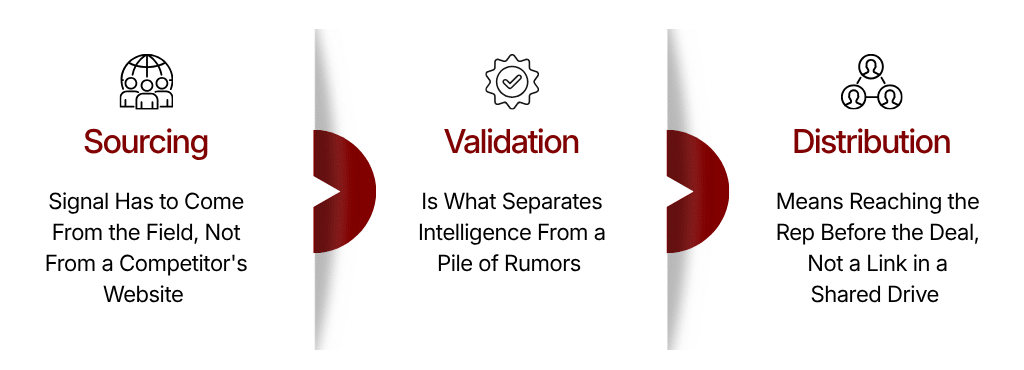
Sourcing: Signal Has to Come From the Field, Not From a Competitor’s Website
Most organizations source competitive intelligence from places that do not produce it. Monitoring platforms index public sources. A competitor’s website shows the positioning they want the market to believe. Press releases announce what they want announced. G2 reviews reflect the customers who felt strongly enough to log in and type something.
The rep who lost a deal last Tuesday to that competitor has better intelligence than any of those sources. She knows what the competitor said about pricing, which claims landed with the buyer, and the objection that stopped her cold. That intelligence expires within 72 hours if nobody captures it.
Field intelligence comes from three places:
- Reps who competed against a specific competitor last week
- Service leads who hear churn signals tied to competitor capabilities
- Buyers who volunteer comparisons during evaluations because they are actively comparing vendors
The information system starts by building a consistent mechanism to capture from all three.
However, field teams produce raw data. Before any of it is transformed into actionable insight, it has to be confirmed and validated.
Validation Is What Separates Intelligence From a Pile of Rumors
A single rep’s account of a competitor pricing change is a data point, not a confirmed market shift worth reacting to.
Left uncontrolled, unvalidated signals can spread fast. One rep posts in Slack that a competitor dropped pricing by 20%, and by end of day the whole team is discounting deals to close now. If the competitor was running a single-SKU promotion, the organization just trained its reps to give away margin against a threat that did not exist.
Validation requires cross-referencing:
- Is the same signal appearing across multiple reps in different territories?
- Does what service leads are hearing align with what sellers reported?
- Can it be confirmed against a public source or a second buyer account?
Validation is also where human judgment creates a ceiling automated systems cannot reach. A monitoring tool can surface a signal, but it cannot determine whether that signal represents a competitive shift or a blip. That judgment belongs to someone who understands the market. Keeping a human in the loop ensures someone owns the effort, rather than leaving it to run unsupervised.
By itself, validated intelligence isn’t valuable until it reaches the right stakeholder at the right moment.
Distribution Means Reaching the Rep Before the Deal, Not a Link in a Shared Drive
The shared drive is where intelligence goes to die. Reps do not open folders before a competitive call; they scan whatever surfaces in the tools they are already inside.
Timing determines whether intelligence is actionable. Validated intel about a competitor’s new pricing structure, delivered two hours before a buyer meeting, is perfect. That same intel, dropped in a monthly newsletter, never reaches the deal it was built for.
Distribution architecture means routing the right information to the right rep at the right moment: pushing updates into the CRM, into the call prep workflow, into Slack tagged for the relevant territory. The format is designed for pre-call consumption. If a rep needs ten minutes to find and read it, the insight is too far away.
The rep who encounters a competitive objection during discovery should already have seen the validated response in their systems and workflows. If the intelligence arrives after the conversation, the system missed the moment it was built to serve.
Distribution is the make-or-break point for the entire system. Without it, no amount of collection or validation matters.
FieldForce: How the Always-On System Works in Practice
The three stages described above define what a working information system requires.
FieldForce is the system that runs it:
- Collection: AI-led interview engine capturing field intelligence on a recurring cadence
- Validation: Sedulo analysts validate insights and deliverables before they go out to any stakeholder
- Distribution: Output reaches reps through the tools they already use
The AI-Led Interview Engine Captures Field Intelligence Without the Rep Overhead
The objection that kills most field intelligence programs before they launch is: “How much of our sales reps’ time will this take up?” Asking reps to file competitive reports after every deal is asking them to do a second job. Most will do it twice, then stop, and the program dies.
FieldForce does not ask reps to file reports.
The capture mechanism is an AI-led interview engine that contacts reps on a structured cadence, asks a short list (fewer than 10) of targeted questions about what they encountered in recent deals, and extracts competitive intel without requiring reps to sit down and compose anything. It’s built for stray moments between calls: a rep who spent the morning in a competitive evaluation can answer a couple of questions about what the competitor said and what landed before the day is out.
The questions are calibrated to the competitors active in that rep’s territory, the deals in their pipeline, and the objections that have surfaced recently across the team. A rep is never asked to summarize a full quarter or every competitor, just what they saw and learned this week.
The engine runs across the whole field organization, not just reps who raise their hands, so what gets captured doesn’t depend on who happened to submit something. Coverage is continuous across the full team, independent of deal outcomes.
Sedulo Analysts Validate Every Signal Before Anything Ships
Every submission gets reviewed by Sedulo analysts before it routes into the enablement system.
Validation is pattern recognition. An analyst sees three reps in different territories reporting the same competitor claim in the same week and confirms that claim has entered the competitor’s active pitch. One rep’s account of a new pricing structure, or any input that looks like an anomaly, stays flagged until more data arrives.
This is where monitoring platforms reach their ceiling. They index public-facing sources and surface changes as they happen, a competitor’s pricing page update, a product announcement, a job posting signaling a new segment push.
What they cannot capture is what that competitor’s rep said in a deal last Thursday, or how a buyer described a competitor’s implementation during a live evaluation. Validating it requires someone who understands the market and can read context across everything coming in.
FieldForce and a monitoring platform are not mutually exclusive. They source from different places and gather different intelligence. If the organization already has public monitoring covered, the field intelligence layer fills the gap that platform cannot reach.
The analyst layer also means the organization doesn’t need another dedicated internal resource to run this: that pattern matching and judgment call sits inside FieldForce, and enablement’s job becomes stakeholder alignment, not intelligence production.
When something ships, reps know it cleared that process. That is what rebuilds the trust a static program erodes.
Validated Intelligence Routes Into the Tools Reps Already Use
Validated intelligence goes where reps already are. FieldForce output is formatted for the CRM, for call prep tools, for Slack channels segmented by territory and competitive set. A rep preparing for a deal sees what that competitor has been saying in recent deals, which claims are landing with buyers in similar segments, and what objection responses have held up under pressure. It arrives in the tool the rep opens before the call.
The cadence is continuous, so reps don’t have to go looking for a “v6” or “2026 Q3” version of a battlecard to check it’s current. When a competitor reprices, the change enters the engine within days, clears validation, and routes to the relevant reps before the next deal. The system updates because it caught something, not because the calendar said it was time.
That is the difference between a refresh cycle and a feed.
Case Study
A Fortune 500 packaging company had built a full battlecard library: objection scripts, feature comparisons, market monitoring tools. Reps had quietly stopped opening any of it. Nobody had touched the content in eight months, and the sales team had gone back to trading competitive notes over Slack instead.
The enablement program was static. There was no mechanism connecting what reps were hearing in the field to what sat in the shared drive. When the market moved, the battlecards didn’t, and reps knew it before enablement did.
The intelligence existed. Reps had been fielding a new competitor claim around implementation speed for weeks. It was sitting in their heads, in personal notes, and in Slack threads that never reached the objection responses reps were supposed to be using.
Sedulo deployed FieldForce across the full commercial organization. The AI-led interview engine asked reps targeted questions tied to the competitors appearing in their active pipeline. Within two weeks, the same claim had surfaced in submissions from reps across four separate territories. The pattern was not anecdotal.
Sedulo analysts validated it against public sources, confirmed the competitor had updated its website language and was referencing go-live timelines in published case study content, and flagged the signal for immediate distribution. Within weeks of launch, the validated response was live in the CRM sidebar and the Slack channel the team already used for competitive deal support, not sitting in a battlecard update nobody opened.
Objection handling stopped being guesswork. Reps cited the validated response instead of repeating a stale claim, and by the next QBR, the assets enablement built were the ones the field team was actually using.
Where to Go From Here
The four diagnostic questions from the opening of this guide were a structural test.
Two or more shrug answers identify a structural gap: the program is distributing static content into a market that moves faster than the refresh cycle, decaying from the day it’s identified.
A working information system changes what feeds the sales enablement assets. Sourcing, validation, and distribution running as a continuous system means the tools sales relies on stay accurate and timely.
The program that looks like an enablement problem is usually an infrastructure problem. If the diagnostic questions above surfaced more shrugs than confident answers, the fix isn’t another battlecard rewrite; it’s building the system underneath it.
To see how FieldForce keeps competitive intelligence sourced, validated, and delivered straight into the tools your reps already use, click here to learn more about FieldForce.
Frequently Asked Questions (FAQs)ted.
What is competitive intelligence for sales enablement?
Competitive intelligence for sales enablement is the practice of capturing what competitors are doing in live deals, validating it, and delivering it to reps in a usable form before they face that competitor again. It covers pricing changes, positioning shifts, product claims, and the objections buyers raise on a competitor’s behalf. Effective competitive intelligence is a continuous feed that keeps enablement content current as the market moves.
Why do sales battlecards go stale so quickly?
Battlecards go stale because they capture a single snapshot and have no mechanism to update it. A card built this quarter reflects the competitive landscape as it existed the day it shipped. A competitor can reprice, repackage, or reposition in a week. Most enablement functions update competitive content quarterly, which means the card always trails the market by one to three months. The staleness is structural, not a content quality problem.
How do you build sales battlecards that work?
Reps use a battlecard when it is accurate at the moment they need it and reaches them where they already work. That requires two things a static card lacks: a feed that updates the content as the market moves, and distribution into the CRM or call prep tools reps open before a deal. Sourcing the content from real field intelligence rather than a competitor’s website is what makes it accurate. Continuous updating is what keeps it that way.
What is an objection handling framework and how should it be built?
An objection handling framework is a structured set of responses to the pushback buyers raise during competitive evaluations. Most are built in a conference room from what the team expects buyers to say. That is the wrong source. Buyers push back with the specific claims a competitor made to them, and those claims change as the competitor changes its pitch. Build the framework from real deal data: the objections buyers actually raised, the competitor language they repeated, and the responses that held up in the deal.
How do you get competitive intelligence into the CRM workflow?
Route it into the tools reps already use rather than a shared drive they never open. That means pushing validated intelligence into the CRM sidebar, into call prep workflows, and into Slack channels segmented by territory or competitive set. Format matters as much as placement. Intelligence built for pre-call consumption reaches the deal it was built for. A document that takes ten minutes to find and read does not.
Do you need a dedicated CI team to run this?
No. The intelligence work, source triangulation, pattern recognition across the field, judgment on what’s signal versus noise, can sit with a research partner rather than an internal function. FieldForce runs the capture and validation externally, leaving enablement responsible for distribution, not intelligence production. Organizations without headcount for a standing CI function can still run a working information system.
What is the difference between a monitoring platform and sales enablement CI?
A monitoring platform indexes public sources: pricing pages, press releases, job postings, product announcements. Sales enablement CI captures what happens in deals: what a competitor’s rep said, which claims landed with a buyer, and what objection stopped a rep cold. Monitoring platforms like Crayon and Klue catch public-facing changes, but they cannot capture what a competitor said in a live evaluation, because that information exists in no public source. The two are complementary, not redundant.
How do I equip my sales team with competitive intelligence?
Equipping a sales team means giving reps accurate, current information at the moment they need it, not a static deck they reference during onboarding and never open again. That takes a source of continuous field intelligence, a validation step so reps aren’t acting on rumor, and a distribution path into the tools reps already use for call prep. Teams that skip any one of those three steps end up back where most enablement programs start: a battlecard that was right once and a sales team that has stopped trusting it.
How do you measure whether competitive enablement is working?
The clearest measure is win rate against specific named competitors, tracked over time. Supporting indicators include the time between a competitor’s move and the update reaching reps, adoption of enablement assets versus reps building their own workarounds, and whether objections raised in deals get captured and fed back into responses. Falling adoption is the clearest sign the content stopped being trusted.