

The most recent QBR deck shows a four-point drop in win rate against a competitor the team has been consistently beating for years. What’s changed?
The best answer with the leadership team is that the competitor seems to be pricing more aggressively, but they don’t know when that started or why the competitor decided to price lower lately.
In reality, nobody in the boardroom knows what happened.
The pricing move occurred six months ago. Reps encountered it in deals starting back in Q2. The pattern was in the market long before it reached the QBR deck. By the time leadership identified it as a threat, it had shaped outcomes across multiple quarters of deals.
This is how most sales leaders learn about competitive threats: after the fact, through a metric that confirms the damage is done. Win rate shows what happened. Pipeline coverage shows how much is at risk. Neither shows what is happening in the market right now, and neither delivers that signal in time to change anything.
The organizations that consistently outmaneuver competitors focus on capturing insights directly from the field, validating them, and delivering them to leadership at the right time and in the right format.
The rest of this piece works through what building that system requires, how to tell if yours is already running on lagging intelligence, and what good looks like.
The Diagnostic: Is Your Organization Running on Lagging Intelligence?
Before continuing, apply this quick test and go through the questions below:
- When a rep loses a deal to a competitor, is the reason captured in your CRM useful for a strategic response?
- Did your last formal win/loss review touch on deal data more than 90 days old?
- The last time a competitor made a pricing move or product announcement, did you learn about it from a rep or from a structured internal system?
- Do you have a competitive intelligence program? If yes, does it have resources?
- Has your battlecard library been meaningfully updated this quarter? What about last quarter?
- If a new competitor entered your primary segment today, would you be more likely to hear about them from a prospect or an internal system?
- Do you know how the market views your company? Are you sure?
These questions are written to lead the witness. You should be able to tell if you’ve answered correctly or incorrectly. If you had difficulty with any of them, you may have a structural gap examined below.
CRM Loss Reasons Capture What Happened, Not Why the Competitor Won
Your CRM has a clean record of every lost deal: stage history, close date, amount, and a loss reason picked from a dropdown. What it doesn’t have is what the competitor actually said or what the buyer was weighing when they decided. That gap is the difference between knowing a deal was lost and knowing why a pattern of deals keeps going the same way.
Fixing that gap deal by deal is rep-level diagnostic work, and it matters.
For a deeper dive into diagnosing root causes behind lost deals, read Why Are We Losing Deals? The Real Reason B2B Sales Teams Lose Winnable Accounts (And How to Fix It).
The question that matters at the leadership level is different: when a rep does get a real answer, does it ever reach anyone positioned to act on the pattern across deals, or does it stay a dropdown value nobody revisits? In most organizations, it’s the latter. Sales teams have robust CRM tools, call logs, and deal notes, and none of them are aimed at surfacing competitive intelligence to the people who need it.
A Win/Loss Review Built on 90-Day-Old Data Is Analyzing a Market That Has Already Moved
Win/loss reviews are useful, and every deal in them was active three to six months ago. Whatever your biggest competitor has done since then, repriced, repositioned, shipped a feature your reps are now fielding questions about, won’t show up until the next review cycle, if it shows up at all.
We run win/loss programs for some of the largest companies in the world. They’re built to explain what already happened, usually at least a quarter behind, and that’s a fine tool for broad buyer-journey feedback. It’s the wrong tool for a real-time competitive response, and no amount of rigor in the review process changes what the data can and can’t tell you.
By the Time a Pricing Move Reaches Leadership the Damage Is Done
In most organizations, competitive intelligence surfaces through informal channels. News travels through conversation rather than through a system. There is no mechanism aggregating what multiple reps in different territories independently encounter. One rep’s observation may reach leadership only because that rep happened to mention it at the right moment to the right person.
For example, a competitor introduces a multi-year discount. The first rep who encounters it mentions it to her manager. Six weeks later, after three more reps in separate regions lose to the same offer, someone finally puts it on the QBR agenda. The discount ran unanswered for a quarter and a half before it became a named problem.
A CI Program That Stalled for Headcount Reasons Will Stall Again for the Same Reason
Most organizations have attempted competitive intelligence in some form. Most have also watched it fall apart for some reason. The most common pattern we see is that ownership is assigned to someone with other priorities, or the program launches without dedicated resources. It might hold for a quarter before collapsing under the weight of other priorities or the next budget cut.
A CI program that stalled for resource reasons was structured as a side project. Any rebuild using the same architecture will produce the same result.
The result of an underfunded CI program is that a product marketer will inherit a battlecard folder when the previous owner leaves. They will waste their time updating it maybe once or twice before getting sent on other priorities. Over the next two quarters, market conditions shift and the battlecards don’t. By the time someone flags it, the battlecards reflect a competitive landscape from six months ago.
A Battlecard That Has Not Changed in Two Quarters Is a Competitive Threat Detection Failure
A rep walks into a competitive evaluation with a battlecard that hasn’t been updated since last year. She cites a platform limitation for a competitor. The buyer she is talking to just got off a phone call with that competitor, who spoke directly to their new platform… which doesn’t have that limitation. This sales conversation stops being about the product, and now the buyer doesn’t trust you to know your own market. How can you be innovative if you don’t even know what competitors are doing?
Battlecards are built at moments of organizational pain and updated on planning cycles, not market cycles. A competitor can reprice, repackage, or reposition in a week. A quarterly refresh cadence means the card always lags the market by at least one cycle.
We regularly see battlecards that haven’t been touched in two or three quarters (sometimes years) still sitting in CRMs as the active version. Nobody flagged them as outdated because nobody owns the update between planning events.
The First Mention of a New Competitor Shouldn’t Come From a Prospect
Most organizations have no structured mechanism for early competitive detection. They learn about new entrants when they encounter them in deals, usually only after a prospect or client brings them up.
If the first internal signal of a new competitor comes from a prospect, that competitor has established enough of a presence to appear in live competitive deal evaluations. That takes time. Meanwhile, the competitor has been in market building traction while you had no awareness of them.
The sales team has no competitive brief, no positioning response, and no understanding of where the entrant wins. The deal is already at risk from a competitor the organization learned about one call too late.
Market Visibility Is Only as Current as Your Last Conversation
Without structured field capture, leadership’s understanding of how the organization is perceived in the market depends on what their reps proactively share, what is in deal notes, and what managers synthesize informally.
Rep intuition is the source of the real intelligence leadership needs, but it is also unvalidated, unevenly distributed, and rarely documented.
The field organization generates competitive signal every day, but if you’re this deep into this article, I can bet that you don’t have a structure that captures it, validates it, and routes it to the people who can act on it before the window closes.
Sales Leadership Metrics Beyond Win Rate
Every gap above shows up first in operational reality, months before it shows up in a number leadership actually reviews. That’s not a coincidence. Win rate and pipeline coverage are the two metrics most sales leaders default to, and both are lagging by design: they measure deals that already closed or are already at risk, not what’s forming in the market this week.
A sales organization with real market visibility tracks a different set of signals: leading indicators that surface before they show up in a quarterly number.
- How many competitive threats are currently being actively monitored and validated, versus how many are sitting undetected in live deals.
- How fresh the battlecard library is against how fast the competitive landscape is actually moving, not against the last planning cycle.
- What percentage of deals generate a captured, validated competitive signal versus a CRM dropdown selection.
- How long it takes a signal from the field to reach a decision-maker who can act on it.
None of these show up on a standard sales dashboard, which is the actual gap behind all seven questions above. If the only competitive metrics your leadership team reviews are win rate and pipeline coverage, you are, by definition, only finding out about competitive threats after they’ve already cost you deals.
What Do You Need to Do to Fix This Problem?
You have probably already tried to fix this. Whether you changed the “Loss Reasons” in Salesforce, built a new Slack channel for competitive intel, or sent out a rep survey a few times, you’ve been here before.
The problem isn’t effort or intention. It’s architecture. The intelligence doesn’t flow because you don’t have the correct capture mechanism built.
A continuous field intelligence system requires three functional capabilities that are not typically found in your standard sales infrastructure. Whether you build this internally or bring in a partner, this is what to hold any option against.

Capture Must Be Structured, Recurring, and Low-Friction
Every initiative that asked reps to do something extra on top of a full deal load will fail. Reps are paid to close deals, not to maintain your intelligence infrastructure.
Capture has to happen at a natural deal lifecycle moment, in a quick format. An AI-led interview engine that surfaces targeted questions at the right moment captures substantially more usable signal than a CRM field or a post-call survey.
The design constraint is friction. The moment sharing new insights competes for a sales rep’s time against selling activities, selling wins… and it should. That’s what you’re paying them for. Pay someone else to build the infrastructure to capture the insights within their heads.
If you’re assessing whether an internal effort or a vendor actually solves this, start here: does it ask reps to do new work, or does it fit inside how they already sell? Most CI programs fail this test in the first month.
Learn more by reading Competitive Intelligence for Sales Enablement: A Practical Guide.
Validation Separates Competitive Pattern from Individual Experience
Your best rep tells you a competitor has dropped pricing by 20%. Maybe they have. Maybe their prospect who told them this is lying. Maybe the competitor ran a one-time promotional discount in one territory.
Without validation, you don’t know which is true. And if you act on the wrong one, you’ve trained your whole team to preemptively discount against a threat that doesn’t exist.
Validation means cross-referencing what one rep surfaces against what others are seeing. A single new piece of intelligence is something to watch. The same intelligence appearing across four reps in three regions is something to act on. That distinction is where most internal programs fall apart.
Organizations that skip validation produce intelligence the field does not trust and therefore does not use. Then all of the investment you just spent building up an infrastructure to capture these insights won’t produce an ROI.
The question worth asking of any program, internal or vendor-run, is who does the cross-referencing and how many independent sources it takes before something gets called a pattern. If the answer is “we trust the rep who raised it,” that’s not validation.
Distribution Must Route Intelligence Into the Decisions, Not Shared Drives
You can capture new information, validate it, and still produce nothing useful for sales reps.
If your intelligence ends up in a folder someone has to remember to open before a competitive call, it won’t get used.
The rep about to walk into a deal needs intelligence before the call and in a format built for pre-call consumption. Similarly, your VP of Sales needs that information in a very different format.
- A pricing pattern belongs in the CRM sidebar for a rep to use.
- A pricing pattern also belongs in a short memo to the VP of Sales before the next planning cycle.
Same intelligence, different stakeholder, different timing, different format. Intelligence that reaches the right person after the relevant decision window has closed is documentation, not intelligence.
Most internal CI programs cover capture, skip validation, and treat distribution as an afterthought (“just throw it into our SharePoint”). The result is a program that produces insights nobody reads. The routing question is as important as capture and validation combined: who needs which signal, in what form, and by when.
It’s also worth being clear about who this reaches beyond the sales floor. A validated pricing pattern or recurring objection isn’t just a rep enablement problem: it’s GTM strategy input. The same signal that tells a rep how to handle an objection this week is also the evidence a pricing team needs to decide whether to adjust packaging, or a product marketing team needs to reposition against a specific competitor’s new play. Most CI programs stop at the battlecard. The organizations that get the most value out of field intelligence route it into pricing, packaging, and segment-prioritization conversations too, not just the next sales call.
FieldForce Runs This Intelligence Cycle Continuously Across the Whole Field Organization
FieldForce is a continuous field intelligence system built on an AI-led interview engine that operates across the full sales organization, independent of deal outcomes. It captures competitive signal at the deal level on a recurring basis, validates it across the rep population with Sedulo’s human research team, and sends structured intelligence to the stakeholders who need it by when they need it.
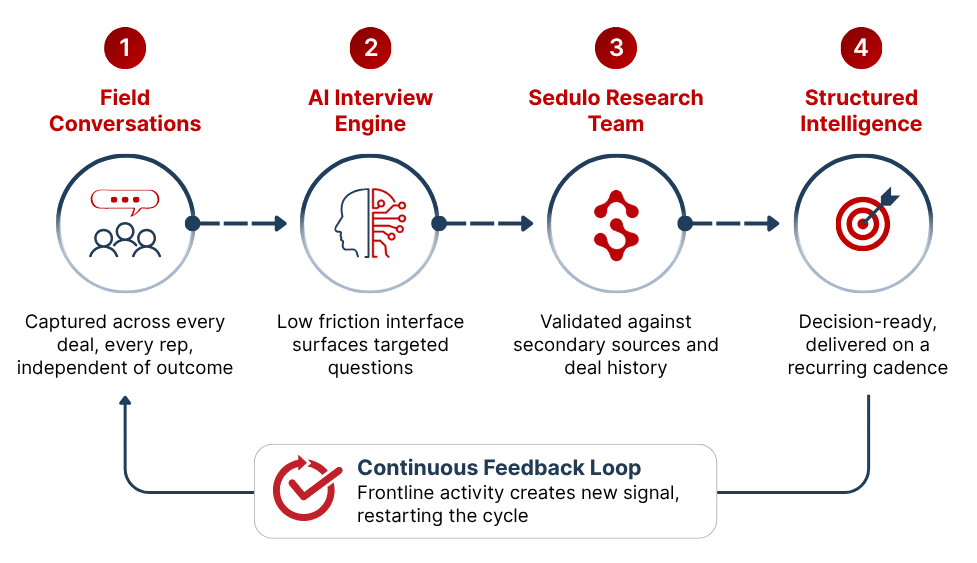
Reps are not asked to file reports or populate CRM fields with structured competitive data. The interview engine surfaces targeted questions through a low-friction interface. The insights are captured across the field. Sedulo’s consultants process these insights against secondary sources and historical deal patterns. Once approved, the system packages the information as decision-ready intelligence rather than raw field notes.
For a closer look at how enablement teams operationalize this kind of capture without adding to rep workload, see Competitive Intelligence for Sales Enablement: A Practical Guide.
You probably already have a competitive monitoring tool. Crayon, Klue, Kompyte. They catch what competitors publish in the public domain: pricing page updates, product announcements, job postings that signal a new segment push.
FieldForce captures what none of those platforms reach: unstructured, deal-level intelligence from active sales conversations:
- The objection appearing across six reps this quarter in a specific segment.
- The pricing narrative a competitor is running in mid-market that has not yet shown up in any public announcement.
- The product gap that is costing deals your CRM records only as “lost to competitor.”
That signal does not exist on a public website. It lives in the field, and it disappears when the call ends… unless something is built to capture it on a recurring basis. FieldForce is built for that.
What This Actually Looks Like Inside a Sales Organization
Here’s what life could look like if FieldForce was launched:
- A competitor privately starts discounting to win three-year commitments.
- Your reps start losing deals they expect to close.
- Within two weeks, enough of them have flagged it through the interview engine that Sedulo can see and validate the pattern.
- You get a brief on the topic before it shows up in your pipeline report: what the competitor is offering, which segments it’s appearing in, which deal stages it’s hitting hardest, and how to respond.
- Your reps walk into the next competitive deal with an answer.
Without FieldForce, that same sequence takes a quarter… maybe longer.
The losses accumulate. Someone notices the pattern at the QBR and eventually a response gets developed.
With FieldForce, the entire conversation within a QBR changes. Instead of identifying and diagnosing problems, the competitive loss patterns are already documented, attributed, and the QBR is focused on brainstorming a solution and response. Then, at the next QBR, the conversation opens on whether the response is working, where the next competitive pressure is forming, and what the field signal indicates about the following quarter. That is a materially different use of leadership time, and, we’d argue, a more valuable one.
Why This May Not Work…
“Reps are already survey-fatigued. Another capture tool won’t get used.”
Reps won’t engage with another survey, but FieldForce isn’t one. The interview engine surfaces a handful of targeted questions at natural moments in the deal cycle. It feels interactive, natural, and only takes minutes. It’s not a form to fill out at the end of the week when the details are already blurred.
And when reps see a battlecard update two weeks later that reflects exactly what they flagged, they prioritize the next round of AI interviews because they know it comes back to help them. Participation holds strong when the output is visible, but it will die when capturing insights feels like more paperwork.
For the clients we’ve launched FieldForce with, we’ve seen a >90% response rate each wave of AI interviews.
“Can’t we use AI or a tool like ChatGPT for this?”
Public-facing AI tools synthesize what is already published about competitors. They cannot generate insights that do not exist in any public dataset. A language model will tell you what Gartner wrote about a competitor’s positioning last year, but it will not tell you what objection is showing up across six mid-market deals this quarter.
The two capabilities serve different functions.
Retrieval of public competitor information is worth the effort and very easy to do with AI models like Claude and ChatGPT. FieldForce does not replace this. FieldForce collects knowledge that only lives with your field team.
“We don’t have a dedicated CI team or the headcount to build one.”
This is the build vs. buy question in miniature. FieldForce operates without a CI team inside the sales organization. The interview engine runs autonomously on deal cadence. The validation and synthesis work sits with Sedulo’s research team. What you provide is access to the field: specifically the reps and deal flow that generate the insights. Then tell us where to point the output, which stakeholders and which formats.
Building it internally is the version that requires headcount. Someone has to run capture, someone has to validate what comes in, and someone has to own distribution. No CI team, no way to build this internally, but you can always partner with Sedulo to get to the same place.
“What does this cost in rep time, and is it worth it against what we’re doing now?”
Responding to the interview engine takes minutes per deal cycle. The heavier organizational lift is during onboarding (building your industry baseline knowledge facts, identifying key competitors, understanding products, etc.).
However, the more useful question is: “What are reps spending time on right now by not having accessible and validated competitor information?”
Take the deals lost where your team had no good answer to a competitor’s pitch. Add the ones that will go the same way next quarter because nothing has changed. That’s the actual cost of the current state, and it compounds every quarter you wait.
Where to Go From Here
Go back to the seven questions at the top of this post. If you knew the right answers while reading them, and knew your organization wasn’t there, the rest of this post hopefully explained why.
The decision isn’t whether competitive intelligence matters. The decision is whether to build a system that helps you internalize, capture, validate, and share competitive intelligence automatically, or not.
We have helped some of the largest sales organizations in the world close the gap between what the field team knows and what leadership needs to know. We can help you too.
Frequently Asked Questions
What is competitive intelligence for sales leaders?
It’s the practice of capturing what your field team learns in live deals (e.g., what competitors are saying, how buyers are responding, what’s changing in the market, etc.), validating it, and getting it to the people who can act on it before the next deal runs the same pattern. It’s different from competitor monitoring, which only tracks what competitors publish. This captures their actual actions within the deals your field team is competing in every day.
How is field intelligence different from a win/loss program?
A W/L program tells you why you lost or won a deal that closed. Field intelligence tells you what’s happening in deals that haven’t closed yet. You probably need both. They’re not the same thing, and one doesn’t replace the other.
Does this require a dedicated CI team?
No. FieldForce runs on Sedulo’s infrastructure. Your team provides access to the field reps, and we work with you to determine which stakeholders receive which outputs.
How quickly does an insight surface after it appears in deal conversations?
Typically two to three weeks from the first rep flagging it to a validated pattern reaching leadership. Fast enough to respond before it shows up in closed-lost data.
How is FieldForce different from Crayon, Klue, or Kompyte?
Those platforms track what competitors publish. FieldForce captures what they say in your deals, which never gets published anywhere. If you already have a monitoring tool, FieldForce fills the gap it can’t reach.
How do I build the internal business case for this?
Start with what you already know. Take the deals your team lost because nobody had a good answer to the competitor’s pitch. Estimate the value. That’s your baseline. The question is whether that number is big enough to warrant an investment to fix.
How does this fit into our broader GTM strategy, not just sales enablement?
Field intelligence is an input, not just an output for reps. The same validated signal that updates a battlecard also belongs in pricing, packaging, and segment-prioritization conversations. If the only place this intelligence lands is the CRM sidebar, you’re using a fraction of what it’s worth. Organizations that get the most value route it to whoever owns the GTM decision it affects, not just to the field.
What results should we expect to see, and on what timeline?
Most clients see the first validated pattern within two to three weeks of launch. The metric to watch isn’t win rate, since that will always lag. Watch whether competitive threats are getting flagged and validated before they show up in closed-lost data, and whether battlecards are staying current against the market instead of the planning calendar. Those are the leading indicators that tell you the system is working before the quarterly numbers do.