

Introduction
It’s no secret that in the life sciences industry the degree to which the CI function is integrated in planning and decision-making varies from one organization to the next. But in an increasingly competitive industry, where competitive pressures continue to rise, the strategic importance of CI has never been greater.
Why? Because CI enables companies to anticipate competitor moves, regulatory and market shifts, and clinical development trends, and take action ahead of time rather than react after the fact. As pipelines become more crowded and development timelines increasingly overlap, the ability to identify and interpret early signals is becoming a major competitive advantage.

For this reason, CI is becoming an increasing strategic priority for many organizations. To demonstrate this trend, Sedulo Group’s pioneering industry-wide CI survey, first released in 2024, found that the CI function had already been integrated into strategic planning within the majority (64%) of larger life sciences organizations with a headcount above 1,000.
Since then, we’ve further explored the drivers of high-impact CI through two additional primary research initiatives involving subject matter expert interviews, and our 2025 survey has continued to demonstrate the growing influence of CI across commercial strategy, launch planning, and organizational decision-making.
With these rich data sources, combined with extensive internal knowledge, we offer a wealth of knowledge and tools to help life sciences organizations to increase the impact of CI:
- An evidence-based framework on how to create strategic foresight from signals (read From Signals to Strategy: A Modern Framework Competitor & Market Monitoring in Life Sciences)
- A cross-functional launch planning roadmap for leveraging market and competitive insights
- Access to our Annual Life Sciences CI Survey
In this post, we’ll share five recommendations pulled from across our research and tools on how to increase the strategic impact of CI in life sciences organizations.
1) Build a CI model around strategic foresight and early warning intelligence
Start by assessing your CI capability maturity level using a framework such as a CI maturity model (see Figure 2). As maturity increases, CI functions evolve from simply tracking competitors toward supporting broader business decision-making and strategic foresight.

Importantly, each monitoring framework should be treated as unique rather than as a one-size-fits-all approach. CI teams should dedicate time to understanding stakeholder priorities and decision-making processes, defining Key Intelligence Topics (KITs) and Key Intelligence Questions (KIQs), and mapping them against strategic goals. This helps ensure monitoring activities remain purposeful rather than becoming reactive or distracted by noise.
A modern CI model should aim for proactive foresight rather than retrospective analysis. Effective early warning systems integrate multiple forms of monitoring, including scientific, clinical, commercial, regulatory, payer, corporate, and market signals, alongside primary research and conference intelligence. Together, these provide a more complete view of how competitors and markets may evolve over time.
From signals to strategic foresight
Once a monitoring framework has been defined, implementation should involve a structured process for transforming raw information into actionable intelligence.
Signals first need to be filtered and validated so that meaningful patterns can be identified from the constant flow of market information. From there, CI teams can develop coherent intelligence narratives and contextualized insights that provide foresight into competitor strategies, evolving treatment landscapes, or future market dynamics.
The next step is translating those insights into implications and strategic action. This may involve asking questions such as:
- What does this mean for our trial design?
- How could this affect launch strategy or positioning?
- What are the implications for pricing, market access, or field force deployment?
- How should scenario planning assumptions change?

Importantly, information should be validated before being used in strategic decision-making, whether through triangulation across multiple sources, stakeholder discussion, or primary research to deepen contextual understanding.
Read more about how to build a modern framework for competitor and marketing monitoring by downloading our white paper From Signals to Strategy: A Modern Framework Competitor & Market Monitoring in Life Sciences.
2) Optimize access and engagement with stakeholders
Access to stakeholders and regular engagement cannot be underestimated when it comes to increasing the strategic impact of CI.
Sedulo data from the Annual Life Sciences CI Survey 2025 showed that, according to CI professionals, the most important factor for increasing the strategic impact of CI was better access to stakeholders (see Figure 3). Professionals who reported that CI had a high strategic influence within their organizations also demonstrated significantly higher levels of stakeholder engagement, with around one-third reporting daily interaction with stakeholders.
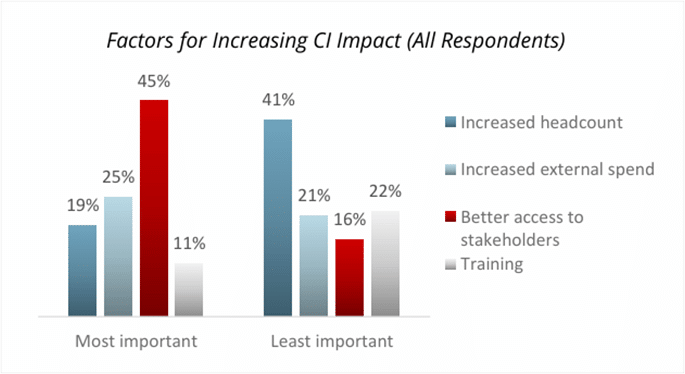
Our interviews with launch planning leaders reinforced this finding. For CI to exert greater influence, leaders need to establish the CI function as a strategic partner early and continuously through direct collaboration with Commercial, Clinical Development, Medical Affairs, Market Access, and Brand teams.
This level of integration allows CI teams to anticipate stakeholder needs proactively rather than simply responding to ad hoc requests. It also helps ensure that intelligence outputs are aligned to real business decisions rather than becoming generic reporting exercises.
Equally important is tailoring outputs to the audience. Senior leadership often requires concise, implication-focused summaries, while operational teams may need more detailed analyses and supporting evidence. High-impact CI teams understand these differences and adapt their communication style accordingly.
Read about how to increase stakeholder engagement and satisfaction in the recommendations section of our Annual Life Sciences CI Survey Report, 2025.
3) Leverage CI for “launch excellence” and “launch readiness”
According to Deloitte data, 58% of missed pre-launch expectations are due to poor product differentiation compared with competitors. This highlights one of the most strategically important uses of CI: improving launch readiness and launch excellence.[6]
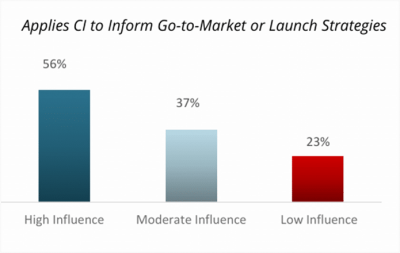
The Sedulo Group 2025 Annual Life Sciences CI Survey found that organizations where CI had a high influence on strategic planning were also far more likely to use CI to inform go-to-market and launch strategies. As the strategic influence of the CI function declined, so too did the use of CI to proactively support launch preparation (see Figure 4). The majority of survey respondents (56%) who reported high CI influence on strategic planning also reported that CI is used to inform Go-to-Market and launch strategies.
How to use CI to strategically prepare for launch
For CI to be used effectively to improve launch performance, CI needs to understand what key decisions competitor and market insights will be informing throughout clinical development, and how these help define product positioning during this early period, not just in the penultimate year before launch. During early development, CI should help shape indication strategy, evidence generation planning, and product differentiation. As products move into phase 3, competitor trial design, endpoint selection, messaging, and market positioning become increasingly important.
CI teams should then understand the strategic shift that typically happens two years ahead of launch, when competitor tracking intensifies, local leadership teams become more involved, and organizational priorities shift toward launch execution. Then, as phase 3 data is published and core product messages are formulated at a global level, scenario planning, competitor benchmarking and shadow brand plans start to bring real value across stakeholder teams.
Crucially, CI and external CI thought partners can also provide an important layer of objectivity. Brand teams can naturally become highly attached to their assets over time, which sometimes creates “rose-tinted glasses” around positioning or competitive risk. Experienced CI partners can act as valuable checks and balances by challenging assumptions and providing independent perspective.
Read more about how to build a modern framework for competitor and marketing monitoring by downloading our white paper Insights-Driven Launch Planning: A Cross-Functional Roadmap for Leveraging Market and Competitive Insights.
4) Recognize that external CI budgets matter
Our research also showed a strong relationship between external CI investment and strategic influence. In the 2025 Annual Life Sciences CI Survey, increased external spend was identified as the second most important factor for increasing CI impact. Organizations reporting high strategic influence had an average external CI budget of approximately $2.5 million, compared with $1.5 million among those reporting moderate influence and $0.5 million among those reporting low influence. This likely reflects the additional expertise and capabilities required for high-impact CI, including primary research, conference coverage, advanced analytics, and experienced external thought partners.
5) Choose a thought partner with deep CI and therapeutic area expertise
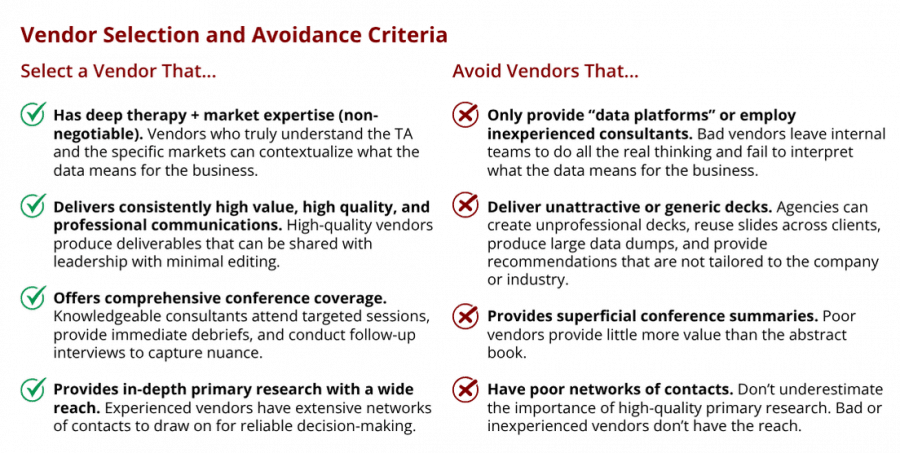
According to the 2025 Annual Competitive Intelligence Survey, the most important factor for industry executives when selecting a CI partner was knowledge of the space, followed by capabilities.
Follow-up interviews with CI leaders highlighted three core areas of expertise that organizations value most in external CI partners:
- Deep therapeutic area knowledge
- Strong CI experience and analytical capability
- Market expertise and understanding of industry-specific dynamics
These capabilities are critical because effective CI goes far beyond information collection. High-value partners help organizations interpret signals, anticipate competitor strategies and countermoves, contextualize implications, and support strategic decision-making.
Our interviews also revealed a recurring frustration among industry teams: some vendors provide large quantities of information but little interpretation. Deliverables were often described as “data dumps” or overly generic slide decks that left internal teams with the burden of extracting insights and implications themselves.
By contrast, the most valuable CI partners were described as true thought partners; organizations capable of understanding the therapeutic landscape, interpreting evolving market dynamics, and helping internal stakeholders translate intelligence into action.
[2] Sedulo Group, Insights-Driven Launch Planning: A Cross-Functional Roadmap for Leveraging Market and Competitive Insights, 2025.
[3] Sedulo Group, Annual Life Sciences Competitive Intelligence Survey, 2025
[4] Sedulo Group, Annual Life Sciences Competitive Intelligence Survey, 2024
[5] Global Intelligence Alliance, Determining the Purpose, Target Groups and Focus Areas of an Intelligence Program, 2010.
[6] Deloitte Insights, Drug launches reflect overall company performance, 2023.